Donate

Sunday, November 29, 2015

A Citizen is One Thing, But a Natural Born Citizen is Another

A Citizen is One Thing, But a Natural Born Citizen is Another

By Mario Apuzzo, Esq.
November 29, 2015


Image result for image declaration of independence laws of nature and of nature's god

Understanding that a citizen of the United States (“citizen”) is one thing, but that a natural born citizen of the United States (“natural born citizen”) is another is the key to understanding what a natural born citizen is.  To avoid constitutional error, it is critical that these two classes of citizens not be conflated, confounded, and confused.  There are different way by which one can become a citizen.  But none of that does or should change what a natural born citizen is.  
Why is it important that we understand the constitutional distinction between a citizen and a natural born citizen and give the correct meaning to a natural born citizen?  It is important because the Framers looked to the natural born citizen clause, apart from the Electoral College, through its requirement of absolute allegiance and love of country, as a means to provide for the safety and national security of the republic.  They looked to the natural born citizen clause as a way to keep monarchical and foreign influence out of the singular and powerful civil Office of President and military Office of Commander in Chief of the Military.   The Framers saw such monarchical and foreign influence as an insidious way to destroy what they had so greatly sacrificed to build. 
The historical record is replete with examples showing how the Framers sought to keep monarchical and foreign influence out of the Office of President and Commander in Chief of the Military.  For sake of brevity, I shall focus on this one example.  Alexander Hamilton gave a speech to the Convention on June 18, 1787.  He read to Convention his Propositions for A Constitution of Government.  See Works of Alexander Hamilton  (page 393); 3 Max Farrand, The Records of the Federal Convention of 1787, at 617 (1911)  (Farrand).  This speech contained a sketch of a plan which has become known as the English Plan.  This plan can be read here, http://avalon.law.yale.edu/18th_century/debates_618.asp .  James Madison informed us in his Convention notes that “[i]t meant only to give a more correct view of his ideas, and to suggest the amendment which he should probably propose to the plan of Mr. R. in the proper stages of its future discussion.  Although this plan was not formally before the Convention in any way, several of the delegates made copies . . . Farrand.  at 617.  Hamilton proposed in his Propositions that the "supreme executive authority of the United States to be vested in a Governor. . ." and that he also be the "commander-in-chief. . ."  In this initial sketch, Hamilton did not include any eligibility requirements for the supreme executive authority who he would call the President rather than Governor in his later draft of the Constitution.  In his speech to the Convention, Hamilton advocated an executive for life.  The reason that he gave for such a life position was the following:  “The Hereditary interest of the King was so interwoven with that of the Nation, and his personal emoluments so great, that he was placed above the danger of being corrupted from abroad-and at the same time was both sufficiently independent and sufficiently controuled, to answer the purpose of the institution at home. one of the weak sides of Republics was their being liable to foreign influence & corruption. Men of little character, acquiring great power become easily the tools of intermedling Neibours.”  Id.  Here we can see that Hamilton was very concerned with the harm that could be done to the nation by an executive who was corrupted by foreign influence and intrigue.
This “sketch of a plan of government” was not formally presented to the Convention, but delegates, including James Madison, had various copies of this plan.  Farrand, at 617.  This plan does not include Hamilton’s “born a citizen” language which he included in his later draft of a constitution. 
On July 25, 1787, about five weeks later, John Jay wrote a letter to then-General Washington, who was acting as president of the Constitutional Convention, stating:
"Permit me to hint, whether it would not be wise & seasonable to provide a strong check to the admission of Foreigners into the administration of our national Government; and to declare expressly that the Command in chief of the american army shall not be given to, nor devolve on, any but a natural born Citizen" (“born” underlined in the original).
John Jay reminded General George Washington of the importance of remanding back to the original concerns of the people and offered his presentation, to which George Washington offered, verbatim, to the convention.  Alexander Heard and Michael Nelson, Presidential Selection 123 (Duke University Press 1987) via Google Books.
Jay demanded that there be a "strong check" on foreign influence infiltrating the national government in general and the Office of Commander in Chief of the Military specifically.  A “natural born subject,” as defined by the English common law, which permitted dual and conflicting allegiance at birth, would not have provided that strong check on foreign influence for which Jay was looking. 
On September 2, 1787, George Washington wrote a letter to John Jay the last line of which read:  "I thank you for the hints contained in your letter."  4 Documentary History of the Constitution of the United States of America 1786-1870, p. 269 (1905).   While the Committee on Detail originally proposed that the President must be merely a citizen as well as a resident for 21 years, the Committee of Eleven changed "citizen" to "natural born citizen" without recorded explanation.  On September 4, 1787, about six weeks after Jay's letter and just two days after Washington wrote back to Jay, the "natural born citizen" requirement appeared in the draft of the Constitution.  Here is the first style of the clause as presented by the Committee of Eleven:
(5) 'Sect. 2. No person except a natural born citizen or a Citizen of the U. S. at the time of the adoption of this Constitution shall be eligible to the office of President; nor shall any person be elected to that office, who shall be under the age of thirty five years, and who has not been in the whole, at least fourteen years a resident within the U. S.'
Madison's notes of the Convention http://www.nhccs.org/dfc-0904.txt .
The proposal passed unanimously without debate which does not mean that the proposal was not discussed, for the convention meetings were conducted in secrecy.  Another reason that there was no debate is probably that the definition that was used of a natural born citizen was of such universal acceptance that it satisfied all laws then know to the Framers. 
At the close of the Convention, Hamilton gave to Madison another document which does contain in Article IX provision for the election of a President and the “born a citizen” language for eligibility.  Ferrand wrote that Hamilton gave this “paper” to Madison at the end of the Convention and that Hamilton “would have wished to be proposed by the Convention:  He had stated the principles of it in the course of the deliberations.”  p. 619.   Farrand also wrote that Hamilton’s paper “was not submitted to the Convention and has no further value than attaches to the personal opinions of Hamilton.”  p. 619.  This draft of the Constitution is not to be confused with his sketch of a plan of government (the British Plan) which he read to the Convention on June 18, 1787.
Elliott’s Debates has additional information on this proposed constitution.  He explains: 
No. 5.
Copy of a Paper communicated to James Madison by Col. Hamilton, about the close of Convention in Philadelphia, 1787, which, he said, delineated the Constitution which be would have wished to be proposed by the Convention. He had stated the principles of it in the course of the deliberations.
Note.— The caption, as well as the copy of the following paper, is in the hand-writing of Mr. Madison, and the whole manuscript, and the paper on which it is written, corresponds with the debates in the Convention with which it was preserved. The document was placed in Mr. Madison’s hands for preservation by Col. Hamilton, who regarded it as a permanent evidence of his opinion on the subject. But as he did not express his intention, at the time, that the original should be kept, Mr. Madison returned it, informing him that he had retained a copy. It appears, however, from a communication of the Rev. Dr. Mason to Dr. Eustis, (see letter of Dr. Eustis to J Madison, 28th April, 1819,) that the original remained among the papers left by Col. Hamilton.
In a letter to Mr. Pickering, dated Sept. 16 1803, (see Pitkin’s History, Vol. 2, p. 259—60) Col Hamilton was under the erroneous impression that this paper limited the duration of the presidential term to three years. This instance of the fallibility of Col. Hamilton’s memory, as well as his erroneous distribution of the numbers of the “Federalists” among the different writers for that work, it has been the lot of Mr. Madison to rectify; and it became incumbent, in the present instance, from the contents of the plan having been seen by others, (previously as well its subsequently to the publication of Col. Hamilton’s letter,) that it, also, should be published.
Elliott’s Debates:  Volume 5 Appendix to the Debates of the Federal Convention, Note 5.  http://teachingamericanhistory.org/ratification/elliot/vol5/appendix/ 
This subsequent draft of a constitution provided that the President be either at that time a citizen of one of the States or be “born a citizen of the United States.”  Article IX Sec. 1 in Appendix F of the Hamilton Plan of 1787 read:  “No person shall be eligible to the office of President of the United States unless he be now a citizen of one of the States, or hereafter be born a citizen of the United States.”
Hamilton gave his paper to Madison before the convention came to an end which we know occurred on September 17, 1787, the date the delegates signed the Constitution.  Hamilton served on committees that drafted convention rules and provided for writing style.  We can reasonably assume that since the document was in the hands of these two influential Founders and Framers, they would have discussed Hamilton’s presidential citizenship proposal with others making decisions at that time.  While we do not know exactly what happened during the convention regarding Hamilton’s “now a citizen of one of the States” and “born a citizen of the United States” concept, we do know that they were both rejected and “natural born Citizen, or a Citizen of the United States, at the time of the Adoption of this Constitution[]” was accepted.  We can see that the Framers did not accept merely being a citizen of the United States at birth.  Rather, they demanded that future presidents be natural born citizens. 
Hamilton did provide his paper containing the “born a citizen” language to James Madison.  Additionally, he most likely also discussed his paper with other Convention delegates, even if he did not submit his paper to the Convention.  Ferrand stated that Hamilton “had stated the principles of it in the course of the deliberations” of the Convention.  Id. at 619.  It is hard to accept that Hamilton would have gone through all that effort to draft that proposed constitution and not share its principles with the Convention delegates prior to the end of the Convention.  Hence, enough delegates probably knew about Hamilton’s “born a citizen,” but no one made any suggestion that the Constitution read “born a citizen” rather than “natural born citizen.”
What is critical to understand about the Hamilton “born a citizen” language is that it shows that he did not request that the President be a “natural born citizen.”  So he knew that the definition of the clause was a child born in the country to citizen parents.  By advocating born a citizen, anyone who was made a citizen from the moment of birth by positive law [Endnote 1] such as an Act of Congress would have been eligible to be President.  This would have included children born out of the United States to U.S. citizen parents and even children born in the United States to alien parents who should by positive law be made citizens from the moment of birth.  But the Convention adopted “natural born citizen” and not “born a citizen,” which means that the delegates wanted a more stringent standard than just born a citizen.  So then how did the Framers define a natural born citizen? 
To understand who the natural born citizen are, we must first understand who the citizens are.  Our U.S. Supreme Court has many times looked to the principles of the English common law and William Blackstone to understand what the Framers meant by various terms and phrases that they used in the Constitution.  But Blackstone did not define either a citizen or a natural born citizen.   “The constitution uses the words 'citizen' and 'natural born citizens;' but neither that instrument nor any act of congress has attempted to define their meaning.  British jurisprudence, whence so much of our own is drawn, throws little light upon the subject . . . . Blackstone and Tomlin contain nothing upon the subject.”  United States v. Rhodes, 27 F. Cas. 785, 788 (Cir. Ct. Ky 1866) (Justice Noah H. Swayne).  In fact, Minor v. Happersett, 88 U.S. 162 (1875) did not look to the English common law to define a citizen.  Minor explained who the citizens were in a general way thus: 
Before its adoption the Constitution of the United States did not in terms prescribe who should be citizens of the United States or of the several States, yet there were necessarily such citizens without such provision. There cannot be a nation without a people. The very idea of a political community, such as a nation is, implies an [p166] association of persons for the promotion of their general welfare. Each one of the persons associated becomes a member of the nation formed by the association. He owes it allegiance and is entitled to its protection. Allegiance and protection are, in this connection, reciprocal obligations. The one is a compensation for the other; allegiance for protection and protection for allegiance.
For convenience it has been found necessary to give a name to this membership. The object is to designate by a title the person and the relation he bears to the nation. For this purpose the words "subject," "inhabitant," and "citizen" have been used, and the choice between them is sometimes made to depend upon the form of the government. Citizen is now more commonly employed, however, and as it has been considered better suited to the description of one living under a republican government, it was adopted by nearly all of the States upon their separation from Great Britain, and was afterwards adopted in the Articles of Confederation and in the Constitution of the United States. When used in this sense it is understood as conveying the idea of membership of a nation, and nothing more.
Id. at 165-66. 
The Founders and Framers were greatly influenced by natural law and the law of nations.  Their favorite writer on the law of nations was Emer de Vattel, and his treatise, The Law of Nations (1758) was constantly in their hands in the early years of the republic.  Vattel did not define the citizens, simply saying in Section 212 of his treatise that they “are the members of the civil society:  bound to this society by certain duties, and subject to its authority, they equally participate in its advantages.”  We can understand why Vattel would not have defined the citizens other than to say that they were the members of a civil and political society, for each society defined its members based on its own historical development and positive laws.  As we saw, Minor added that being a citizen under the Constitution did nothing more than “convey[] the idea of membership of a nation, and nothing more.” 
Again, without mentioning the English common law or Blackstone, but rather expressing concepts of natural law and the law of nations, Minor then explained who the original “citizens’ were during the Founding of the free and independent states and then the United States as a nation: 
To determine, then, who were citizens of the United States before the adoption of the amendment it is necessary to ascertain what persons originally associated themselves together to form the nation, and what were afterwards admitted to membership.
Looking at the Constitution itself we find that it was ordained and established by "the people of the United States," [n3] and then going further back, we find that these were the people of the several States that had before dissolved the political bands which connected them with Great Britain, and assumed a separate and equal station among the powers of the earth, [n4] and that had by Articles of Confederation and Perpetual Union, in which they took the name of "the United States of America," entered into a firm league of [p167]friendship with each other for their common defence, the security of their liberties and their mutual and general welfare, binding themselves to assist each other against all force offered to or attack made upon them, or any of them, on account of religion, sovereignty, trade, or any other pretence whatever. [n5] 
Whoever, then, was one of the people of either of these States when the Constitution of the United States was adopted, became ipso facto a citizen -- a member of the nation created by its adoption. He was one of the persons associating together to form the nation, and was, consequently, one of its original citizens. As to this there has never been a doubt. Disputes have arisen as to whether or not certain persons or certain classes of persons were part of the people at the time, but never as to their citizenship if they were.
Id. at 166-67. 
Having examined the concept of who the original citizens were, now we have to consider who the natural born citizens were.  Minor said that “additions might always be made to the citizenship of the United States in two ways: first, by birth, and second, by naturalization.”  Id. at 167.  It is in telling us about those additions to the citizens that Minor then told us how the Framers defined a natural born citizen.  The Framers had one and only one definition of a natural born citizen.  How do we know that?  The unanimous U.S. Supreme Court in Minor informs us.  There it held: 
The Constitution does not, in words, say who shall be natural-born citizens. Resort must be had elsewhere to ascertain that. At common-law, with the nomenclature of which the framers of the Constitution were familiar, it was never doubted that all children born in a country of parents who were its citizens became themselves, upon their birth, citizens also. These were natives, or natural-born citizens, as distinguished from aliens or foreigners. Some authorities go further and include as citizens children born within the jurisdiction without reference to the citizenship of their [p168] parents. As to this class there have been doubts, but never as to the first. For the purposes of this case it is not necessary to solve these doubts. It is sufficient for everything we have now to consider that all children born of citizen parents within the jurisdiction are themselves citizens. The words "all children" are certainly as comprehensive, when used in this connection, as "all persons," and if females are included in the last they must be in the first. That they are included in the last is not denied. In fact the whole argument of the plaintiffs proceeds upon that idea.
Id. at 167-68. 
The Court explained that neither the original nor amended Constitution (with the Fourteenth Amendment) defined a natural born citizen.  It said that we had to look outside the Constitution for a definition of the clause.  It held that the definition of a natural born citizen existed at common law the nomenclature with which they were familiar.  Explaining what that common law provided, it said that “all children” born in a country to “parents” who were its citizens were “natives, or natural-born citizens,” and that all the rest of the people were “aliens or foreigners,” who would need a naturalization Act of Congress in order to become a citizen of the United States.  Here we can see that like when it defined citizens, the Court did not rely upon the English common law and Blackstone, who explained that any child born in the King’s dominion and under his jurisdiction, regardless of the citizenship of the child’s parents, was a natural-born subject.  Rather, Minor’s definition of “natives, or natural born citizens” was a paraphrase of the definition of those terms provided by Emer de Vattel who in his The Law of Nations, Section 212 (1758) (1797) explained:  “The citizens are the members of the civil society: bound to this society by certain duties, and subject to its authority, they equally participate in its advantages. The natives, or natural-born citizens, are those born in the country, of parents who are citizens.” 
So, Minor looked to the law of nations and not to the English common law for the Framers’ definition of a natural born citizen.  Chief Justice John Marshall in The Venus, 12 U.S. 253, 289 (1814) (Marshall, C.J., concurring) and Justice Daniel in Dred Scott v. Sandford, 60 U.S. 393, 476 (1857) (Daniel, J., concurring), had done the same, citing and quoting the law of nations and Vattel at Section 212 and not the English common law and Blackstone.  Hence, when Minor said that a natural born citizen was defined “at common-law,” it was not referring to the English common law.  Rather, it was referring to American national common law which incorporated the citizenship principles of the law of nations. 
Minor explained that if one was a natural born citizen, there was no doubt that one was a citizen.  Hence, accepting that Virginia Minor was a natural born citizen, it held that she was a citizen.  After the Court defined the natural born citizens and told us that anyone who was a natural born citizen was without any doubt a citizen, the Court raised the question sua sponte whether there could be other “citizens” by birth “within the jurisdiction.”  This question regarding other “citizens” did not involve the “natural born citizens,” who the Court had just defined through an all-inclusive and all-exclusive definition (the Court said that under that common law all the people who did not meet that definition were “aliens or foreigners”).  So the Court did not raise any question of whether there could be other birth circumstances that could serve as the basis for making one a natural born citizen.  These other children were different from those that were natural born citizens because unlike them, they were born to alien parents.  In fact, the Court even referred to these children as belonging to another “class.”  The Court said that “some authorities” included these other children as “citizens” also.  The Court, however, said that “there have been doubts” whether they were citizens.  So, not only did the Court explain that those children could not be natural born citizens, it also said that it was doubtful whether they were even just citizens.  The Court was referring to The Slaughter House Cases, 83 U.S. 36 (1873) which stated that children born in the United States to alien parents were not citizens of the United States under the Fourteenth Amendment.  In the end, the Court explained that it was not necessary for it to solve the doubts involving whether the children of that other class were citizens.  For sure, it was not necessary because Virginia Minor was born in the country to parents who were its citizens which made her a natural born citizen.  Knowing that Virginia Minor was born in the country to parents who were citizens, which made her a natural born citizen, provided the Court with sufficient information for it to decide the question of whether Virginia Minor was a citizen. 
The Court finally held that “all children born of citizen parents within the jurisdiction are themselves citizens,” meaning that all children who were natural born citizens were citizens.  Accepting both that rule to be true and that Virginia Minor satisfied that rule was sufficient for the Court to hold that she was a citizen.  It simply was not necessary for the Court to explore any other avenues by which Virginia Minor could be a citizen.  Indeed, she was a natural born citizen which without any doubt ipso facto made her a citizen and that is all she had to be in order for her to have standing to make her Fourteenth Amendment argument that as a citizen of the United States, she had a privilege or immunity that created a constitutional right to vote which the State of Missouri could not abridge by making or enforcing any law against her.  The Court in the end held that citizenship did not constitutionally give one the right to vote and so Missouri could through its laws decide that it would not allow women to vote.  But the Court's ultimate holding regarding a woman’s right to vote has absolutely no bearing on the court’s ratio decidendi that it applied to defining the citizens and the natural born citizens, an analysis which makes its definition of a natural born citizen binding precedent.
So Minor confirmed the Framers’ definition of a natural born citizen.  It also left open the question of whether a child born in the United States to alien parents could be a citizen of the United States under the Fourteenth Amendment.  Again, the Court demonstrated that there was only one way to become a natural born citizen which was to be born in the country to parents who were its citizens.  But it also explained that there were different avenues by which one could become a citizen.  It explained that one way was for a person to satisfy the naturalization Acts of Congress.  Another way was to satisfy the requirements of the Fourteenth Amendment which it chose not to analyze and left to be done another day. 
The majority of the United States Supreme Court in U.S. v. Wong Kim Ark, 169 U.S. 649 (1898) answered in 1898 the Fourteenth Amendment question regarding birth in the United States to alien parents which Minor left open in 1875.  It is the seminal case for interpreting and applying the Fourteenth Amendment’s citizenship clause, which establishes thereunder who may be a “citizen” of the United States from the moment of birth, to persons who are born in the United States, but who do not satisfy Minor’s common law definition of a natural born citizen.  Wong Kim Ark thoroughly analyzed the question of who was included as a citizen of the United States under the Fourteenth Amendment and it showed that people like Wong, born in the United States to alien parents who were legally domiciled and permanently residing in the United States and neither foreign diplomats nor military invaders, were citizens of the United States from the moment of birth by virtue of the Fourteenth Amendment, but they could not be natural born citizens by virtue of the common law which Minor explained defined a natural born citizen.
Wong Kim Ark explained that “[t]he Constitution of the United States, as originally adopted, uses the words "citizen of the United States," and "natural-born citizen of the United States" and that “[t]he Constitution nowhere defines the meaning of these words, either by way of inclusion or of exclusion, except insofar as this is done by the affirmative declaration that "all persons born or naturalized in the United States, and subject to the jurisdiction thereof, are citizens of the United States."  Id. at 654.  Hence, Wong Kim Ark also confirmed that the Fourteenth Amendment did not define a natural born citizen.  The Court then explained that “[i]n this as in other respects, it must be interpreted in the light of the common law, the principles and history of which were familiarly known to the framers of the Constitution. Minor v. Happersett, 21 Wall. 162; Ex parte Wilson, 114 U.S. 417, 422; Boyd v. United States, 116 U.S. 616, 624, 625; Smith v. Alabama, 124 U.S. 465. The language of the Constitution, as has been well said, could not be understood without reference to the common law. Kent Com. 336; Bradley, J., in Moore v. United States, 91 U.S. 270, 274.”  Id. at 654.  Hence, Wong Kim Ark, like Minor, explained that the Court could use the common law to interpret the Constitution, Article II in Minor and the Fourteenth Amendment in Wong Kim Ark. 
While it acknowledged Minor’s definition of a natural born citizen and the common law it relied upon to arrive at that definition, in rendering its decision it did not rely upon American national common law, but rather on colonial English common law.  It did not rely on the former because it was not defining an Article II natural born citizen, but rather a different clause of the Constitution, as amended, the Fourteenth Amendment.  In fact, Wong Kim Ark said that it was not constrained by any rule of “international law” or the municipal laws of any foreign nation in interpreting the Fourteenth Amendment.  Rather, it resorted to looking to and using colonial English common law as an aid to construing the Fourteenth Amendment’s “subject to the jurisdiction thereof” clause.  It found that under the English common law, a child born in the King’s dominion to alien parents who were neither foreign diplomats nor military invaders were born subject to his jurisdiction and entitled to his protection, and therefore English natural-born subjects.  It found that this rule had been continued in the new free and independent states after the Declaration of Independence and the adoption of the Constitution, by the states selectively adopting the English common law through their constitutions and reception statutes.  By the force of that state practice, it ruled by analogy that a child born in the United States to alien parents who were permanently domiciled and resident in the United States and neither foreign diplomats nor military invaders was born in the United States and “subject to the jurisdiction thereof.”  Hence, that child was a “citizen” of the United States from the moment of birth by virtue of the Fourteenth Amendment.  Relying on the English common law’s exceptions to being born in the King’s dominion and within the jurisdiction of the King, it also explained that any child born in the United States to foreign diplomats or military invaders would not be born subject to its jurisdiction and therefore not a citizen of the United States under the Fourteenth Amendment. 
So Wong Kim Ark resolved the question of the meaning of the Fourteenth Amendment’s “subject to the jurisdiction thereof” clause, as applied to children born in the United States to alien parents, by resort to the colonial English common law, which under its notion of broad allegiance, treated non-diplomatic and friendly aliens present in the King’s dominions as his subjects.  It used the colonial English common law to interpret the meaning of the Fourteenth Amendment’s “subject to the jurisdiction thereof” clause, not the meaning of an Article II natural born citizen.  In conducting its jurisdiction analysis, it did not reinterpret the natural born citizen clause under the English common law, for Minor had already demonstrated that its definition was to be found in American common law.  In fact, no U.S. Supreme Court that ever provided the definition of a natural born citizen relied upon any jurisdiction analysis when defining a natural born citizen.  Actually, Wong Kim Ark recognized that a natural born citizen was a different type of citizen than a citizen of the United States at birth under the Fourteenth Amendment.  “The citizens are the members of the civil society; bound to this society by certain duties, and subject to its authority, they equally participate in its advantages. The natives, or natural-born citizens, are those born in the country, of parents who are citizens.” Emer de Vattel, The Law of Nations, Section 212 (1758) (1797).  “At common-law, with the nomenclature of which the framers of the Constitution were familiar, it was never doubted that all children born in a country of parents who were its citizens became themselves, upon their birth, citizens also. These were natives, or natural-born citizens, as distinguished from aliens or foreigners.”  Minor 88 U.S. at 167.  “The child of an alien, if born in the country, is as much a citizen as the natural born child of a citizen, and by operation of the same principle.” Wong Kim Ark, 169 U.S. at 665 (citing and quoting Horace Binney, “Alienigenae of the United States,” 22, note (2nd ed. Philadelphia, December 1, 1853). As we can see, both Vattel and Minor said a natural born citizen was a child born in the country to parents who were its citizens.  Justice Gray in Wong Kim Ark agreed.
Another crucial point needs to be addressed.  What did Vattel and Minor mean when they said “children” and “parents” as in all “children” born in the country to citizen “parents” were natural born citizens?  Under the law of nations and at common law, children meant legitimate children.  Hence, using the term children suggested that the father and mother were married or at least that the child was legitimated at some point.  Under the law of nations and at common law, “parents” could only mean father and mother.  In fact, Vattel throughout The Law of Nations, when referring to parents, spoke about a child’s father and mother.  Under the common law doctrine of coverture, a wife upon marriage (femes covert) become one with her husband.  She acquired the citizenship and allegiance of her husband, whether her husband was a citizen or an alien.  At the Founding and until the passage of the Cable Act in 1922 (ch. 411, 42 Stat. 1021), there was no such thing as a husband having one citizenship and the wife having another.  This father and mother interpretation of Vattel has been confirmed by our U.S. Supreme Court which has always interpreted Vattel’s “parents” to mean both father and mother.  In their concurring opinions, Chief Justice John Marshall in The Venus (1814) and Justice Daniel in Dred Scott did just that.  Minor provided a scenario where the child’s parents were both either citizens or both aliens.  The same occurred in Wong Kim Ark, where the Court explained that a child born in the country to an alien parent is as much a “citizen” as the natural born child born in the country to a citizen parent.  This statement can have sense only if both parents are either aliens or citizens.  So, both Minor and Wong Kim Ark provided scenarios wherein the child’s parents are both either citizens or both aliens.  See also Lynch v. Clarke, 1 Sandf.Ch. 583, 3 NY Leg. Obs. 236 (1844)  (confirms the same scenario when it said:  “it is insisted that the national rule is that of the public law, by which a child follows the status of its parents (emphasis in the original);” “Suppose a person should be elected President who was native born, but of alien parents . . .;” and “every person born within the dominions and allegiance of the United States, whatever were the situation of his parents”); Ankeny v. Governor of the State of Indiana, 916 N.E.2d 678 (Ind. Ct.App. 2009) (stating in footnote 12 “that the Court in Minor contemplates only scenarios where both parents are either citizens or aliens, rather in the case of President Obama, whose mother was a U.S. citizen and father was a citizen of the United Kingdom”).  This reasoning followed from our nation adopting the common law doctrine of coverture that the wife acquired the citizenship of her husband.  Hence, the word “parents” in both Vattel’s and Minor’s definition of a natural born citizen could not mean that one parent had one citizenship and another had a different one; it could only mean father and mother who had the same citizenship at the time of the child’s birth.  This law of nations and common law rule regarding parents having the same nationality is reflected in the 1961 Convention on the Reduction of Statelessness.  Article 2 provides: “A foundling found in the territory of a Contracting State shall, in the absence of proof to the contrary, be considered to have been born within that territory of parents possessing the nationality of that State,” in effect providing that a foundling is to be treated and considered as though she satisfies the definition of a natural born citizen under the law of nations.  Hence, the common public understanding of “parents” at the time the Constitution was adopted and ratified was that parents meant father and mother, with the spouses acquiring the citizenship of the husband, and children meant legitimate children of those parents.  So, at the time of the adoption and ratification of the Constitution, legitimate children were born either to two citizen parents or to two alien parents.  Under the ancient maxim partus sequitur patrem (children follow the condition of their parents), those children inherited the citizenship and allegiance of their parents.   
Finally, other convincing evidence demonstrating that the Framers defined a natural born citizen as a child born in the country to citizens parents are the Naturalization Acts of 1790, 1795, 1802, and 1804.  The only children Congress did not seek to reach with its naturalization powers in these Acts were children born in the United States to U.S. citizen parents.  There was no constitutional basis for Congress to do that, for these children were the natural born citizens.  What is also most telling is that in these naturalization Acts, Congress treated children born in the  United States to alien parents as aliens and in need of naturalization.  This Congressional naturalization rule was not changed until after the U.S. Supreme Court in Wong Kim Ark held that children born in the United States to qualifying alien parents were citizens of the United States from the moment of birth. 
What this historical and legal evidence (not meant to be exhaustive) shows is that there is only one definition of a natural born citizen.  That definition is a child born in a county to parents (father and mother) who were its citizens at the time of the child’s birth.   But there can be different definitions of a citizen.  Those other definitions exist under the Fourteenth Amendment, naturalization Acts of Congress, and treaties, all positive laws.  We can argue, for whatever reasons, about what those other definitions of being a citizen should be under those particular positive laws.  But whatever we agree or disagree on with respect to a citizen under those laws, none of that changes or can change the Framers’ original common law definition of a natural born citizen which under the Constitution is a child born or reputed born in the United States to parents, meaning a married father and mother, who were U.S. citizens at the time of the child’s birth.  The Framers adopted this definition of a natural born citizen into the Constitution.  As such, it is the supreme law of the land and cannot be changed unless done so by a duly ratified constitutional amendment. 
Even if today we were to relax the requirement of parents having to be married due to Fourteenth Amendment equal protection requirements, we would still be left with the requirement that the father and mother be both U.S. citizens at the time of the birth of their child in the United States.  Finally, the Cable Act of 1922, which for the first time gave to women the right to have a separate citizenship and allegiance from that of their husbands, did no more than that; it did not nor could it amend the definition of a natural born citizen which required that both parents be U.S. citizens at the time of their child’s birth in the United States. 
For sure, the United States would never deny its protection to a natural born citizen, for no other foreign nation can make any legitimate claim based on its sovereign authority to that person’s citizenship and allegiance based on either jus sanguinis or jus soli, for under the American national common law’s definition of a natural born citizen, i.e., a child born in a country to parents who were its citizens at the time of the child’s birth, both right of blood and right of soil merge into the child at the moment of birth to create a unity of citizenship and allegiance in the child at the time of birth.  Hence, that child is born with allegiance only to the United States and to no other nation.  Simply stated, all the nations of the world recognize that person to be only a citizen of the United States and of no other nation.  The Framers commanded that future Presidents and Commanders be born with sole allegiance to the United States.  In contrast, citizens at birth under the Fourteenth Amendment and naturalization Acts of Congress, who do not meet the definition of a natural born citizen, while born with allegiance to the United States, are also born with citizenship and allegiance to some foreign nation, under the Fourteenth Amendment, citizenship in and allegiance to the foreign nation of one or both alien parents, and under a naturalization Act of Congress, citizenship in and allegiance to the foreign nation in which born and/or of an alien parent.  These citizens “at birth” are made citizens at birth only by operation of law, the Fourteenth Amendment or Act of Congress, and not by universal principles of natural law and the law of nations, recognized and adopted by American national common law. 
It is treason upon the Constitution and the Framers’ command that for the sake of the national security of the republic, for persons born after the adoption of the Constitution, no person except a natural born citizen is to be eligible to be President and Commander in Chief of the Military, to interpret the natural born citizen clause out of the Constitution and replace it with how we may today define under the positive laws of the Fourteenth Amendment or naturalization Acts of Congress a citizen of the United States at birth, a person who, if not also a natural born citizen, is not born with sole allegiance to the United States.   
With these principles to guide us, we can only conclude that de facto President Barack Obama, Senator Ted Cruz, Senator Marco Rubio, and Governor Bobby Jindal are all not natural born citizens.  None of them were born in the United States to parents who were both U.S. citizens at the time of their children’s birth. 
Obama, assuming he was born in the United States, is a citizen of the United States at birth, but only by virtue of the Fourteenth Amendment.  He is not and cannot be a natural born citizen under the common law because while he was presumably born in the United States to a U.S. citizen mother, he was born to a non-U.S. citizen father.   
Cruz was born in Canada, presumably to a U.S. citizen mother and a non-U.S. citizen father.  He can be a citizen of the United States at birth, but only by virtue of a naturalization Act of Congress (section 301(a)(7) of the Immigration and Nationality Act of 1952).  He is not and cannot be a natural born citizen under the common law because, while he was born to a U.S. citizen mother, he was not born in the United States and he was born to a non-U.S. citizen father. 
Rubio and Jindal were born in the United States to two non-U.S. citizen parents.  They are both citizens of the United States at birth, but only by virtue of the Fourteenth Amendment.  They are not and cannot be natural born citizens under the common law because, while they were born in the United States, they were born to two non-U.S. citizen parents.    
__________________ 
Endnote 1:  The concept of "positive law" has existed since the beginning of ordered legal systems. Positive law includes constitutions, statutes, case law, and any other law adopted by whatever sovereign has power to make law at any given moment in time.  It has been said by many political and legal philosophers throughout the ages that positive law has its origin in what man perceives to be natural law and God's law, or what Thomas Jefferson in The Declaration of Independence called “the Laws of Nature and of Nature’s God,” meaning the laws of nature and the laws of nature's God.  
Mario Apuzzo, Esq.
November 29, 2015
http://puzo1.blogspot.com
####

Copyright © 2015
Mario Apuzzo, Esq.
All Rights Reserved  

Wednesday, November 25, 2015

New Hampshire Ballot Access Challenges Against Ted Cruz and Marco Rubio Fail for Want of Jurisdiction


New Hampshire Ballot Access Challenges Against Ted Cruz and Marco Rubio Fail for Want of
                                                           Jurisdiction

                                                    By Mario Apuzzo, Esq.
                                                       November 25, 2015


New Hampshire state flag


Christopher Booth of Concord, New Hampshire, Cameron Elliott of Pittsburgh, Pennsylvania, and Robert Laity of Tonawanda, New York, filed ballot access challenges in New Hampshire against presidential contenders Senator Ted Cruz and Senator Marco Rubio, arguing that neither of them is an Article II natural born citizen.  The challengers are correct.

Still, the New Hampshire Ballot Law Commission refused to rule on the question of whether the senators are natural born citizens because, chairman Brad Cook said, the issues were not under the panel’s purview.

“Our precedents say we don’t’ go there,” Cook said. “Personally, would I like the U.S. Supreme Court to decide these issues so we know what is, so it doesn’t keep coming up? Absolutely. Are we the vehicle to start that discussion? No, we’re not.”

http://www.wmur.com/politics/elections-panel-allows-cruz-rubio-to-appear-on-primary-ballot/36641254

~~~~~

The Commission refused to rule, basically saying that it does not have jurisdiction over the question of whether Ted Cruz and Marco Rubio are Article II natural born citizens.  It also said that it would like the U.S. Supreme Court to rule on the issue.

On the merits, neither Ted Cruz nor Marco Rubio are natural born citizens.  Neither the original nor amended Constitution defines a natural born citizen.  The unanimous U.S. Supreme Court in Minor v. Happersett (1875) informed that we have to look outside the Constitution for its meaning.  It explained that at common law the nomenclature with which the Framers were familiar when the Constitution was adopted, all children born in a country to parents who were its citizens were "natives, or natural-born citizens," and that under that same common law all the rest of the people were "aliens or foreigners," who could be naturalized if they met the requirements of naturalization Acts of Congress. Minor v. Happersett (1875).

Cruz was neither born in the country, nor was he born to two U.S. citizen parents.  He was born in Canada, presumably to a U.S. citizen mother and a non-U.S. citizen father.  Unlike Senator John McCain, who was born in Panama to two U.S. citizen parents who were there to serve the military interest of the United States, neither of Cruz's parents were in Canada for purposes of serving in the U.S. military.  He therefore does not meet the definition of a natural born citizen.  Cruz is a citizen of the United States at birth only by virtue of a naturalization Act of Congress.  He is therefore not a "natural born citizen" of the United States by virtue of the common law.  A “naturalized born” citizen of the United States is not and cannot be a “natural born” citizen of the United States.

Rubio was born in the country.  But he was not born to two U.S. citizen parents.  He was born in the United States, but to two non-U.S. citizen parents.  Hence, he also does not meet the definition of a natural born citizen.  He is a citizen of the United States at birth only by virtue of the Fourteenth Amendment and not by virtue of the common law that provides the only definition of the clause.  He needs the Fourteenth Amendment because, while born in the United States, he was not born to two U.S. citizen parents.  Rubio is a "born citizen" of the United States only by virtue of the Fourteenth Amendment.  He is therefore not a "natural born citizen" of the United States by virtue of the common law. Simply being a born citizen of the United States under the Fourteenth Amendment does not make one a natural born citizen of the United States under the common law.
 
So, neither Cruz nor Rubio are natural born citizens.  It is treason upon the Constitution and the rule of law to see our political institutions kick the can down the road under the guise of want of jurisdiction.

Mario Apuzzo, Esq.
November 25, 2015
http://puzo1.blogspot.com/
####
Copyright © 2015
Mario Apuzzo, Esq.
All Rights Reserved

Saturday, July 4, 2015

July 4, 1776, the Birth Day of the Nation and the Natural Born Citizen


July 4, 1776, the Birth Day of the Nation and the Natural Born Citizen

By Mario Apuzzo, Esq.
July 4, 2015


Image result for image us flag wavingIn defining an Article II “natural born Citizen,” it is important to find any authority from the Founding period who may inform us how the Founders and Framers themselves defined the clause. Who else but a highly respected historian from the Founding period itself would be highly persuasive in telling us how the Founders and Framers defined a natural born citizen.  Such an important person is David Ramsay, who in 1789 wrote, A Dissertation on the Manners of Acquiring the Character and Privileges of a Citizen (1789), a very important and influential essay on defining a natural born citizen.

David Ramsay (April 2, 1749 to May 8, 1815) was an American physician, patriot, and historian from South Carolina and a delegate from that state to the Continental Congress in 1782-1783 and 1785-1786. He was the Acting President of the United States in Congress Assembled. He was one of the American Revolution’s first major historians. A contemporary of Washington, Ramsay wrote with the knowledge and insights one acquires only by being personally involved in the events of the Founding period. In 1785 he published History of the Revolution of South Carolina (two volumes), in 1789 History of the American Revolution (two volumes), in 1807 a Life of Washington, and in 1809 a History of South Carolina (two volumes). Ramsay “was a major intellectual figure in the early republic, known and respected in America and abroad for his medical and historical writings, especially for The History of the American Revolution (1789)…” Arthur H. Shaffer, “Between Two Worlds: David Ramsay and the Politics of Slavery,” J.S.Hist., Vol. L, No. 2 (May 1984). “During the progress of the Revolution, Doctor Ramsay collected materials for its history, and his great impartiality, his fine memory, and his acquaintance with many of the actors in the contest, eminently qualified him for the task….” http://www.famousamericans.net/davidramsay/. In 1965 Professor Page Smith of the University of California at Los Angeles published an extensive study of Ramsay's “History of the American Revolution” in which he stressed the advantage that Ramsay had because of being involved in the events of which he wrote and the wisdom he exercised in taking advantage of this opportunity. “The generosity of mind and spirit which marks his pages, his critical sense, his balanced judgment and compassion,'' Professor Smith concluded, “are gifts that were uniquely his own and that clearly entitle him to an honorable position in the front rank of American historians.”

In his 1789 essay, Ramsay explained: 

The “United States” are a new nation, or political society, formed at first by the declaration of independence, out of those “British subjects” in “America,” who were thrown out of royal protection by act of parliament, passed in “December,” 1775.   

A citizen of the “United States,” means a member of this new nation.  The principle of government being radically changed by the revolution, the political character of the people was also changed from subjects to citizens. 

The difference is immense.  Subject is derived from the latin word, “sub” and “jacio,” and means one who is “under” the power of another; but a citizen is a “unit” of a mass of free people, who, collectively, possess sovereignty. 

Subjects look up to a master, but citizens are so far equal, that none have hereditary rights superior to others.  Each citizen of a free state contains, within himself, by nature and the constitution, as much of the common sovereignty as another.  In the eye of reason and philosophy, the political condition of citizens is more exalted than that of noblemen.  Dukes and earls are the creatures of kings, and may be made by them at pleasure; but citizens possess in their own right original sovereignty. 

Id. at 3. (emphasis in the original).   

Here Ramsay described how the new nation came into being from the revolution with Great Britain and that its new members were citizens and not subjects.  He then explained the “immense” difference between a citizen and a subject.  Indeed, citizens were masters of their own destiny, all equal to each other, and under no one. 

Then he went on to explain how one became a citizen, stating: 

The following appear to be the only modes of acquiring this distinguishing privilege.
1st.  By being parties to the original compact, the declaration of independence.
2d.  By taking an oath of fidelity to some one of the “United States,” agreeable to law.
3d.  By tacit consent and acquiescence. 
4th.  By birth or inheritance. 
5th.  By adoption.

Id. at 4  (emphasis in the original). 

He then explained how one acquired citizenship through each one of his categories.  As to the 1st category, these included all those persons who adhered to the American Revolution by being a party to the Declaration of Independence through which “’a nation was born in a day.’”  The 2nd and 3rd categories included those who took an oath of allegiance to the American cause, or upon reaching the age of majority just accepted the new states and continued to reside there under their protection. 

Ramsay then went on to describe the 4th category persons who the Framers in Article II, Section 1, Clause 5 called the “natural born Citizens.”  Here is what he said: 

4th.  None can claim citizenship as a birth-right, but such as have been born since the declaration of independence, for obvious reasons:  no man can be born a citizen of a state or government, which did not exist at the time of this birth.  Citizenship is the inheritance of the children of those who have taken a part in the last revolution; but this is confined exclusively to the children of those who were themselves citizens.  Those who died before the revolution, could leave no political character to their children, but of subjects, which they themselves possessed.  If they had lived, no one could be certain whether they would have adhered to the king or congress.  Their children, therefore, may claim by inheritance the rights of “British subjects,” but not of “American citizens.” 

5th.  Persons born in any country may have acquired citizenship by adoption, or naturalization, agreeably to law.  The citizenship of such must be dated from the time of their adoption. 

Id. at 6 (emphasis in the original). 

Then Ramsay drew these conclusions:  "The citizenship of no man could be previous to the declaration of independence, and, as a natural right, belongs to none but those who have been born of citizens since the 4th of 'July,' 1776. . . . From the premises already established, it may be farther inferred, that citizenship, from inheritance, belong to none but the children of those 'Americans,' who, having survived the declaration of independence, acquired that adventitious character in their own right, and transmitted it to their offspring.”  Id. at 6-7 (emphasis in the original).   

While not using the phrase “natural born citizen,” Ramsay described the original citizens that existed during the Founding and what it meant to acquire citizenship by birthright after the Founding. The Constitution itself shows that the Framers called the original citizens “Citizens of the United States” and those that followed them “natural born Citizens.” He said concerning the children born after the declaration of independence, “[c]itizenship is the inheritance of the children of those who have taken part in the late revolution; but this is confined exclusively to the children of those who were themselves citizens….” Id. at 6. He added that “citizenship by inheritance belongs to none but the children of those Americans, who, having survived the declaration of independence, acquired that adventitious character in their own right, and transmitted it to their offspring….” Id. at 7. He continued that citizenship “as a natural right, belongs to none but those who have been born of citizens since the 4th of July, 1776….” Id. at 6. We can see why the Framers in Article II, Section 1, Clause 5 grandfathered "Citizens of the United States," which included themselves, to be eligible to be President.  He also explained that persons born in any country may have acquired citizenship by adoption or naturalization, telling us that in order to be a natural born citizen one had to be born in the United States.  Ramsay did not use the clause “natural born Citizen.” Rather, he referred to citizenship as a birthright which he said was a natural right. But there is little doubt that how he defined birthright citizenship meant the same as "natural born citizen," "native," and "indigenes," all terms that were then used interchangeably.

Here we have direct and convincing evidence of how a very influential Founder defined a natural born citizen. Noah Webster, 1828, in explaining how an American dictionary of the English language was necessary because American words took on different meanings than the same word in England, placed David Ramsay among great Founders such as “Franklin, Washington, Adams, Jay, Madison, Marshall, Ramsay, Dwight, Smith, Trumbull...” Given his position of influence and especially given that he was a highly respected historian, Ramsay would have had the contacts with other influential Founders and Framers and would have known how they too defined a natural born citizen.  Ramsay, being of the Founding generation and being intimately involved in the events of the time would have known how the Founders and Framers defined a natural born citizen and he told us that such a person was one born in the country to citizen parents. In giving us this definition, it is clear that Ramsay did not follow the English common law but rather natural law, the law of nations, and Emer de Vattel, who also defined the “natives, or natural-born citizen” the same as did Ramsay in his highly acclaimed and influential treatise, The Law of Nations, Or, Principles of the Law of Nature, Applied to the Conduct and Affairs of Nations and Sovereigns, Section 212 (1758 French) (1759 English). We can reasonably assume that the other Founders and Framers would have defined a natural born citizen the same way that Ramsay did, for being a meticulous historian he would have gotten his definition from the general consensus that existed at the time. Ramsay’s dissertation presents valuable evidence of how the Founding generation defined the original citizens and the future generations of citizens, who were either descendants of the original citizens or children of naturalized citizens, born in the United States, who the Framers called natural born citizens. It is valuable because it is evidence of the public meaning of these terms at the time they were framed and ratified.

Ramsay’s article and explication are further evidence of the influence that Vattel had on the Founders in how they defined the new national citizenship. This article by Ramsay, provided to me by an anonymous source in 2010 while I was handling the Kerchner v. Obama and Congress case, is one of the most important pieces of evidence which provides direct evidence on how the Founders and Framers defined a natural born citizen and that there is little doubt that they defined one as a child born in the country to citizen parents.  This time-honored definition of a natural born citizen has been confirmed by subsequent United States Supreme Court and lower court cases such as The Venus, 12 U.S. (8 Cranch) 253, 289 (1814) (Marshall, C.J., concurring and dissenting for other reasons, cites Vattel and provides his definition of “natives, or indigenes,” or who the Framers called natural born citizens);
Inglis v. Trustees of Sailors’ Snug Harbor (1830) (decided on the citizenship principles of the law of nations and Vattel and not the English common law); Shanks v. Dupont, 28 U.S. 242, 245 (1830) (decided on the citizenship principles of the law of nations and Vattel and not the English common law); Dred Scott v. Sandford, 60 U.S. 393 (1857) (relied upon the law of nations definition of citizenship and not the English common law definition of a natural born subject) (Daniel, J., concurring) (specifically citing and quoting Vattel and his Section 212 for the definition of “natives, or natural-born citizens” and not the English common law); Slaughter-House Cases, 83 U.S. 36 (1873) (in explaining the meaning of the Fourteenth Amendment clause, “subject to the jurisdiction thereof,” said that the clause “was intended to exclude from its operation children of ministers, consuls, and citizens or subjects of foreign States born within the United States”); Minor v. Happersett, 88 U.S. 162, 167-68 (1875) (same definition without citing Vattel); Ex parte Reynolds, 1879, 5 Dill., 394, 402 (same definition and cites Vattel); United States v. Ward, 42 F.320 (C.C.S.D.Cal. 1890) (same definition and cites Vattel); U.S. v. Wong Kim Ark, 169 U.S. 649 (1898) (quoted the same definition of natural born citizen as did Minor v. Happersett); Rep. John Bingham (in the House on March 9, 1866, in commenting on the Civil Rights Act of 1866 which was the precursor to the Fourteenth Amendment: "[I] find no fault with the introductory clause, which is simply declaratory of what is written in the Constitution, that every human being born within the jurisdiction of the United States of parents not owing allegiance to any foreign sovereignty is, in the language of your Constitution itself, a natural born citizen.” John A. Bingham, (R-Ohio) US Congressman, March 9, 1866 Cong. Globe, 39th, 1st Sess., 1291 (1866)). 

The two-citizen-parent requirement would have followed from the common law that provided that a woman upon marriage took the citizenship of her husband. In other words, the Framers required both (1) birth on United States soil (or its equivalent) and (2) birth to two United States citizen parents as necessary conditions of being granted that special status which under our Constitution only the President and Commander in Chief of the Military (and also the Vice President under the Twelfth Amendment) must have at the time of his or her birth. Given the necessary conditions that must be satisfied to be granted the status, all natural born citizens" are "citizens of the United States" but not all "citizens of the United States" are natural born citizens.  It was only through both parents being citizens that the child was born with unity of citizenship and allegiance to the United States which the Framers required the President and Commander in Chief of the Military to have.

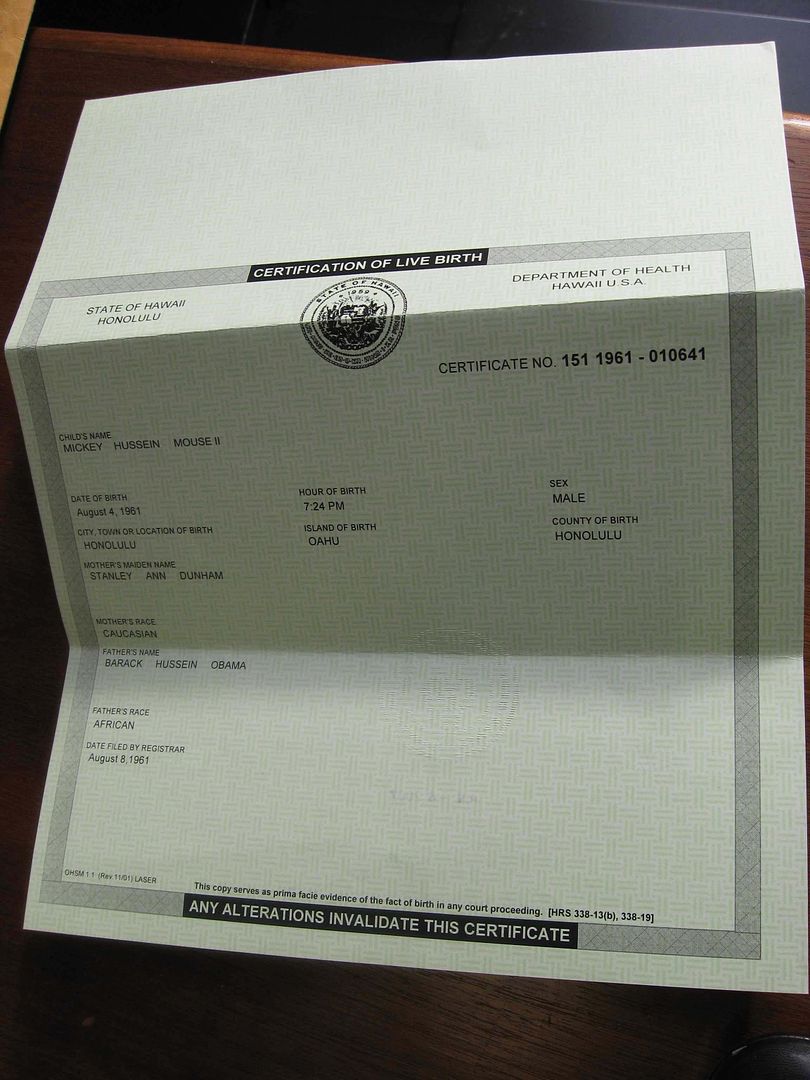
De facto President Barrack Obama fails to meet this “natural born Citizen” eligibility test because when he was born in 1961 (regardless of where that may be), he was not born to a United States citizen mother and father. At his birth, his mother was a United States citizen. But under the British Nationality Act 1948, his father, who was born in the British colony of Kenya, was born a Citizen of the United Kingdom and Colonies (CUKC) which by descent made Obama himself a CUKC. Prior to Obama’s birth, Obama’s father neither intended to nor did he become a United States citizen. Being temporarily in the United States only for purpose of study and with the intent to return to Kenya, his father did not intend to nor did he even become a legal resident or immigrant to the United States.

Obama may be a plain born “citizen of the United States” under the Fourteenth Amendment or a Congressional Act (if he was born in Hawaii). But as we can see from David Ramsay’s clear presentation, citizenship “as a natural right, belongs to none but those who have been born of citizens since the 4th of July, 1776….” Id. at 6. Hence, Obama is not an Article II natural born citizen, for upon Obama's birth his father was a British subject and Obama himself by descent was also the same. Hence, Obama was born subject to a foreign power. Obama lacks the birth status of natural sole and absolute allegiance and loyalty to the United States which only the President and Commander in Chief of the Military and Vice President must have at the time of birth. Being born subject to a foreign power, he lacks Unity of Citizenship and Allegiance to the United States from the time of birth which assures that required degree of natural sole and absolute birth allegiance and loyalty to the United States, a trait that is constitutionally indispensable in a President and Commander in Chief of the Military. Like a naturalized citizen, who despite taking an oath later in life to having sole allegiance to the United States, is not a natural born citizen because of being born subject to a foreign power, Obama too is not a natural born citizen.  He has therefore held the civil and military powers of the Office of President and Commander in Chief contrary to the Constitution and therefore without any constitutional legitimacy.  

For a demonstration as to why Senator Ted Cruz, Senator Marco Rubio, and Governor Bobby Jindal are also not natural born citizens and therefore not constitutionally eligible to be elected President, see Mario Apuzzo, “Senator Cruz, Senator Rubio, and Governor Jindal Should Not Be Allowed to Participate in the Presidential Debates Because They, Like De Facto President Obama, Are All Not Natural Born Citizens and Therefore Not Eligible to Be President, accessed at http://puzo1.blogspot.com/2015/05/senator-cruz-senator-rubio-and-governor.html .    

So, David Ramsay told us that a natural born citizen was born on July 4, 1776.  Today is July 4, 2015, or 239 years since that birth.  Happy Birth Day natural born citizen of the United States of America. 

Mario Apuzzo, Esq.
July 4, 2015
http://puzo1.blogspot.com/
####
Copyright © 2015
Mario Apuzzo, Esq.
All Rights Reserved

I have adapted this article from an article that I wrote and published on David Ramsay on April 2, 2010, entitled, “Founder and Historian David Ramsay Defines a Natural Born Citizen in 1789,” accessed at http://puzo1.blogspot.com/2010/04/founder-and-historian-david-ramsay.html

Monday, May 25, 2015

Senator Cruz, Senator Rubio, and Governor Jindal Should Not Be Allowed to Participate in the Presidential Debates Because They, Like De Facto President Obama, Are All Not Natural Born Citizens and Therefore Not Eligible to Be President

Senator Cruz, Senator Rubio, and Governor Jindal Should Not Be Allowed to Participate in the Presidential Debates Because They, Like De Facto President Obama, Are All Not Natural Born Citizens and Therefore Not Eligible to Be President

By Mario Apuzzo, Esq.
May 25, 2015

Soon, we will see various presidential candidates debate each other for the right to win their party’s nomination for President and ultimately to win the people’s and Electoral College’s vote for that Office.  The organizations that will be sponsoring these presidential debates, Commission on Presidential Debates, Fox News, Fox Business Network, Reagan Library Foundation, Salem Media Group, CNBC, ABC, CBS, NBC, Telemundo, and National Review, in keeping with their bylaws, should not allow any person who is not constitutionally eligible for that office to debate.  Allowing constitutionally ineligible candidates to debate will only give the false impression to the American people that such persons are constitutionally eligible to be elected President.  This result is more damaging to the Constitution and the rule of law, given that the federal courts refused to get involved in the question of whether de facto President Barack Obama is an Article II natural born citizen.  There has been mentioned in the news of some individuals who will be vying for the Office of President.  These are Senator Ted Cruz, Senator Marco Rubio, and Governor Bobby Jindal.  But these individuals, like Obama, are not natural born citizens and hence not eligible to be elected President.  They should therefore not be allowed to debate.  Allow me to explain. 

Article II, Section 1, Clause 5 provides that for those born before the adoption of the Constitution, having satisfied the 35 years age and 14 years residency requirements, being a "citizen" of the United States was sufficient to be eligible to be President.  It also provides that for those born after the adoption, only a "natural born citizen" of the United States is eligible to be President.  So, with presidential eligibility under Article II, for those born after the adoption of the Constitution, we are looking to define a natural born citizen, not a citizen.  We can also see from this constitutional scheme that in the United States there are only “citizens” or “natural born citizens” and that all natural born citizens are citizens, but not all citizens are natural born citizens. 

The Framers used the natural born citizen clause to assure that future Presidents and Commanders in Chief of the Military would be born citizens of and in allegiance with only the United States from the moment of birth and throughout their lives.  They concluded that such a person would be one to least have sympathies for some foreign power or influence which could result in conflict of interests which could harm the United States and its people.    

Since the Framers wrote citizen and natural born citizen into the Constitution, the next question is what do these terms mean?  The historical and legal record demonstrates that they did not look to the English common law for the definitions of those terms.  Indeed, Justice Noah H. Swayne, commenting on whether the English common law defined a “citizen” or a “natural born citizen,” said:  “The constitution uses the words 'citizen' and 'natural born citizens;' but neither that instrument nor any act of congress has attempted to define their meaning.  British jurisprudence, whence so much of our own is drawn, throws little light upon the subject . . . . Blackstone and Tomlin contain nothing upon the subject.”  United States v. Rhodes, 27 F. Cas. 785,  788 (Cir. Ct. Ky 1866).  Rather, that record shows that the Founders and Framers looked to natural law and the law of nations and the Enlightenment for principles which justified and motivated the American Revolution, the Declaration of Independence, and the writing of the Constitution.   It was also in natural law and the law of nations that they found their definitions of citizens and natural born citizens. 

As their most trusted expert on the law of nations, the Founders and Framers looked to Emer de Vattel.  In his, The Law of Nations or Principles of Natural Law, Book I, Chapter XIX, Section 212 (1758) (1797), Vattel defined a citizen as:   “The citizens are the members of the civil society: bound to this society by certain duties, and subject to its authority, they equally participate in its advantages. Id. at Section 212.  The Framers also knew from the teachings of both the English common law and the law of nations that citizenship and allegiance can be either inherited from one’s parents (jus sanguinis) or acquired from being born in a country (jus soli).  Hence, when the Framers wrote the Constitution, a citizen was any member of the United States made so by any means, which included the American Revolution, Acts of Congress, or treaty.  These citizens were subject to the laws of the United States and enjoyed all the privileges, immunities, and rights of all other citizens, including the right of being protected by the United States.  The early naturalization Acts of Congress reflected this understanding.  As time went on and because of the immediate need to make freed slaves citizens of the United States, the Civil Rights Act of 1866 and the Fourteenth Amendment were added to the list of laws that could make citizens.  As we shall see below, these laws, while capable of making one a citizen from the moment of birth or after birth, did not make one a natural born citizen.  

The Framers also defined a natural born citizen under natural law and the law of nations.  Again looking to Vattel upon whom they would have relied for that definition, he defined a natural born citizen as follows: 

The natives, or natural-born citizens, are those born in the country, of parents who are citizens. As the society cannot exist and perpetuate itself otherwise than by the children of the citizens, those children naturally follow the condition of their fathers, and succeed to all their rights. The society is supposed to desire this, in consequence of what it owes to its own preservation; and it is presumed, as matter of course, that each citizen, on entering into society, reserves to his children the right of becoming members of it. The country of the fathers is therefore that of the children; and these become true citizens merely by their tacit consent. We shall soon see, whether, on their coming to the years of discretion, they may renounce their right, and what they owe to the society in which they were born. I say, that, in order to be of the country, it is necessary that a person be born of a father who is a citizen; for if he is born there of a foreigner, it will be only the place of his birth, and not his country.”

Id. Sec. 212 Citizens and natives.  We can see that Vattel expected not the citizens, but the natural born citizens as being the persons upon whom the expectation lied as being the ones who would best protect and perpetuate the civil and political society into which they were born.  

Under this natural law and law of nations rule, a natural born citizen had to do nothing other than be born in the county to parents who were both citizens of that country.  No law, including any naturalization act or treaty, was needed to make him or her a natural born citizen. 

The universal and immutable principle of the law of nations that defined a natural born citizen was incorporated into American national common law.  We know this by what the unanimous U.S. Supreme Court said in Minor.  There it explained: 

At common law, with the nomenclature of which the framers of the Constitution were familiar, it was never doubted that all children, born in a country, of parents who were its citizens, became themselves, upon their birth, citizens also. These were natives, or natural-born citizens, as distinguished from aliens or foreigners. Some authorities go further and include as citizens children born within the jurisdiction, without reference to the citizenship of their parents. As to this class there have been doubts, but never as to the first. For the purposes of this case it is not necessary to solve these doubts. It is sufficient, for everything we have now to consider, that all children, born of citizen parents within the jurisdiction, are themselves citizens.

Minor v. Happersett, 88 U.S. 162, 167-68 (1875).

So Minor explained that it was this common law to which the Framers looked to define a natural born citizen.  Accord U.S. v. Wong Kim Ark (1898) (distinguishing a natural born citizen from a citizen of the United States under the Fourteenth Amendment, said that “[t]he child of an alien, if born in the country” can be a citizen of the United States from the moment of birth by virtue of the Fourteenth Amendment and “is as much a citizen as the natural born child of a citizen, and by operation of the same principle").  Hence, the Framers defined a natural born citizen as a child born in a country to parents who were its citizens at the time of the child's birth.  Under that same common law, they saw all the rest of the people as "aliens or foreigners," who could be naturalized under some positive law.  With the ratification of the Fourteenth Amendment, those otherwise aliens or foreigners became citizens of the United States “at birth” under Wong Kim Ark’s interpretation of the Fourteenth Amendment. 

The definition of a natural born citizen as reflected in American common law became under Article IV, Clause 2 upon ratification of the Constitution the supreme law of the land subject to change under Article V only by duly ratified constitutional amendment.  

During the Founding and until the Cable Act of 1922 (ch. 411, 42 Stat. 1021, "Married Women’s Independent Nationality Act") was passed, married parents of children were both either U.S. citizens or aliens.  See Minor and Wong Kim Ark (only provided for scenarios in which the child’s parents were both either citizens or aliens).  Hence, citizen parents meant that both father and mother had to be citizens. The Cable Act reversed former immigration laws regarding marriage. 
Previously, a woman lost her U.S. citizenship if she married an alien, since she acquired the citizenship of her husband.  The law did not apply to men who married foreign women, for such women became U.S. citizens.   The law repealed sections 3 and 4 of the Expatriation Act of 1907.  With this new law, women did not lose their citizenship if they married an alien, provided he was an alien eligible to be naturalized under U.S. law.  Marian L. Smith, "Women and Naturalization, ca. 1802-1940," Prologue Magazine 30 (2) (1998).  Additionally, under the Act, women who married aliens who were eligible for naturalization could keep their U.S. citizenship, provided they lived in the United States.  If they married such aliens and lived on foreign soil for two years, they could lose their U.S. citizenship. In 1931, an amendment allowed females to retain their U.S. citizenship even if they married aliens who were not eligible for U.S. citizenship (e.g. at that time an Asian).  The Cable Act was repealed in 1936. The liberation of wives from their husband’s citizenship done by the 1922 Cable Act, an Act of Congress and not a constitutional amendment, has not nor could it amend the constitutional rule that both father and mother had to be citizens at the time of their child’s birth in their country in order to make a natural born citizen. 

To date, the American national common law meaning of a natural born citizen has never been changed by any constitutional amendment or decision of the U.S. Supreme Court.  
    
So, a "citizen" of the United States "at birth" is defined by either the Fourteenth Amendment (only if born in the U.S.) or naturalization Act of Congress (if born in or out of the U.S.).  Regarding the former, it is any person born in the United States and "subject to the jurisdiction thereof."  As to the latter, it includes any person born out of the United States to one or two U.S. citizen parents.  Neither the Fourteenth Amendment nor Act of Congress has any impact on the meaning of a natural born citizen, for, not only because they did not exist when the Constitution was adopted and ratified, but also because they did not repeal or amend the natural born citizen clause or define it. Under these well-established rules, a child of one or two alien parents, if born in the U.S., can be a "citizen" of the United States "at birth" under the Fourteenth Amendment.  A child born out of the U.S., if born to one or two U.S. citizen parents, can also be a "citizen" of the United States "at birth." But not being born in the United States to two U.S. citizen parents, neither of them can be an Article II "natural born citizen" of the United States, regardless of their "at birth" citizen status, for they are born citizens, not natural born citizens.   
    
De facto President Barack Obama is not a natural born citizen because, even if he was born in the United States, he was not born to two U.S. citizen parents.  Obama was born to a U.S. citizen mother, but to a non-U.S. citizen father.  His father was a citizen of Great Britain and then Kenya upon it gaining independence in 1963.  Senator Ted Cruz is also not a natural born citizen.  Unlike Senator John McCain who was born in Panama to two U.S. citizen parents who were serving the national defense of the United States and therefore reputed born in the United States to two U.S. citizen parents, Senator Cruz was born in Canada presumably to a U.S. citizen mother and a non-U.S. citizen father who was a citizen of Cuba and both in Canada for private purposes.  Senator Marco Rubio and Governor Bobby Jindal are also not natural born citizens, for while they were born in the United States, they were born to two non-U.S. citizen parents who were citizens of Cuba and India, respectively.     

If they are not natural born citizens, then what are they?  President Obama, Senator Cruz, Senator Rubio, and Governor Jindal are all "citizens" of the United States "at birth,” but only by virtue of some non-common law positive law.  None of them are "natural born citizens" by virtue of common law which provides the only definition of the clause which is a child born in a country to parents (father and mother) who were its citizens at the time of the child's birth. Obama (if born in the United States), Rubio, and Jindal are “citizens” of the United States “at birth,” but only because of the Fourteenth Amendment, by the only fact of being born in the United States.  Cruz is a “citizen” of the United States “at birth,” but only because of a naturalization Act of Congress, by the only fact of being born to one U.S. citizen parent.  None of them were born with the complete facts and circumstances needed at birth to be a natural born citizen and which allows one to be a natural born citizen and therefore a citizen without the aid of any positive law.  They are all missing either birth to two U.S. citizen parents or birth in the United States. Obama was born a citizen of and in allegiance to the United States (through jus soli if he was born in the United States) and Great Britain and then Kenya upon conversion through its independence from Great Britain (through jus sanguinis from his father).  Cruz was born a citizen of and in allegiance to the United States (through jus sanguinis if his mother was still a U.S. citizen at the time of his birth) and born a citizen of and in allegiance to Canada (through jus soli) and Cuba (through jus sanguinis from his father).  Rubio and Jindal were born citizens of and in allegiance to the United States (through jus soli) and Cuba for Rubio and India for Jindal (through jus sanguinis from both of their parents).  They are all therefore under U.S. law not born with sole allegiance to the United States, but also subject to a foreign power and with natural sympathies for those foreign nations, a condition that the Framers did not allow future Presidents and Commanders to have.  Being born subject to foreign powers and influence and with such sympathies, they are not nor can they be natural born citizens.  Not being natural born citizens, they are not eligible to be President. 

These ineligible candidates should not be allowed to participate in the upcoming presidential debates.   

Mario Apuzzo, Esq.
May 25, 2015
####
Copyright © 2015
Mario Apuzzo, Esq.
All Rights Reserved


Friday, March 13, 2015

A Response to Neal Katyal and Paul Clement on the Meaning of a Natural Born Citizen

A Response to Neal Katyal and Paul Clement on the Meaning of a Natural Born Citizen

By Mario Apuzzo, Esq.
March 13, 2015

I read the March 11, 2015 article entitled, “On the Meaning of a ‘Natural Born Citizen,” written by Neal Katyal and Paul Clement, found at 128 Harv.L.Rev.F 161, and accessed at http://harvardlawreview.org/2015/03/on-the-meaning-of-natural-born-citizen/ .  The first sentence of the article says:  “We have both had the privilege of heading the Office of the Solicitor General.”  The article repeats the existing talking points offered in support of the constitutional eligibility of Senator Ted Cruz (all born citizens are natural born citizens) and offers nothing new.  Mr. Cruz was born in Canada to a U.S. citizen mother and a non-U.S. citizen (Cuban) father.  I have written a recent article in which I conclude that Mr. Cruz is not a natural born citizen and therefore not eligible to be President because he does not satisfy the one and only common law definition of a natural born citizen confirmed by the unanimous U.S. Supreme Court in Minor v. Happersett, 88 U.S. 162 (1875), which is a child born in a country to parents who were its citizens at the time of the child’s birth.  The article is entitled, “What Do President Obama and Senator Cruz Have In Common? They Are Both Not Natural Born Citizens," accessed at http://puzo1.blogspot.com/2015/02/what-do-president-obama-and-senator.html .  Katyal and Clement maintain that any child who becomes a citizen at birth, regardless of where born or by what means, is a natural born citizen.  They add that since Mr. Cruz became a citizen from the moment of birth and did not need any naturalization after birth he is a natural born citizen.  But there is no historical and legal evidence which demonstrates that this is how the Framers defined a natural born citizen and the authors surely have not presented that evidence even if it did exist. 

The authors’ argument suffers from the fallacy of bald assertion.  They provide no convincing evidence for their position on who is included as an Article II natural born citizen.  They do not examine what was the source of the Framers' definition of an Article II natural born citizen, let alone what was the definition of a natural born citizen when the Framers drafted and adopted the Constitution and when it was eventually ratified.  They ignore so much of the historical and legal record in coming to their bald conclusions. For a discussion of this historical and legal evidence, see the numerous articles that I have written and posted at my blog, http://puzo1.blogspot.com .

They gloss over what the Framers' purpose was for requiring the President and Commander in Chief of the Military to be a natural born citizen.  They do not engage in any real discussion on what the Framers were trying to achieve through the clause. They dismiss all debate on the subject of foreign influence by flatly stating without any evidence:  "The Framers did not fear such machinations from those who were U.S. citizens from birth just because of the happenstance of a foreign birthplace."

The authors cite to the Naturalization Act of 1790 and ignore the fact that the Naturalization Act of 1795, with the lead of then-Rep. James Madison and with the approval of President George Washington, repealed it and specifically changed "shall be considered as natural born citizens" to "shall be considered as citizens of the United States."  This is even more a blatant omission given that they argue that the English naturalization statutes referred to persons born out of the King's dominion to British subject parents as "natural born subjects."  They fail to address this critical change made by our early Congress, critical because Article II, Section 1, Clause 5 provides that a “Citizen” of the United States was eligible to be President only if born before the adoption of the Constitution and that thereafter only a “natural born Citizen” was so eligible.  Hence, Congress referring to one as a citizen rather than a natural born citizen, given the presidential eligibility requirements of Article II, was a serious thing.  They do not discuss what the language of the 1790 Act, "shall be considered as," meant.  They fail to address the issue that this was naturalization language and nothing more.  They fail to discuss whether Congress even had the constitutional power to make anyone born out of the United States a natural born citizen, if that was Congress’s intent in the first place.

They assert without demonstrating that the English common law supports their position.  But they totally ignore that under the English common law, only persons born in the King's dominion and under his jurisdiction were natural born subjects and that those born out of the dominion and therefore out of his jurisdiction became subjects only through a naturalization Act of Parliament.

They cite to Blackstone's Commentaries on the Laws of England, but they do not cite to Emer de Vattel and his The Laws of Nations (1758) (1797) or Minor, two leading sources that inform on U.S. citizenship.  Both Vattel and Minor defined a natural born citizen as a child born in a country to parents who were its citizens.  What is incredible is that they cite U.S. v. Wong Kim Ark, 169 U.S. 649 (1898) to demonstrate that British statutes called children born out of the King's dominion to subject parents "natural born."  But they fail to tell the reader that Wong Kim Ark considered children born out of the United States to U.S. citizen parents to be naturalized by acts of Congress. In fact, they give virtually no discussion of the Wong Kim Ark case because they know that the case said that under the English common law, only children born in the King’s dominion and under his jurisdiction were natural born subjects and that any child born  out of that dominion needed an act of Parliament to naturalize him or her.  They also fail to discuss the U.S. Supreme Court case of Rogers v. Bellei, 401 U.S. 815 (1971), in which both majority and dissent said the same as Wong Kim Ark which was that children born out of the United States to U.S. citizen parents become citizens of the United States only through the grace of Congress who made them citizens through a naturalization Act without which those children would be aliens.   It simply defies logic and good reason to conclude that a person who would not be a citizen at all without a naturalization act of Congress is a natural born citizen.

Katyal and Clement argue that John Jay had children born out of the United States while he was on diplomatic assignment and that he would not have disqualified his own children from being natural born citizens.  This is a really baseless point since Jay's children would have been born out of the United States to parents who were serving the national defense of the United States and therefore reputed born in the United States.  Likewise, they present the John McCain situation as proof for their position.  But they fail to realize that John McCain was born in Panama to U.S. citizen parents who were serving the national defense of the United States which makes him reputed born in the United States to U.S. citizen parents and therefore a natural born citizen under the one and only common law definition of a natural born citizen as confirmed by unanimous U.S. Supreme Court in Minor.  See Vattel, Section 217 (children born out of the country to citizen parents serving in the armies of the state are reputed born in the country).  They give the examples of Senator Barry Goldwater and Governor George Romney who they say were eligible to serve as President although neither was born within a state. The argument is meritless, for they were both born to U.S. citizen parents in U.S. sovereign territory subject to no foreign power and hence were born in part of the country known as the United States, all of which made them natural born citizens under the common law definition of a natural born citizen.

The authors conclude without demonstrating:  "Despite the happenstance of a birth across the border, there is no question that Senator Cruz has been a citizen from birth and is thus a “natural born Citizen” within the meaning of the Constitution."  They simply make this conclusion without having shown how their position is valid given the historical and legal record.

The authors also show contempt to the constitutional requirement that the President has to be a natural born citizen and for any person who dare raise any such issue.  For example, they say: "simply because he was delivered at a hospital abroad," rather than saying that he was born in a foreign nation; "born in a Canadian hospital," rather than saying that he was born in Canada;  "[d]espite the happenstance of a birth across the border;"  they call arguments with which they do not agree "spurious;" and they consider objections to candidate's eligibility as "specious objections to candidates eligibility," as if no one ever made any valid argument.

In short, Katyal and Clement’s article lacks any critical research and reasoning and is nothing more than an attempt to convince the reader that Senator Cruz is a natural born citizen because they said so and the reader has to believe that because they were former heads of the Office of Solicitor General of the United States.

Mario Apuzzo, Esq.
March 13, 2015

####

Copyright © 2015
Mario Apuzzo, Esq.
All Rights Reserved