Donate

Showing posts with label Fourteenth Amendment. Show all posts

Tuesday, January 22, 2013

Barack Obama: The De Facto President of the United States-Maybe a Born Citizen But Not A "Natural Born Citizen"


           Barack Obama: The De Facto President of the United States-
              Maybe a Born Citizen But Not A “Natural Born Citizen”

                                         By Mario Apuzzo, Esq.
                                               January 21, 2013


The U.S. Constitution


Barack Obama eligibility supporters maintain that he is an Article II “natural born Citizen” and therefore eligible to be President. But to do so, they have blended together, through ignorance or intent, “citizen,” “born citizen,” and “natural born Citizen,” and denied that there is a critical constitutional distinction between these phrases. These supporters and enablers, who I call the citizen/born citizen/natural born citizen conflationists, in constitutionally supporting Barack Obama to be president, have allowed our Constitution, the rule of law, and our nation to be violated. Allow me to explain.

In order to understand the meaning of an Article II “natural born Citizen,” we have to understand the constitutional distinction between a “citizen,” “born citizen,” and “natural born Citizen.” The first constitutional distinction is between “citizen” and “natural born Citizen.” In Article II, Section 1, Clause 5 the Framers provided in pertinent part: “No person except a natural born Citizen, or a Citizen of the United States, at the time of the Adoption of this Constitution shall be eligible to the Office of President.” Here, we see the Framers distinguished between a “natural born Citizen” and a “Citizen of the United States.” There is no other type of “citizen” mentioned. So, our Constitution, Acts of Congress, and treaties, call “citizens,” or members of the United States, either “natural born Citizens” or “citizens of the United States.” As we shall see, the former are defined by American common law (the definition being based on natural law and the law of nations) and the latter by the Fourteenth Amendment (the definition being in part based on colonial English common law), Congressional Acts, or treaties. From this we can see that a “citizen” is either a “natural born Citizen” or a “citizen of the United States.” Because of the requirement of having to be born in the country to citizen parents, a “natural born Citizen” will necessarily also qualify under these sources as a “citizen of the United States.”

Article II refers to a “natural born Citizen,” but does not define it. In fact, the definition of a “natural born Citizen” is not found anywhere in the original or amended Constitution or any Act of Congress. Rather, it is found in the common law upon which the Founders and Framers relied at the time of the adoption and ratification of the Constitution. Under this common law, the three constituent elements of being a “natural-born citizen” are time (at the moment of birth), birth place (in the country), and birth parents (U.S. citizen parents), what I will call birth time, birth country, and birth parents. See Minor v. Happersett, 88 U.S. 162, 167-68 (1875) (the unanimous U.S. Supreme Court explained that the definition of a “natural-born citizen” is not found in the Constitution and confirmed that “[a]t common-law, with the nomenclature of which the framers of the Constitution were familiar, it was never doubted that all children born in a country of parents who were its citizens became themselves, upon their birth, citizens also. These were natives or natural-born citizens, as distinguished from aliens or foreigners”); United States v. Wong Kim Ark, 169 U.S. 649, 679-80 (1898) (the majority and dissent agreed on the Minor definition of a “natural-born citizen,” but they disagreed as to the definition of a Fourteenth Amendment “citizen of the United States” at birth). Given this settled common law definition of a “natural born Citizen,” these elements are both necessary and sufficient to make a “natural born Citizen.” In the definition, the parents have to have as a minimum the status of a “citizen” (“born citizen” or “natural born Citizen” is not necessary) in order to produce a “natural born Citizen.” Note that Minor said that at common law, if one was not a “natural-born citizen,” one was an alien or foreigner. This means that if these persons qualified, the Fourteenth Amendment, Act of Congress, or treaty could make them a “citizen of the United States.”

These historical and legal developments inform that at common law there is a critical distinction between a “citizen” and a “natural born citizen.” In fact, natural law and the law of nations have always recognized this distinction. See Emer de Vattel, The Law of Nations, Section 212 (London 1797) (1st ed. Neuchatel 1758) (“The citizens are the members of the civil society: bound to this society by certain duties, and subject to its authority, they equally participate in its advantages. The natives, or natural-born citizens, are those born in the country, of parents who are citizens.” http://www.lonang.com/exlibris/vattel/vatt-119.htm ). At common law, if one was a “citizen” but not a “natural born citizen,” then, except for the original “citizens” who became such by the Declaration of Independence and by adhering to the American Revolution, one had to have been alien born and become a “citizen” by naturalization statute. Natural law and the law of nations, along with both English and American common law, have also always recognized that a child gains allegiance and citizenship by either being born on the soil of a country (jus soli) or by being born to parents of that country (jus sanguinis). The Founders and Framers accepted the distinction between a “citizen” and a “natural born Citizen” and understood that birth country and birth parents produce in the child allegiance from the moment of birth. Because they expected the President and Commander in Chief of the Military to have absolute allegiance from birth only to the United States, they applied the distinction to the Office of President. In fact, they used it when they made the “natural born Citizen” clause a requirement of eligibility for the Office of President (the XII Amendment extends it to the Office of Vice-President) and for no other office, requiring, for those to born after the adoption of the Constitution and who would aspire to be President and Commander in Chief of the Military, that they be not only a “citizen,” but a “natural born Citizen.” (The grandfather clause of Article II, Section 1, Clause 5 allowed “Citizens of the United States” to be eligible to be President, provided they had that status “at the time of Adoption of this Constitution.”) The English did not nor did they have to demand such allegiance from their would-be Kings, for their Kings did not have to qualify from among the people. Rather, they lay their claim to the throne by royal blood. Rejecting as a requisite to be President royal blood, the Founders and Framers instead settled with the natural elements of birth time, birth country, and birth parents, and made their distinction between a “citizen” who was also a “natural born Citizen” and a “citizen” who was not. And it was the combination of these three elements at the time of birth which assured them that all means of inheriting allegiance and citizenship (birth country and birth parents) were united at the moment of birth to produce in the child absolute allegiance only to the United States.

The next constitutional distinction is between “born citizen” and “natural born Citizen.” These same Obama eligibility supporters add the word “born” to the word “citizen” and want us to accept that combination as the definition of a “natural born Citizen.” But those who assert that a “natural born Citizen” is just any “born citizen” commit two errors: a textual error of missing the point (or by refusing to see the point) that the clause is “natural born Citizen,” not “born citizen” and a definitional error of not understanding (or refusing to accept) that “born citizen” is neither a definition nor a description of the clause “natural born Citizen.”

First, regarding the textual error, as I have already explained in other articles such as Logic and Defining the “Natural Born Citizen” Clause, at http://puzo1.blogspot.com/2012/11/logic-and-defining-natural-born-citizen.html , we cannot define a clause by merely repeating parts of the clause itself. For example, if we wanted to know what the definition of a “natural born German Shepherd” is, we would not accept as a correct definition the answer that it is a “born German Shepherd.” To argue that a “natural born German Shepherd” is a “born German Shepherd” is tautological, for it only repeats part of the form of the clause and does not define the clause. Such an argument does nothing more than to state the obvious that a “natural born German Shepherd” is a “born German Shepherd.” Likewise, a “natural born Citizen,” is, of course, a “born citizen,” but saying so does not define the clause.

Second, in this “born German Shepherd” definition example, a rational person should also want to know what happened to the qualifier “natural” and its meaning. Does not that word tell us something about under what conditions the “born German shepherd” must come into existence? Likewise, those rational persons who want to know the meaning of a “natural born Citizen” should want to know what happened to the qualifier “natural,” and whether that qualifier also requires that certain conditions be met in order to have a “natural born Citizen.” Actually, these persons would be correct in raising such questions. Given the meaning of a “natural born Citizen,” with its three constituent elements of birth time, birth country, and birth parents, we know that the word “natural” when combined with “born citizen” demands that all three elements be satisfied in order to have a “natural born Citizen.” We might be willing to include others as “born citizens” and Congress has the naturalization powers to do so and has done so throughout our history. But that we are willing to tolerate by the application of some law certain persons as “born citizens” does not, given the applicable common law definition of the clause and its requirements, make them “natural born Citizens”

Regarding the definitional error, the clauses “natural born Citizen” and “born Citizen” are conclusions, birth statuses that do not provide sufficient factual information as to how one arrives at the conclusions or statuses themselves. Rather, to know if one satisfies the status of being a “natural born Citizen,” one must start with the definition of a “natural born Citizen,” identifying its constituent elements. If one satisfies those elements, then one is a “natural born Citizen.” And to know if one satisfies the status of being a “born citizen,” one must also start with the available definitions, however many there are and whether provided by the Fourteenth Amendment or Congressional Acts, of a “born citizen,” identifying their constituent elements. If one satisfies those elements, then one is a “born citizen.” But obviously, we are defining two different clauses which necessarily contain different definitions and requirements. The clause does not tell us how one arrives at being a “born citizen,” which process must be equivalent to the process by which one arrives at being a “natural born Citizen” if the two clauses are to mean the same thing. Hence, to simply use other legal mechanisms of citizenship which produce a “born citizen” and proclaim that they too produce a “natural born Citizen,” simply because they, like “natural born Citizens,” are “born citizens,” is to err. It is to err because being a “born citizen” is only a necessary consequent (a conclusion or status) of being a “natural born Citizen” and by itself, because it is based on a different definition, represents a different class of citizen, one produced by the Fourteenth Amendment or Congressional Act and not by American common law.

There is only one process or means by which one can be a “natural born Citizen,” i.e., by satisfying the necessary and sufficient conditions of birth time (at the moment of birth), birth country (born in the United States), and birth parents (born to U.S. citizen parents). Simply stated, any “born citizen” who does not satisfy these three conditions, while still being a “born citizen” under some legal mechanism (e.g., under the Fourteenth Amendment or Congressional Act), is not a “natural born Citizen” under American common law which is the natural law/law of nations-based law that provides the constitutional definition of the clause.

Minor v. Happersett confirms all this and United States v. Wong Kim Ark changes none of it.

Barack Obama maintains that he was born in Hawaii. With a dispute involving whether his birth certificate, social security number, and military draft registration are authentic still continuing and not having been definitively resolved through any legal process, we have yet to see conclusive legal proof of his place of birth. But even assuming for sake of argument that he was born in Hawaii, he is still not an Article II “natural born Citizen.” We have seen that the three elements of being a “natural born Citizen” are birth time, birth country, and birth parents. Minor; Wong Kim Ark. If Obama was born in Hawaii, he satisfies the birth country requirement. But while Obama was born to a U.S. “citizen” mother, his father never became nor did he strive to become a U.S. “citizen.” Rather, his father was born in the English colony of Kenya, was born a British citizen, and remained such until his death. Hence, Obama was not born to a U.S. “citizen” father. He therefore fails to satisfy the elements of being born to citizen parents at the moment of birth. This means that he can be a “born citizen” under the Fourteenth Amendment or Congressional Act, which provide a more relaxed allegiance standard , but he cannot be a “natural born Citizen” under Article II, which provides a more exacting allegiance standard for would-be Presidents and Commanders of the Military. This also means that because he is neither “a natural born Citizen” nor “a Citizen of the United States, at the time of the Adoption of this Constitution,” he is not eligible to be President.

On January 20, 2013, Barack Obama was again sworn in as the President of the United States. But because he is not an Article II “natural born Citizen,” he is at best a de facto President of the United States, not a constitutionally legitimate one.

Mario Apuzzo, Esq.
January 21, 2013
http://puzo1.blogspot.com
####

Copyright © 2013
Mario Apuzzo, Esq.
All Rights Reserved

Tuesday, September 20, 2011

Having the Status of Birthright Citizenship Is Not Sufficient to Make One an Article II “Natural Born” Citizen

Having the Status of Birthright Citizenship Is Not Sufficient to Make One an Article II “Natural Born” 
                                                                      Citizen

                                                           By: Mario Apuzzo, Esq.
                                                             September 20, 2011

Horace Gray, Associate Justice
of the U.S. Supreme Court


I just read an article regarding a debate going on in Liberia about Presidential and Vice-Presidential eligibility requirements. The issue is whether the residency has to be immediately before the election. The article may be read at http://allafrica.com/stories/201109200851.html.

The President or Vice-President eligibility requirements in Liberia are: (1) being a natural born citizen 35 years or more, (2) 10 years residence in Liberia 10 years prior to elections; (3) owner of unencumbered real property worth not less than 25,000; and (4) President and Vice-President must not come from the same county.

Note that the Liberian Constitution even considers those acquiring the status of "citizen" after birth as "natural born citizens."

What struck me as interesting is that they treat their "natural born citizens" like the Founders and Framers treated plain "Citizens" of the United States (distinguished from "natural born" Citizens of the United States). What is also interesting is that Liberia considers a person to be a "natural born citizen" even if that status was not acquired at birth. Indeed, they have created a contradiction and oxymoron right in their own Constitution.

I suspect that Liberia is treating a "natural born citizen" just like the British treated their "natural born subject." For the British, who followed the feudal and monarchial system of subjectship with allegiance to a sovereign King rather than a true republican system with voluntary membership and allegiance to the sovereign nation and its people through free choice made by a child’s parents who then pass that decision to their children, it did not matter if one was truly a "natural born subject" or even a naturalized subject, for they considered all their subjects to be "natural born subjects," which conveniently for the King carried with it allegiance to the King for life.

The Founders and Framers did not adopt the same oppressive system for the constitutional republic. They rejected that a person was born into the allegiance of a King or any nation for life. They also rejected that one could be born with allegiance to more than one nation or later in life maintain multiple allegiance at the same time. Throughout the Constitution, they were careful to distinguish between a "natural born" Citizen of the United States and a "Citizen" of the United States. In their eyes, a “natural born” Citizen was born with sole and absolute allegiance and jurisdiction to the United States and its people. They gave Congress the power to add additional members to the new republic through naturalization, which could be granted to a person only if he or she swore or affirmed to have the same sole and absolute allegiance to the United States which a “natural born” Citizen acquired by nature at birth. So for the Founders and Framers, all the “citizens” of the republic, either by birth or naturalization, had sole and undivided allegiance and jurisdiction to the United States. Through this process, people could make a decision based on free will whether they first and then through them their children wanted to become members of the republic.

The Constitution gave Congress the power to make uniform the naturalization laws. Congress first exercised that power in 1790. The act of March 26, 1790, 1 Stat. 103, c. 3, provided for the naturalization of aliens and then provided that "the children of such persons so naturalized, dwelling within the United States, being under the age of twenty-one years at the time of such naturalization, shall also be considered as citizens of the United States."

The third section of the act of January 29, 1795, 1 Stat. 414, 415, c. 20, provided "that the children of persons duly naturalized, dwelling within the United States, and being under the age of twenty-one years, at the time of such naturalization, and the children of citizens of the United States, born out of the limits and jurisdiction of the United States, shall be considered as citizens of the United States," etc.

The fourth section of the act of April 14, 1802, 2 Stat. 153, 155, c. 28, carried into the Revised Statutes as section 2172, was: "That the children of persons duly naturalized under any of the laws of the United States, or who, previous to the passing of any law on that subject, by the government of the United States, may have become citizens of any one of the said States, under the laws thereof, being under the age of twenty-one years, at the time of their parents being so naturalized or admitted to the rights of citizenship, shall, if dwelling in the United States, be considered as citizens of the United States."

The provision that children born in the United States to alien parents was carried in all of the following naturalization acts, including that of 1804, 1855, and the Civil Rights Act of 1866 which required that the child be born in the United States and not be “subject to any foreign power.” Given the world-recognized doctrine of jus sanguinis (also utilized by our own Congress in 1790 to make children born out of the United States to U.S. citizen parents “natural born citizens” and starting with 1795 “citizens of the United States”), the only way such a child could be born not subject to any foreign power was to be born in the United States to U.S. citizen parents or to parents who had long lost any foreign nationality who at that time were American slaves and their descendents.

As we can see, Congress, in all of these acts, did not make any exception for children born in the United States. It simply said that any child of any person who naturalized would fall under the act. This is broad language and included also children that were born in the United States. If Congress meant to exclude children born in the United States from having to naturalize it surely knew how to do so by using simple language. Hence, Congress considered children born on U.S. soil to alien parents to be themselves aliens.

From a reading of the text of these acts, we can see that only non-naturalized persons, i.e., person not acquiring citizenship under these Congressional Acts could be "natural born" Citizens. From this legislative history, we can see that the only persons not needing naturalization, i.e., not needing any positive law to acquire U.S. citizenship, were the children born in the United States to U.S. citizen parents. This is confirmed by, among others, the following historical and judicial sources:

(1) Emer de Vattel, The Law of Nations, Sec. 212 (London 1797) (1st ed. Neuchatel 1758):

"§ 212. Citizens and natives.

The citizens are the members of the civil society; bound to this society by certain duties, and subject to its authority, they equally participate in its advantages. The natives, or natural-born citizens, are those born in the country, of parents who are citizens. As the society cannot exist and perpetuate itself otherwise than by the children of the citizens, those children naturally follow the condition of their fathers, and succeed to all their rights. The society is supposed to desire this, in consequence of what it owes to its own preservation; and it is presumed, as matter of course, that each citizen, on entering into society, reserves to his children the right of becoming members of it. The country of the fathers is therefore that of the children; and these become true citizens merely by their tacit consent. We shall soon see whether, on their coming to the years of discretion, they may renounce their right, and what they owe to the society in which they were born. I say, that, in order to be of the country, it is necessary that a person be born of a father who is a citizen; for, if he is born there of a foreigner, it will be only the place of his birth, and not his country."

(2) David Ramsay, A Dissertation on the Manners of Acquiring the Character and Privileges of a Citizen (1789) . He said that after July 4, 1776, birthright citizenship was preserved only for a child born to U.S. citizens. He defined the “natural born citizens” as the children born to citizen parents. Concerning the children born after the declaration of independence, he said that birthright “[c]itizenship is the inheritance of the children of those who have taken part in the late revolution; but this is confined exclusively to the children of those who were themselves citizens….” Id. at 6. He continued that “citizenship by inheritance belongs to none but the children of those Americans, who, having survived the declaration of independence, acquired that adventitious character in their own right, and transmitted it to their offspring….” Id. at 7; Finally, he said that citizenship “as a natural right, belongs to none but those who have been born of citizens since the 4th of July, 1776….” Id. at 6.

(3) The Venus, 12 U.S. (8 Cranch) 253 (1814). Chief Justice John Marshall, concurring and dissenting for other reasons, cited Vattel and provided his definition of natural born citizens, and said: “Vattel, who, though not very full to this point, is more explicit and more satisfactory on it than any other whose work has fallen into my hands, says ‘The citizens are the members of the civil society; bound to this society by certain duties, and subject to its authority, they equally participate in its advantages. The natives or indigenes are those born in the country of parents who are citizens. Society not being able to subsist and to perpetuate itself but by the children of the citizens, those children naturally follow the condition of their fathers, and succeed to all their rights.’” Id. at 289.

(4) Dred Scott v. Sandford, 60 U.S. 393 (1857). Justice Daniels concurring cited Vattel and The Law of Nations and provided his definition of “natural born citizen” and removed Vattel’s references to “fathers” and “father” and replaced them with “parents” and “person.” He stated: “The citizens are the members of the civil society; bound to this society by certain duties, and subject to its authority, they equally participate in its advantages. The natives, or natural-born citizens, are those born in the country, of parents who are citizens. As society cannot perpetuate itself otherwise than by the children of the citizens, those children naturally follow the condition of their parents, and succeed to all their rights.” Again: I say, to be of the country, it is necessary to be born of a person who is a citizen; for if he be born there of a foreigner, it will be only the place of his birth, and not his country. . . .”

(5) Minor v. Happersett, 88 U.S. 162 (1875). Even though the Fourteenth Amendment had already been passed, Minor did not rely upon that amendment to define either a “natural born Citizen” or a “citizen.” Rather, it applied the “common-law” definition of those terms. Providing the same Vattelian definition without citing Vattel, and not in any way referring to the English common law, it held:

“The Constitution does not in words say who shall be natural-born citizens. Resort must be had elsewhere to ascertain that. At common-law, with the nomenclature of which the framers of the Constitution were familiar, it was never doubted that all children born in a country of parents who were its citizens became themselves, upon their birth, citizens also. These were natives or natural-born citizens, as distinguished from aliens or foreigners. Some authorities go further and include as citizens children born within the jurisdiction without reference to the citizenship of their parents. As to this class there have been doubts, but never as to the first. For the purposes of this case, it is not necessary to solve these doubts. It is sufficient, for everything we have now to consider, that all children, born of citizen parents within the jurisdiction, are themselves citizens.”
Id. at 167-68.

Minor did not cite Vattel but as can be seen the Court’s precedential definitions of a “citizen” and a “natural-born citizen” are taken directly out of Vattel’s The Law of Nations, Section 212. Hence, when Minor said “common-law,” it was not referring to the English common law but rather to American common law which had its basis in citizenship matters in natural law and the law of nations. Minor also distinguished between “natural-born citizens” and “citizens.” When Minor spoke of the “common-law,” it referred to the “citizens” and the “natives or natural-born citizens,” explaining that there never had been any doubts that the children born in the country to “citizens” were the “natives or natural-born citizens.” So Minor concluded that any person who was a “natural-born citizen” was necessarily also a “citizen.” The Court, was not, however, willing to say that a child born in the country to parents who were not U.S. citizens was even a “citizen” under the Fourteenth Amendment, let alone a “natural-born citizen” under Article II. The Court added that “there have been doubts” as to whether that child was even a “citizen.” Having decided that such a child was not a “natural-born citizen,” it left the question of whether such a child was a “citizen” of the United States under the Fourteenth Amendment to another day.

It is important to understand that if the English common law prevailed in the United States to define national citizenship, the Court would not have stated that “there have been doubts” whether children born in the country to alien parents were citizens. Under English common law, there was no doubt that such children would have been “natural born subjects,” for under that law the citizenship of the parents was not a factor in determining subjectship when the child was born in the dominion of the King.

So as we can see from this case law, and especially from the precedential definition confirmed by Minor, a “natural born Citizen” was well-defined. All other persons not falling under the well-established American “common-law” definition of a “natural born Citizen,” who wanted to be "citizens" needed a Congressional Act (positive law) to gain membership in the United States which we call naturalization. And these latter persons became so naturalized either at birth or after birth only by Congress.

(6) All this continued unchanged until the U.S. Supreme Court, per Justice Horace Gray--who was appointed to the Supreme Court by President Chester Arthur whom history has recently shown was not a “natural born” Citizen (see the legal research of Attorney Leo Donofrio at http://naturalborncitizen.wordpress.com/2008/12/06/urgent-historical-breakthrough-proof-chester-arthur-concealed-he-was-a-british-subject-at-birth/ )--decided the famous case of U.S. v. Wong Kim Ark, 169 U.S. 649 (1898). The question that Minor did not answer was answered by Wong Kim Ark, in which the United States argued that a child born in the U.S. to alien parents was not a “citizen” of the United States either under the Civil Rights Act of 1866 or the Fourteenth Amendment which had been adopted in 1868. Ruling against the government, Wong Kim Ark declared a child born in the country to domiciled alien parents to be a “citizen” of the United States under the Fourteenth Amendment.

Wong Kim Ark applied the Fourteenth Amendment and colonial-era English common law to determine whether a person born in the United States to domiciled alien parents was a “citizen” of the United States under that Amendment. With the Wong Kim Ark decision, even the judicial branch of government, like Lord Coke did in Calvin’s Case (1608), naturalized a person at birth. By doing so, it went beyond what as we have seen above Congress had always expressed in its naturalization statutes was a born “citizen” of the United States and expanded that "citizen" class. Indeed, Wong Kim Ark did not change the definition of an Article II “natural born Citizen.” Rather, it created another class of born "citizens," those born in the United States to one or two alien parents. Congress had never considered these children to be born “citizens” of the United States. Rather, Congress had always required that these children naturalize, either derivatively when their parents became citizens if done before the child’s age of majority or on their own if done thereafter. These born “citizens” do not meet the definition of a "natural born" Citizen but because of the Wong Kim Ark decision are nevertheless granted a birthright citizenship through naturalization at birth. By naturalizing Wong at birth, the Wong Kim Ark decision, like Congressional Acts which also naturalize children at birth, also created the anomaly that these children are born with allegiance and jurisdiction to the United States and to the nations of their alien parents (through jus sanguinis citizenship), but are not despite our citizenship history required to give an oath of sole allegiance to the United States.

Hence, we now have three birthright citizenships, (1) one under Article II which gives the national status of "natural born Citizen" of the United States, (2) another under the Fourteenth Amendment, Wong Kim Ark, and 8 U.S.C. Sec. 1401(a) which gives the national status of born "citizen" of the United States to person born in the United States to one or two domiciled alien parents and “subject to the jurisdiction thereof,” and (3) another under Congressional Acts (8 U.S.C. Sec. 1401et seq.) which also gives the status of born “citizen” of the United States to children born out of the United States to one or two U.S. citizen parents. But because the Founders and Framers distinguished in Article II’s grandfather clause between “natural born” Citizens of the United States and “Citizens” of the United States (prior to the adoption of the Constitution, one could be a “Citizen” of the United States and be eligible to be President but for those born after its adoption, one had to be a “natural born” Citizen”), only a person who has Article II "natural born" Citizen status is eligible to be President. This means that only a person who was born in the United States to two U.S. citizen parents is eligible to be President.

This all brings us to putative President, Barack Obama. If Obama was born in Hawaii (a fact that he has yet to conclusively prove) and if his parents are Barack Obama and Stanley Ann Dunham (it is reported that these are his parents), he can be a Fourteenth Amendment and 8 U.S.C. Section 1401(a) born “citizen” of the United States, but he cannot be an Article II “natural born Citizen” of the United States which is the constitutional standard that he must meet to be eligible to be President and Commander in Chief of the Military. His mother, Stanley Ann Dunham, was a “citizen” of the United States at the time of Obama’s birth. But his father, being born in 1934 or 1936 in what was then the British colony of Kenya, was under the British Nationality Act of 1948, a Citizen of the United Kingdom and Colonies (“CUKC”). Obama himself by right of decent from his father under the same Act was also born a CUKC. Hence, because Obama was not born in the United States to United States citizen parents, he was not born under the sole and undivided allegiance and jurisdiction of the United States. Obama was not born with sole citizenship in the United States. Consequently, he was not born with unity of allegiance to and citizenship in the United States. Obama, therefore, cannot be an Article II “natural born Citizen” and is not eligible under Article II, Section 1, Clause 5 to be President and Commander in Chief of the Military, just as much as if he had not been at least 35 years of age or 14 years a resident of the United States.

Mario Apuzzo, Esq.
September 20, 2011
http://puzo1.blogspot.com/
####

Copyright © 2011
Mario Apuzzo, Esq.
All Rights Reserved

Saturday, July 30, 2011

Obama’s Rape of the Fourteenth Amendment—From Defining a Natural Born Citizen to Authorizing His Threatened Dictatorial Raising of the Debt Ceiling

                                                              
Obama’s Rape of the Fourteenth Amendment—From Defining a Natural Born Citizen to Authorizing His Threatened Dictatorial Raising of the Debt Ceiling

                                                       By: Mario Apuzzo, Esq.
                                                              July 30, 2011

Reconstruction For putative President, Barack Obama, and his enablers, the Fourteenth Amendment is the gift that just keeps on giving. He has used it to impose legitimacy upon himself concerning the question of whether he is a “natural born Citizen.” Now we see that he may again need the Fourteenth Amendment to carry out his plans. While White House spokesman, Jay Carney, has reportedly ruled out such use, Obama may in the end seek to use it to impose a higher debt ceiling on the American people without any Congressional say.

                                                         The Natural Born Citizen Clause

We have seen the argument put forth by Obama’s camp that the Fourteenth Amendment makes him an Article II “natural born Citizen.” They maintain that the definition of an Article II “natural born Citizen” was confirmed or changed by the Fourteenth Amendment and the U.S. Supreme Court case of U.S. v. Wong Kim Ark. 169 U.S. 649 (1898), a U.S. Supreme Court case that interpreted that amendment. They maintain that this amendment and Wong Kim Ark confirmed or established that the definition of a “natural born Citizen” is based on the English common law and that it means any child born in the United States, even if born to one or two alien parents, and “subject to the jurisdiction thereof.” They add that for children born in the United States, the citizenship of the parents is not relevant, unless the parents are ambassadors or members of invading armies. They proclaim that this territorial birthright citizenship is what a “natural born Citizen” is and that there is not need to satisfy any parental citizenship component. But the historical record and case law show that a reading of the Constitution to produce this definition of a “natural born Citizen” is not correct.

The Founders and Framers in Article II, Section 1, Clause 5 and other parts of the Constitution gave us both a "natural born Citizen" and "Citizen of the United States." These are separate and distinct terms which must be given a meaning of their own. For births after the adoption of the Constitution, one must be a "natural born Citizen" to be eligible to be President. Hence, the issue with Obama is whether he is a "natural born Citizen," not a "Citizen of the United States."

The U.S. Supreme Court has always defined a "natural born Citizen," an idiom and a term of art, as a child born in the country to citizen parents. This is still the only definition of the term ever provided to us by the U.S. Supreme Court.  The Court has never given us any other definition. This American common law definition was confirmed in the precedential case of Minor v. Happersett, 88 U.S. (21 Wall.) 162, 167 (1875), which dealt with the citizenship issue head on in order to determine whether Virginia Minor had the privilege to vote as a “citizen of the United States” under the Constitution, a privilege which she argued could not be denied to her by the State of Missouri under the privileges and immunities clause of the Fourteenth Amendment.  The Court did ultimately hold that based on the history of voting in America, voting was not part of the privileges and immunities granted to citizens.  It therefore held that Minor did not have a constitutional right under the Constitution to vote and that the Missouri constitution and statute granting that right only to male citizens were not unconstitutional.  The Court did add that women probably should have the right to vote but that only Congress could rectify the matter, not the courts.  This part of the Minor case was later overruled by the Nineteenth Amendment which guaranteed women the right to vote. 

But the part of the Minor case that is more important and which still has precedential value has to do with citizenship.  Minor said:

The Constitution does not, in words, say who shall be natural-born citizens. Resort must be had elsewhere to ascertain that. At common-law, with the nomenclature of which the framers of the Constitution were familiar, it was never doubted that all children born in a country of parents who were its citizens became themselves, upon their birth, citizens also. These were natives, or natural-born citizens, as distinguished from aliens or foreigners. Some authorities go further and include as citizens children born within the jurisdiction without reference to the citizenship of their parents. As to this class there have been doubts, but never as to the first. For the purposes of this case it is not necessary to solve these doubts. It is sufficient for everything we have now to consider that all children born of citizen parents within the jurisdiction are themselves citizens.

Id. at 167-68. Under Minor’s definition of a “natural-born citizen,” which it borrowed from Emer de Vattel’s The Law of Nations, at the time of birth, the child must be born in the United States to a father and mother who are both U.S. citizens either by birth or naturalization after birth. See Emer de Vattel, The Law of Nations, Secs. 212-217 (London 1797) (1st ed. Neuchatel 1758) (“The natives, or natural-born citizens, are those born in the country, of parents who are citizens.”).

Also, Minor did not resolve the question of whether a child born in the United States to alien parents is a “citizen of the United States.” But the Minor Court explained that it knew what a “natural-born citizen” was. The Court had no doubts about that definition. It defined the term under natural law and the law of nations as codified by Vattel in Sec. 212 of The Law of Nations. In fact, the Court took Vattel’s definition almost word for word. Including in the definition of a “natural-born citizen” a reference to the citizenship of the child’s parents, the Court clearly did not rely upon the English common law. What it did not decide and did not need to decide was the question of what is a “citizen of the United States.” Since Virginia Minor was a “native” or “natural-born citizen,” there was no need for Minor to address that issue and left it open to another day. This question of what is a “citizen of the United States” was addressed and answered in Wong Kim Ark in 1898.

A careful reading of Wong Kim Ark shows that neither the Fourteenth Amendment nor that Court’s decision amended the definition of an Article II “natural born Citizen” which the Founders and Framers relied upon when drafting that clause. Rather, the Court’s decision shows that under our Constitution, there are two different types of birthright citizenships. There is no indication in its text or in the history of its debates that the Fourteenth Amendment was intended to or that it did in fact define or amend the meaning of an Article II “natural born Citizen.” Hence, the Constitution makes a distinction between an Article II "natural born" "Citizen of the United States" and a Fourteenth Amendment "born" "citizen of the United States." The Constitution provides for different birth circumstances for these two different classes of citizens upon whom it bestows birthright citizenship. These are therefore two different types of birthright citizenships.

In Article II, the Constitution demands the status of "natural born." In the Fourteenth Amendment, it demands "born" in the United States and "subject to its jurisdiction" at the time of birth. Only a child born in the country (or its jurisdictional equivalent) to citizen parents can be an Article II "natural born" "Citizen of the United States." Minor v. Happersett (1875). In contradistinction, a child born in the United States (or its jurisdictional equivalent) to one or two alien parents can under the Fourteenth Amendment be a "born" "citizen of the United States." U.S. v. Wong Kim Ark (1989).  It should be noted that Wong Kim Ark also added in its holding that the alien parents of the U.S.-born child were domiciled in the United States.  The Court felt that the fact of domicile gave the United States sufficient jurisdiction over the parents which at birth spilled over to the child. 

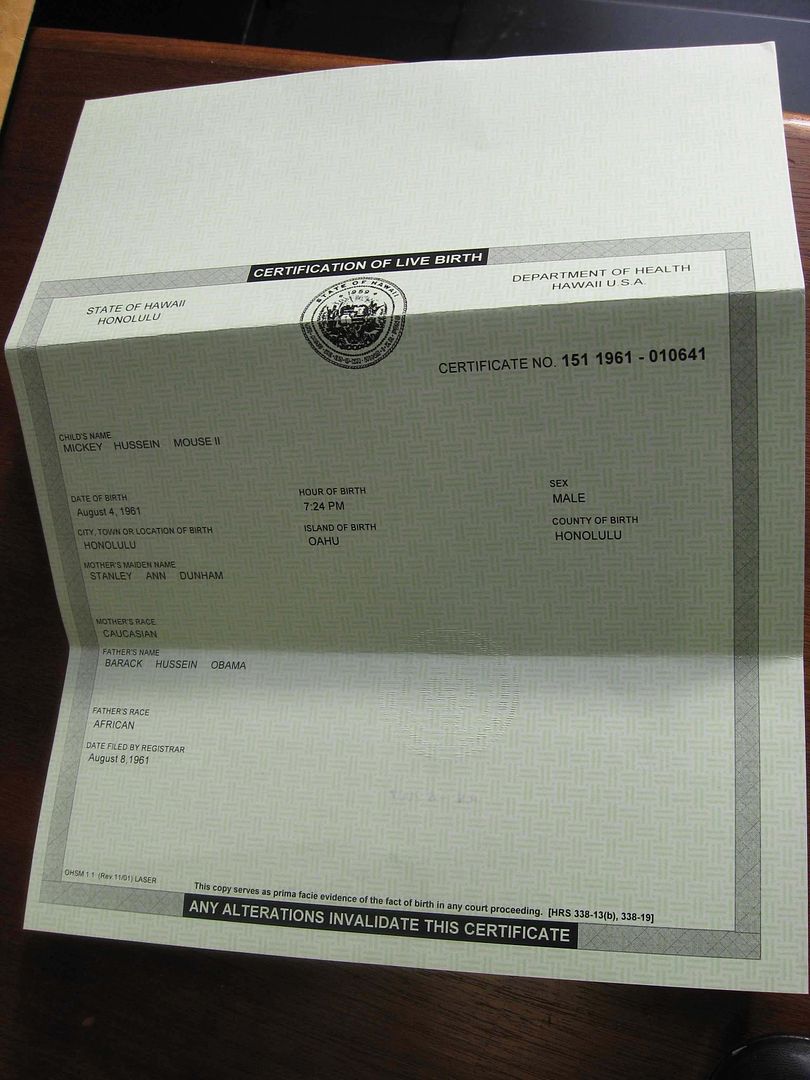
If Obama were born in Hawaii, a fact that he has yet to conclusively prove given the questionable authenticity of his long-form Certificate of Live Birth that he released on the internet on April 27, 2011, and if his parents are Barack H. Obama and Stanley Ann Dunham, who are reported to be his parents, he can at most be a Fourteenth Amendment and 8 U.S.C. Section 1401(a) born “citizen of the United States,” but he cannot be an Article II “natural born Citizen” which is the constitutional standard that he must meet to be eligible to be President and Commander in Chief of the Military. His mother, Stanley Ann Dunham, was a “citizen of the United States” at the time of Obama’s birth. But his father, being born in 1934 or 1936 in what was then the British colony of Kenya, was under the British Nationality Act of 1948, a Citizen of the United Kingdom and Colonies (“CUKC”). Obama himself by right of decent from his father under the same Act was also born a CUKC. Hence, because Obama was not born in the United States to United States citizen parents, he was not born under the sole and undivided allegiance and jurisdiction of the United States. Obama was not born with sole citizenship in the United States. Consequently, he was not born with unity of allegiance to and citizenship in the United States. Obama, therefore, cannot be an Article II “natural born Citizen” and is not eligible under Article II, Section 1, Clause 5 to be President and Commander in Chief of the Military.

                                                                  The Debt Ceiling

Our nation is currently faced with a budgetary desperate situation. Simply put, our federal government over the last decade has spent greatly more money than it took in. Our federal government must continue its business. But it must reduce its spending and increase its revenue. Whether its spending reduction or revenue raising, both sides of the equation are tied to taxes. By reducing the mammoth size of our federal and state governments and their programs, we would be able to reduce our public expenditures and need for more tax revenues. Unfortunately, such choices probably will impact on the American way of life. An alternative that makes much more sense is to help our nation to get richer by putting into place forces which will increase the amount of money the nation makes and thereby allow the government to collect more taxes from current and new income sources without increasing taxes on any one segment of the population which in the end may just be counterproductive.

But Obama’s enablers and maybe even Obama himself want to take the fast and easy way out. Now we see Obama’s enablers and maybe even Obama himself in the future suggesting that he resort to the Fourteenth Amendment to impose his will upon the American people regarding raising their debt ceiling above the current 14 Trillion Dollars without the input or control of Congress.

In a news story entitled, Senate Quickly Kills Boehner Debt Bill, it is reported:

The White House spokesman, Jay Carney, ruled out more definitively than he had before the possibility that Mr. Obama would cite the Fourteenth Amendment to disregard the debt-limit law and order government borrowing to proceed if no deal was reached. House Democratic leaders, former President Bill Clinton and some constitutional lawyers have said that Mr. Obama should, if necessary, invoke the amendment, which holds that “the validity of the public debt ... shall not be questioned.”

“This administration does not believe that the Fourteenth Amendment gives the president the power to ignore the debt ceiling. Congress has the authorities necessary to ensure that we meet our obligations,” Mr. Carney said.

http://www.nytimes.com/2011/07/30/us/politics/30fiscal.html?pagewanted=2&_r=1&nl=todaysheadlines&emc=tha2.

The Fourteenth Amendment was passed during Reconstruction following the Civil War. Its purpose was to address the social, political, and economic problems that led up to and that resulted from that war. The debt clause was only to assure that debts incurred by the United States, including those resulting from that war, would be honored. The amendment sanctified the “public debt,” provided that it was “authorized by law.” It also made sure that neither the United States nor any State would pay any debt incurred by anyone in their effort to overthrow the government of the United States or suffered by anyone from his or her slaves being emancipated. It declared such debts, obligations, and claims illegal and void.

How would Obama expect to unilaterally raise the People’s debt ceiling without that debt being “authorized by law” (meaning Congressional approval) and consider it to be constitutionally valid under the Fourteenth Amendment? Note that the debt belongs to the People and not to their government. Only if our political and legal institutions were to again turn a blind eye to the Constitution could Obama get away with such unconstitutional behavior.

It is only expected that Obama and his handlers would again rape the Fourteenth Amendment for their purpose of maintaining political power and satisfying their self-ambitions. Here we see that he would dare override the authority and will of a co-equal branch of government, the legislature. Doing such an act would show that he has no respect for and attachment to Article I, Sections 7, 8, and 9 of the Constitution, separation of powers, and the republican form of our government under which the People act through their elected representatives for the purpose of achieving the greater good.

Concerned Americans who questioned Obama’s eligibility to be President said early on that if Obama and his enablers were ready, willing, and able to turn a blind eye to Article II, Section 1, Clause 5 regarding his eligibility to be President, they would do the same when it came to other important issues with which our nation may be faced in the future. Here, we again see how desperate people will get for the sake of maintaining power and showing the world that they are right.

Mario Apuzzo, Esq.
July 30, 2011
http://puzo1.blogspot.com/
####

Copyright © 2011
Mario Apuzzo, Esq.
All Rights Reserved