Donate

Showing posts with label Atty Mario Apuzzo. Show all posts

Tuesday, November 8, 2011

Is Putative President Barack Hussein Obama II Really Bari Shabazz, Fugitive from Justice For 21 Years Following An Auto Accident in Honolulu County, Hawaii on March 12, 1982?

Is Putative President Barack Hussein Obama II Really Bari Shabazz, Fugitive from Justice For 21 Years Following An Auto Accident in Honolulu County, Hawaii on March 12, 1982?


                                                        By Mario Apuzzo
                                                       November 7, 2011

On November 2, 2011, I published an article entitled and asking the question, “Is Barack Hussein Obama II Really Bâri′ M. Shabazz, Born October 28, 1959 in New York City? ”, accessed at
http://puzo1.blogspot.com/2011/11/is-barack-hussein-obama-ii-really-bari.html. The basis of the question that I asked came from a November 2, 2011 breaking story published by Martha Trowbridge entitled, “Bâri′, Barry, Barack, accessed at http://terribletruth.wordpress.com/2011/11/02/bari%e2%80%b2-barry-barack/. In her article, Ms. Trowbridge’s contends that putative President Barack Hussein Obama II’s real name is Bâri′ M. Shabazz and that his date of birth is October 28, 1959, and his social security number is 084-54-5926. She says he was born in New York City. She adds that he was born with the name Bâri′ M. Shabazz. She also says that to be able to enter the political world, Bâri′ M. Shabazz had to change his birth identity and take on a new one which became Barack Hussein Obama II.

Ms. Trowbridge says: “We know this: Bâri′ M. Shabazz was assigned social security number 084-54-5926, issued in New York, in 1974.”

Ms. Trowbridge has found that the Social Security Death Index shows: “SHABAZZ, B M 28 Oct 1959 Aug 1994 (V) 34 (PE) (none specified) New York 084-54-5926.” From this, one would think that Bâri′ died in August 1994. But no, Ms. Trowbridge informs that only his identity was made “dead.” The real person continued to live and that person became “Barack Hussein Obama II.” Note how she explains that the “death” of Bâri′ was only reported by someone (“V” or “Verified”) and that the person did not present any valid death certificate (“P” or “Proof).

What’s more Ms. Trowbridge explains that “[o]nce in the federal system, the [death] record was flagged as ‘PE’, meaning that an inconsistency exists between what was reported and what was recorded in the government’s files.”

Finally, and the most shocking part of her report is that Ms. Trowbridge contends that Bâri′ M. Shabazz is the biological son of Malcolm X. Hence, if Barack Hussein Obama II is the same person as Bâri′ M. Shabazz, that would make putative President Obama the biological son of Malcolm X.

On November 4, 2011, an anonymous source emailed me something very interesting. To substantiate the content of the email, the writer directed me to go to a web site of the Judiciary for the State of Hawaii and to do a search of cases that have been disposed of by that State’s traffic courts. The anonymous source had done just that and so the person provided me with the information which that traffic court shows on its web site.

I did go to the Hawaii traffic court’s web site which is called eCourt Kokua and I was eventually able to confirm the information that the anonymous source sent me. Access to the court’s web site may be gained by going to http://jimspss1.courts.state.hi.us:8080/eCourt/ECC/ECCDisclaimer.iface;jsessionid=FDFF513AA90109AC4375A7CBE7C8AF36. Once at the site, click “Agree” to the terms and conditions. Then click, “Search for case details by case ID or citation number.” Once there, enter at the prompt, Case ID or Citation Number(*): 1193041MO and hit Search.” The following report appears:


What do these reports say and what questions do they raise? The Case ID is 1193041 MO. The name of the case is State v. Bari Shabazz which was a non-jury case. The case is characterized as a “Traffic Crime,” with a “REPORT number W50100.” The offense occurred on March 12, 1982. The charging police officer is Duane Masayuki Espinueva. The event is characterized as an “Accident Major.” The charge was driving without a valid driver’s license. The case was first filed on Tuesday, March 16, 1982, in the First Circuit, located at Kane’Ohe Division. I checked and this court is located at
45-939 Pookela Street, Kaneohe, HI  96744
. The case was continued to April 5, 1982.

The record also shows that Bari Shabazz was supposed to be arraigned and enter a plea on April 5, 1982, at 8:30 a.m., in Kane’ohe Traffic Court, Courtroom B, at the Kane’ohe Division. The case was continued to May 5, 1982.

On May 5, 1982, at 8:00 a.m., Bari Shabazz was supposed to again be arraigned and enter his plea in the same court room. He apparently did not appear and so the court issued a bench warrant on May 5, 1982, bearing number “BWO 050582.” It appears as though the court set bail at $25.00. The record also shows the entry of “HONDA,” maybe meaning that Bari Shabazz was driving a Honda or that the prosecutor’s name was “HONDA.” The next entry is for May 5, 1982, at 8:30 a.m. The court ordered the “AP” (maybe meaning accused person) to show proof of “NEW YORK DRIVER’S LICENSE.”

The report then shows that the prosecutor on April 9, 2003, filed an ex parte motion to recall the bench warrant and announced on the record “nolle prosequi.” This is a Latin phrase which is formally entered into a court record which means that the prosecutor in a criminal case “will no further prosecute” the case. The motion was listed as “NP [nolle prosequi] 040903.” So, the charge was dismissed upon the prosecutor’s ex parte “Nolle Prosequi” motion made on April 9, 2003. “Ex parte” means that only one side made the application which in this case was the prosecutor.

The final entry was for October 30, 2005, at 8:00 a.m., when the court noted that a $-0- balance was owed, but said “Pls check.”

This information raises the following questions:

1. Is the Bari Shabazz named in this traffic court report the same person Ms. Trowbridge calls “Bâri′ M. Shabazz” in her report and who is listed as “B M Shabazz” in the Social Security Death Index? If it is the same person, then that puts New Yorker Bâri′ M. Shabazz in Honolulu County, Hawaii, on March 12, 1982. Using a date of birth of October 28, 1959, this would have made Bâri′ M. Shabazz 22 years old at the time that he had this major automobile accident in Honolulu County.

2. The accident is characterized as a major accident. Chances are that Bari Shabazz and/or any passenger was taken to a local hospital in Honolulu County due to his/their injuries. If Bari Shabazz suffered any major injuries or laceration, the physical signs of those injuries and/or lacerations could still be present somewhere on his body if he is still alive.

3. Bari Shabazz was charged with driving without a driver’s license. The court ordered him to show proof of his New York driver’s license. Hence, Bari Shabazz must have told the charging police officer or the court that he did have a driver’s license and that it was one issued by the State of New York. Hence, Bari Shabazz must have been a resident of the State of New York. Note that Ms. Trowbridge said that Bâri′ M. Shabazz was born in New York City. Also, what was Bari Shabazz doing driving in Hawaii with what should have been a New York driver’s license? Was he now living in Hawaii? Was he there on vacation? Was he there visiting family or friends? Was he going to school there?

4. On April 9, 2003, the prosecutor filed a motion to recall the bench warrant, to terminate prosecution, and close the case. Why would this case come to the attention of some local prosecutor 21 years following the initial violation of March 12, 1982? A local prosecutor does not just go looking for cases that are 21 years old and file motions to dismiss those cases. Someone must have asked that local prosecutor to dismiss the case so that the arrest warrant was cleared from the court’s and nation’s computer system.

5. Ms. Trowbridge shows that Bâri′ M. Shabazz, according to the Social Security Death Index, died in August 1994. If Bâri′ M. Shabazz is the same person as is listed in this Hawaii auto accident as Bari Shabazz, why would someone care to recall his arrest warrant on April 9, 2003 or almost 9 years after his death? Surely, it could not be Bâri′ M. Shabazz who was interested since he had been dead since 1994. On the other hand, if he was not dead he would be interested.

6. On October 30, 2005, or 23 years following the date of the accident of March 12, 1982, the court again re-visits the case of Bari Shabazz, noting that he did not owe the court any money but to “Pls. check.” Why would the court again concern itself with this case on that date, especially if Bari Shabazz was dead since 1994?

7. So, is the Bari Shabazz named in this Hawaii traffic court report the same person Ms. Trowbridge calls “Bâri′ M. Shabazz” in her report and who is listed as “B M Shabazz” in the Social Security Death Index? That question surely merits an investigation. If he is, then that puts the New-York-born Bâri′ M. Shabazz in Honolulu County, Hawaii, the alleged birth place and once place of residence of putative President, Barack Hussein Obama II. Given what Ms. Trowbridge has concluded in her report, that is a circumstantial piece of evidence that is surely worth investigating. What also supports Ms. Trowbridge’s position that Bâri′ M. Shabazz really did not die in August 1994 and that he is still alive as Barack Hussein Obama II is that the traffic court in Hawaii was still acting on the Bari Shabazz traffic case 9 and 11 years after the alleged death in August 1994 of Bâri′ M. Shabazz. What needs to be investigated is why the local prosecutor and court took those actions so many years after the traffic accident and at whose behest.

8. Finally, when there is an auto accident, the police do a detailed accident report. That report includes the name, addresses, date of birth, and social security number of the person involved in the accident who is charged for that accident. The driver’s license number is also included if that license is produced or otherwise verified. A physical description of the defendant is also included. The make of auto, including the year made and VIN number are also included, along with statements of witnesses. There could be a photograph of the defendant in the police record. A thorough investigation of this matter would surely include searching the police record in Honolulu County for this report so that this information may be examined and evaluated.

Mario Apuzzo, Esq.
November 7, 2011
http://puzo1.blogspot.com/
####

Copyright © 2011
Mario Apuzzo, Esq.
All Rights Reserved

Sunday, August 21, 2011

The Rule of Law and the “Natural Born Citizen” Clause

                                           The Rule of Law and the “Natural Born Citizen” Clause


                                                            By: Mario Apuzzo, Esq.
                                                                 August 21, 2011


 Watch this video of putative President Obama at http://www.telegraph.co.uk/news/worldnews/us-election/8712959/Barack-Obama-accuses-Congress-of-holding-back-recovery.html. His point, which was also made by George Washington in his Farewell Address of 1796, http://www.ourdocuments.gov/doc.php?flash=true&doc=15, is that we can bring our nation back to greatness if politicians would only put country before party. But what is Obama talking about? When we talk about putting country before party, are we not really saying that we should put first what is good for the country as a whole rather than what is good for a particular political party? But how could Obama pretend to promote and defend the greater good of the country without at the same time honoring and respecting the rule of law that keeps that country together? The answer is that the country and the rule of law are inseparable. We cannot have one without the other.

The rule of law is nothing more than intelligence and reason applied to produce a just and predictable result concerning the distribution to people of benefits and obligations offered by the society in which they live. It is a fundamental component of good government and its proper administration. The rule of law, joined with military might, has made our country great and will allow us to prevail in the future. The Founders and Framers, being passionate students of ancient history, recognized the vital importance of the rule of law. In fact, they saw the rule of law to be so critical to life, liberty, and the pursuit of happiness that as a testament of that understanding they gave us a constitutional republic in which military power is subordinate to civilian power. Indeed, the rule of law, which picked up where the Roman Empire ( http://www.usu.edu/markdamen/1320Hist&Civ/chapters/08ROMFAL.htm) left off when it transitioned into the medieval ages, has brought both quantity and quality to world populations. It has given our lives order and civility, allowing Americans to freely study, pray, work, trade, and travel, and thereby to live healthy, prosperous, and peaceful lives.

There exists plenty of historical and legal evidence that Obama is not and cannot be an Article II "natural born Citizen" and is therefore ineligible to be President. Since the Founding, a “natural born Citizen” has been understood to be a child born in the country to citizen parents. The Founders and Framers were particularly careful to keep out of the Office of President and Commander in Chief of the Military foreign and monarchial influence. They therefore demanded that future presidents be "natural born Citizen[s]." By demanding such birth status, they assured that future presidents would be born with no allegiance to any foreign power and therefore loyal and attached only to the United States from birth.

A "natural born Citizen" was well-defined in natural law and the law of nations upon which the Founders and Framers heavily relied in the early years of our Republic. Founder historian, David Ramsay (http://puzo1.blogspot.com/2010/04/founder-and-historian-david-ramsay.html) who in his A Dissertation on the Manners of Acquiring the Character and Privileges of a Citizen (1789) ( http://www.scribd.com/doc/33676461/Founder-and-Historian-David-Ramsay-Defined-Natural-Born-Citizenship-in-1789-by-Atty-Mario-Apuzzo) told us that after July 4, 1776, birthright citizenship was preserved only for a child born to U.S. citizens, making no mention of place of birth.  This definition surely came from natural law and the law of nations and not from the English common law which in defining a “natural born subject” made no reference to the nationality of the parents.  In his 1789 article, Ramsay first explained who the “original citizens” were and then defined the “natural born citizens” as the children born to citizen parents. He said concerning the children born after the declaration of independence, “[c]itizenship is the inheritance of the children of those who have taken part in the late revolution; but this is confined exclusively to the children of those who were themselves citizens….” Id. at 6. He added that “citizenship by inheritance belongs to none but the children of those Americans, who, having survived the declaration of independence, acquired that adventitious character in their own right, and transmitted it to their offspring….” Id. at 7. He continued that citizenship “as a natural right, belongs to none but those who have been born of citizens since the 4th of July, 1776….” Id. at 6. As we can see, Ramsay put forth a definition of a “natural born Citizen” that only depended upon the child being born to U.S. citizen parents with no mention of place of birth.

Other relevant historical materials such as Emer de Vattel’s, The Law of Nations, Section 212 (London 1797) (1st ed. Neuchatel 1758) (http://www.constitution.org/vattel/vattel_00.htm), tell us: “The citizens are the members of the civil society: bound to this society by certain duties, and subject to its authority, they equally participate in its advantages. The natives, or natural-born citizens, are those born in the country, of parents who are citizens. As the society cannot exist and perpetuate itself otherwise than by the children of the citizens, those children naturally follow the condition of their fathers, and succeed to all their rights. The society is supposed to desire this, in consequence of what it owes to its own preservation; and it is presumed, as matter of course, that each citizen, on entering into society, reserves to his children the right of becoming members of it. The country of the fathers is therefore that of the children; and these become true citizens merely by their tacit consent. We shall soon see, whether, on their coming to the years of discretion, they may renounce their right, and what they owe to the society in which they were born. I say, that, in order to be of the country, it is necessary that a person be born of a father who is a citizen; for if he is born there of a foreigner, it will be only the place of his birth, and not his country.”

Then we have Minor v. Happersett, 88 U.S. 162, 167-68 (1875) (http://www.law.cornell.edu/supct/html/historics/USSC_CR_0088_0162_ZS.html), which providing the same Vattelian definition without citing Vattel, and not in any way referring to the English common law, stated: “The Constitution does not in words say who shall be natural-born citizens. Resort must be had elsewhere to ascertain that. At common-law, with the nomenclature of which the framers of the Constitution were familiar, it was never doubted that all children born in a country of parents who were its citizens became themselves, upon their birth, citizens also. These were natives or natural-born citizens, as distinguished from aliens or foreigners. Some authorities go further and include as citizens children born within the jurisdiction without reference to the citizenship of their parents. As to this class there have been doubts, but never as to the first. For the purposes of this case, it is not necessary to solve these doubts. It is sufficient, for everything we have now to consider, that all children, born of citizen parents within the jurisdiction, are themselves citizens.” Id., 169 U.S. at 679-80.  We can see from this American common law definition of a "natural-born citizen" that the Supreme Court did not rely upon the English common law for the definition, but rather on natural law and the law of nations as set forth by Vattel in Section 212 of The Law of Nations.  We can also see from the Minor decision that an American “natural born Citizen” is much different from a British “natural born subject,” for the latter did not consider the nationality of the parents and also included naturalized British subjects “at birth” and after birth.

Then there is U.S. v. Wong Kim Ark, 169 U.S. 649, 708 (1898) (http://www.law.cornell.edu/supct/html/historics/USSC_CR_0169_0649_ZS.html), which cited and quoted Minor and its definition that a “natural-born citizen” is a child born in the country to citizen parents. Wong then decided that a child born in the country to alien parents who were domiciled in the U.S. was a "citizen" under the Fourteenth Amendment. The Court did not nor did it have to rule that he was an Article II "natural born Citizen" which the Court told us was defined by Minor. Rather, the Court told us that he was a "citizen" under the Fourteenth Amendment. So what the Court actually did was naturalize Wong to be a “citizen of the United States” “at birth” like the Exchequer Chamber in Calvin’s Case (1608), creating the English rule of jus soli birthright citizenship, naturalized Calvin (the postnati) based on “procreation and birthright” to be a “natural born subject.” It is interesting to note that neither the British Parliament which started to debate the matter in 1604 nor the U.S. Congress prior to 1898 were willing to naturalize persons like Calvin and Wong, respectively, so the matter fell upon the courts of justice, and that those who were born prior to 1603 (the antenati), when James VI of Scotland inherited the throne of England as James I, could naturalize only by statute. Hence, the jus soli rule of Calvin’s Case is really a naturalization rule used to bestow citizenship or nationality at birth.  This is confirmed by Vattel who in Section 214 of The Law of Nations, entitled, Naturalisation, said: “Finally, there are states, as, for instance, England, where the single circumstance of being born in the country naturalises the children of a foreigner.” Hence, the jus soli rule of Calvin’s Case, as applied by Justice Gray in Wong Kim Ark, is a rule allowing person to become naturalized “at birth” and not a rule that can be used to establish “natural born Citizen” status in the new republic, for being naturalized “at birth” one cannot be a “natural born Citizen.” Our courts have incorporated the jus soli rule of Calvin’s Case into the application of the Fourteenth Amendment. By doing so, they have declared children born in the United States to one or two alien parents to be “born” “citizens of the United States.” But these children, being naturalized “at birth” under jus soli are not “natural born" “citizens of the United States.” 

There are other historical sources and cases which inform on the definition of a “natural born Citizen” but for the sake of brevity, I will not include them here.

We know from Vattel and Minor that "citizens" can be the parents of "natural born Citizens" but are not necessarily "natural born Citizens" themselves. Being born in the country to citizen parents allows a child to be born with no foreign allegiance and with loyalty and attachment only to the country of his or her parents. Such birth circumstances allow a child to be born under the full and complete allegiance and jurisdiction of the United States.

Obama's father, a British citizen, was never a U.S. citizen. Hence, Obama was not born in the country to citizen parents. Because Obama’s father was not a U.S. citizen, Obama, even if born in Hawaii which he has yet to conclusively prove, was also born with allegiance to and citizenship in Great Britain. Consequently, Obama was not born with no foreign allegiance and with sole loyalty and attachment to the United States. He was not born with sole allegiance and unity of citizenship in the United States at birth, a natural condition that the Founders and Framers wanted in future presidents and commanders in chief. He was not born under the full and complete allegiance and jurisdiction of the United States. He is not and cannot be an Article II "natural born Citizen." Under Article II, Section 1, Clause 5, he is therefore not eligible to be President and Commander in Chief.

But how can we expect to achieve and maintain greatness as a nation when our own president does not follow the rule of law as it pertains to his eligibility to be President? Being the putative President and Commander in Chief, Obama should be the first one to follow his own advice of putting country first. He and his enablers should put the Constitution (country) before his personal political ambitions (party). But up to now, Obama and his enablers are just saying "do as I say, not as I do."

A great number of Americans have come to understand these fundamental truths and are not happy with how Obama and political and legal institutions have turned a blind eye to Obama’s ineligibility to be President. These Americans are demanding justice on a daily basis. If Obama and his enablers were to follow Obama’s advice, these Americans, who have lost respect for their political and legal institutions, could once again get behind their political leaders and help them solve the many social and economic issues which are currently disrupting our nation. On the other hand, some Americans believe that the “natural born Citizen” issue is a “distraction” from the real issues pressing our country. But as we have seen, the "natural born Citizen" issue goes to the heart of our constitutional republic, the rule of law. Without the rule of law, we have no constitution or republic. I would not consider any of that a "distraction."

This state of affairs leaves Americans who truly care about their country and the rule of law with having to continue this fight on their own. Their fight will not go unrewarded, for as history has shown, those who persevere will in the end win.

Mario Apuzzo, Esq.
August 21, 2011
####

Copyright © 2011
Mario Apuzzo, Esq.
All Rights Reserved


Thursday, March 31, 2011

Donald Trump Is a “Natural Born Citizen” But Putative President Barack Obama Is Not

Donald Trump Is a “Natural Born Citizen” But Putative President Barack Obama Is Not

By Mario Apuzzo, Esq.
March 31, 2011

Based on the information that has so far been provided to the public, I conclude that Donald Trump is an Article II "natural born Citizen" but Barack Obama is not.

The Founders and Framers understood that under natural law and the law of nations, as explained by Emer de Vattel in his, The Law of Nations, Or, Principles of the Law of Nature (London 1797) (1st ed. Neuchatel 1758) (“Vattel”), a nation’s most fundamental duty is self-preservation. They therefore included the "natural born Citizen" clause in the Constitution so that each and every citizen would be protected by having someone assume and exercise the great and singular civil and military powers of the President and Commander in Chief with only their and the nation's values and safety at heart. To accomplish that end, the Founders and Framers required in Article II, Section 1, Clause 5 of our Constitution that anyone who was a “citizen of the United States” at the time of the adoption of the Constitution was eligible to be President. But for anyone born thereafter, they built in extra protection for the nation by requiring that anyone born after the adoption of the Constitution be a “natural born Citizen.”

While a “citizen of the United States” is any citizen so made by the Fourteenth Amendment, Act of Congress, or treaty, a "natural born Citizen" is a child born in the country to citizen parents. Vattel, Sections 212-217. Here are some supporting sources, and there are more, for this definition:

(1) Founder historian, David Ramsay, who in his A Dissertation on the Manners of Acquiring the Character and Privileges of a Citizen (1789) told us that after July 4, 1776, birthright citizenship was preserved only for a child born to U.S. citizens, making no mention of place of birth. In his 1789 article, Ramsay first explained who the “original citizens” were and then defined the “natural born citizens” as the children born to citizen parents. He said concerning the children born after the declaration of independence, “[c]itizenship is the inheritance of the children of those who have taken part in the late revolution; but this is confined exclusively to the children of those who were themselves citizens….” Id. at 6. He added that “citizenship by inheritance belongs to none but the children of those Americans, who, having survived the declaration of independence, acquired that adventitious character in their own right, and transmitted it to their offspring….” Id. at 7. He continued that citizenship “as a natural right, belongs to none but those who have been born of citizens since the 4th of July, 1776….” Id. at 6. As we can see, Ramsay put forth a definition of a “natural born Citizen” that only depended upon the child being born to U.S. citizen parents with no mention of place of birth;

(2) The Venus, 12 U.S. (8 Cranch) 253, 289 (1814) (Chief Justice John Marshall, concurring and dissenting for other reasons, cited Vattel and provided his definition of natural born citizens and said: “Vattel, who, though not very full to this point, is more explicit and more satisfactory on it than any other whose work has fallen into my hands, says ‘The citizens are the members of the civil society; bound to this society by certain duties, and subject to its authority, they equally participate in its advantages. The natives or indigenes are those born in the country of parents who are citizens. Society not being able to subsist and to perpetuate itself but by the children of the citizens, those children naturally follow the condition of their fathers, and succeed to all their rights’”);

(3) Inglis v. Sailors’ Snug Harbor, 28 U.S. 99, 3 Pet. 99, 7 L.Ed. 617 (1830) (the majority, which included Chief Justice John Marshall, cited Vattel on the right of election to change one’s allegiance and thus citizenship in the context of the new nation being formed after revolution. The Court found on principles consistent with Vattel’s jus sanguinis and not on the English common law rule of jus soli, that simply being born in New York, after July 4, 1776 and before September 15, 1776, when the British took possession of New York, was not sufficient to establish one’s status as an American citizen, for a child of minor years is incapacitated from making any citizenship election but rather followed the citizenship held or chosen by the father. On the contrary, relying upon principles of the English common law, Justice Johnson and Justice Story, who wrote separate minority concurring opinions, would have found the child born in New York during the same time period a citizen of the State of New York or American citizen, respectively, regardless of the citizenship of his parents. Id. 136 and 164. This case shows what the majority rule was on citizenship and that it followed the Vattelian doctrine that a child when born took on the national character of his or her father (meaning father and mother under the doctrine of merger of the wife’s citizenship into the husband) and did not acquire his or her citizenship from the territory in which he or she was born);

(4) Dred Scott v. Sandford, 60 U.S. 393 (1857) (Justice Daniels concurring cited Vattel and The Law of Nations and provided his definition of natural born citizens and took out of Vattel’s definition the reference to “fathers” and “father” and replaced it with “parents” and “person,” respectively, and stated: “'The citizens are the members of the civil society; bound to this society by certain duties, and subject to its authority, they equally participate in its advantages. The natives, or natural-born citizens, are those born in the country, of parents who are citizens. As society cannot perpetuate itself otherwise than by the children of the citizens, those children naturally follow the condition of their parents, and succeed to all their rights.' Again: 'I say, to be of the country, it is necessary to be born of a person who is a citizen; for if he be born there of a foreigner, it will be only the place of his birth, and not his country. . . .'”);

(5) Minor v. Happersett, 88 U.S. (21 Wall.) 162, 167-68 (1875) (providing the same Vattelian definition without citing Vattel, and not in any way referring to the English common law, stated: “The Constitution does not in words say who shall be natural-born citizens. Resort must be had elsewhere to ascertain that. At common law, with the nomenclature of which the framers of the Constitution were familiar, it was never doubted that all children born in a country of parents who were its citizens became themselves, upon their birth, citizens also. These were natives or natural-born citizens, as distinguished from aliens or foreigners. Some authorities go further and include as citizens children born within the jurisdiction without reference to the citizenship of their parents. As to this class there have been doubts, but never as to the first. For the purposes of this case, it is not necessary to solve these doubts. It is sufficient, for everything we have now to consider, that all children, born of citizen parents within the jurisdiction, are themselves citizens.” Id., 169 U.S. at 679-80);

(6) United States v. Wong Kim Ark 169 U.S. 649, 693 (1898) (a “citizen of the United States” under the Fourteenth Amendment is a child born or naturalized in the United States and “subject to the jurisdiction thereof” but an Article II “natural born Citizen” is a child born in the United States to citizen parents, citing and quoting Minor v. Happersett for that definition. The question that Minor did not answer was answered by Wong Kim Ark, wherein the United States argued that a child born in the U.S. to alien parents was not a “citizen of the United States” under the 14th Amendment. Ruling against the government, Wong Kim Ark declared a child born in the country to alien parents to be a “citizen of the United States” under the 14th Amendment. Wong Kim Ark, citing and quoting Minor and acknowledging its definition that a “natural-born citizen” was born in the country to citizen parents, in no way disturbed Minor’s definition of a “natural-born citizen,” for it was asked to decide only if Wong was a “citizen of the United States” under the 14th Amendment. Wong Kim Ark also allowed Wong to be a 14th Amendment “citizen of the United States” because it found that his parents, while not U.S. citizens, were, among other things, domiciliaries, residents of the United States, and not working in some foreign diplomatic capacity and therefore “subject to the jurisdiction” of the United States. So Wong decided only the “citizen” part of Wong’s status. It never decided whether he also had the “natural born” part. The Court cautioned in its opinion in the beginning and at its end that it was only deciding whether Wong was a “citizen of the United States” under the 14th Amendment and also informed us under what limited conditions (born in the U.S. to alien parents who were domiciled and residing in the U.S. and not employed in some foreign diplomatic capacity) it ruled that he was so); and

(7) Perkins v. Elg, 307 U.S. 325 (1939) (confirmed that a child born in the United States to a naturalized U.S. citizen father and naturalized citizen mother, the mother being derivatively naturalized by marrying a U.S. citizen, was a “natural born Citizen.”

Donald Trump has expressed some interest in running for President in 2012. We have recently seen some commentators say that Trump is not a “natural born Citizen.” The question now is whether they are correct? Trump was born on June 14, 1946, in New York to U.S. citizen parents. He is therefore a “natural born Citizen.” His father, Fred C. Trump, was born on October 11, 1905, in New York, New York. His mother, Mary Anne (Mac Leod) Trump, was born on May 10, 1912, in Stornoway, Scotland. Trumps father was a U.S. citizen when he married Trump’s mother, who at that time had not yet naturalized to be a U.S. citizen. Trump was born in the United States thereafter. Under merger of the husband’s citizenship into that of the wife which was the doctrine existing at the time the Constitution was adopted and under Elg, this makes Trump a “natural born Citizen.”

In 1924, the Congress passed the Married Women’s Act, also known as the Cable Act. This act gave each woman a nationality of her own. Under this act, an alien woman who married a U.S. citizen did not need to file a declaration of intention to become a U.S. citizen. She needed only to file a naturalization petition to become a U.S. citizen. Given their dates of birth, Trump’s parents most probably married after 1924, the year the Cable Act was passed. Hence, Trump’s mother would have had to naturalize on her own to acquire U.S. citizenship. Trump’s mother naturalized to be a U.S. citizen on her own on March 10, 1942, which is over 4 years before Trump was born. Hence, when Trump was born, both his parents were "citizens of the United States." These birth circumstances make Trump a “natural born Citizen.” See http://www.thebirthers.org/misc/trumped.html for screen shots of the supporting documentation which shows that Donald Trump is a “natural born Citizen.”

Putative President Barrack Obama might also run for re-election in 2012. While our legal and political institutions have allowed Obama to escape having to prove that he is a “natural born Citizen,” he will not be able to do the same when running for re-election in 2012. Hence, the question still remains whether Obama is a “natural born Citizen.” As I have stated repeatedly in the past, I cannot conclude that Obama is a “natural born Citizen.” Obama fails to meet the “natural born Citizen” eligibility test because when he was born in 1961 (wherever that may be), he was not born to a United States citizen father and mother.

There are two open issues regarding whether putative President Obama is eligible to be President. One is place of birth. Consider that in all the law suits filed against Obama and others on the place of birth issue, including the Kerchner v. Obama/Congress law suit (which also argued that regardless of place of birth, Obama is not and cannot be a “natural born Citizen” because he was not born in the United States to a U.S. citizen father and mother), Obama never once produced any birth certificate (neither his Certification of Live Birth known as the COLB nor his long-form, hospital generated Certificate of Live Birth) for the court which would have put an end to the birth place issue. Why did he pursue a legal strategy (e.g. standing, political question, and other justiciability defenses) which only worked in the short term rather than just produce the birth certificate which would finally end the birth place controversy?

Why spend so much private and public money and resources fighting the same issue over and over again? Even now, over two years after the 2008 election, we see the same place of birth issue raised in various contexts. It has risen in the military context with LTC Terry Lakin, who is serving 6 months in federal prison for defending the Constitution by wanting to assure that Obama is a “natural born Citizen.” We see it in ObamaCare litigation. Now some states are also moving to require proof of birth as part of a presidential candidate's requirements to get on the ballot. Officials with the National Conference of State Legislatures report that 10 states already have some sort of requirement to prove eligibility. There is Arizona's H.B. 2177 and S.B. 1157, Connecticut's SB391, Georgia's HB37, Indiana's SB114, Maine's LD34, Missouri's HB283, Montana's HB205, Nebraska's LB654, Oklahoma's SB91, SB384 and SB540, and Texas; HB295 and HB529. With Texas' 34 votes, these states possess 107 Electoral College votes. http://www.wnd.com/index.php?fa=PAGE.printable&pageId=258585 .

Hawaii Governor Abercrombie has recently revived the birth place issue, vowing to find the birth certificate and put an end to the debate. But we have seen that he found no birth certificate. Now Donald Trump has publicly announced that Obama should do the right and simple thing and just release his long form, hospital generated birth certificate.

So, there is no end to the issue of Obama’s place of birth. Should we not blame Obama himself for this issue still existing? After all, the Constitution says that he must be a “natural born Citizen.” Is not the burden on him to satisfy that requirement? The question of where Obama was born is not a distraction, for it only takes 10 minutes and $10.00 to resolve (the amount of time and money needed to produce his real birth certificate).

Why has Obama allowed this issue to continue unabated? Why have all the Department of Justice attorneys repeatedly taken the same approach in defending Obama, i.e., fighting jurisdiction (standing) and raising any other justiciability defense? Why have they fought so hard to prevent any litigant to have discovery so that a copy of the birth certificate could be obtained? Why have they to this day never produced a copy of any birth certificate in any court which would have put an end to the birth place issue not only in that court but in all other courts present and in the future?

While the courts have not been too kind to the "birthers," why has not one court even mentioned the fact that not one court in the whole nation has yet to see Obama’s alleged birth certificate?

But apart from the place of birth issue, we also have the question of whether Obama is an Article II "natural born Citizen." Assuming that he was born in Hawaii and also assuming that his parents are who he says they are, does Obama meet the definition of an Article II "natural born Citizen?" At his birth, his mother was a United States citizen. But under the British Nationality Act of 1948, his father, who was born in the British colony of Kenya, was born a Citizen of the United Kingdom and Colonies (CUKC) which under that same law and by descent made Obama himself a CUKC. Prior to Obama’s birth, Obama’s father neither intended to nor did he become a United States citizen. Being temporarily in the United States only for purpose of study and with the intent to return to Kenya, his father did not intend to nor did he become even a legal resident or immigrant to the United States.

The U.S. State Department has confirmed that Obama was born with dual allegiances. Leventhal cites FactCheck.org to state, "Obama was originally both a U.S. citizen and a citizen of the United Kingdom and Colonies from 1961 to 1963 given that his father was from Kenya, which gained its independence from the British Empire in 1963. Upon independence, Obama became both a U.S. and Kenyan citizen from 1963 to 1982 [sic should be 1984], and solely a U.S. citizen after that." The entry "The Obama Birth Controversy" was written by Todd Leventhal, the chief of the Counter-Misinformation Team for the U.S. Department of State.

Obama may be a plain born “citizen of the United States” under the 14th Amendment or a Congressional Act (if he was born in Hawaii). But he is not an Article II "natural born Citizen," for upon Obama's birth his father was a British subject and Obama himself by descent was also the same. Hence, Obama was born subject to a foreign power. Obama lacks the birth status of natural sole and absolute allegiance and loyalty to the United States which only the President and Commander in Chief of the Military and Vice President must have at the time of birth. Being born subject to a foreign power, he lacks sole allegiance and unity of citizenship to the United States from the time of birth which assures that required degree of natural sole and absolute birth allegiance and loyalty to the United States from birth, a trait that is constitutionally indispensable in a President and Commander in Chief of the Military. Like a naturalized citizen, who despite taking an oath later in life to having sole allegiance to the United States cannot be President because of being born subject to a foreign power, Obama too cannot be President.

Mario Apuzzo, Esq.
March 31, 2011
http://puzo1.blogspot.com/
####

Copyright © 2011
Mario Apuzzo, Esq.
All Rights Reserved

Saturday, March 26, 2011

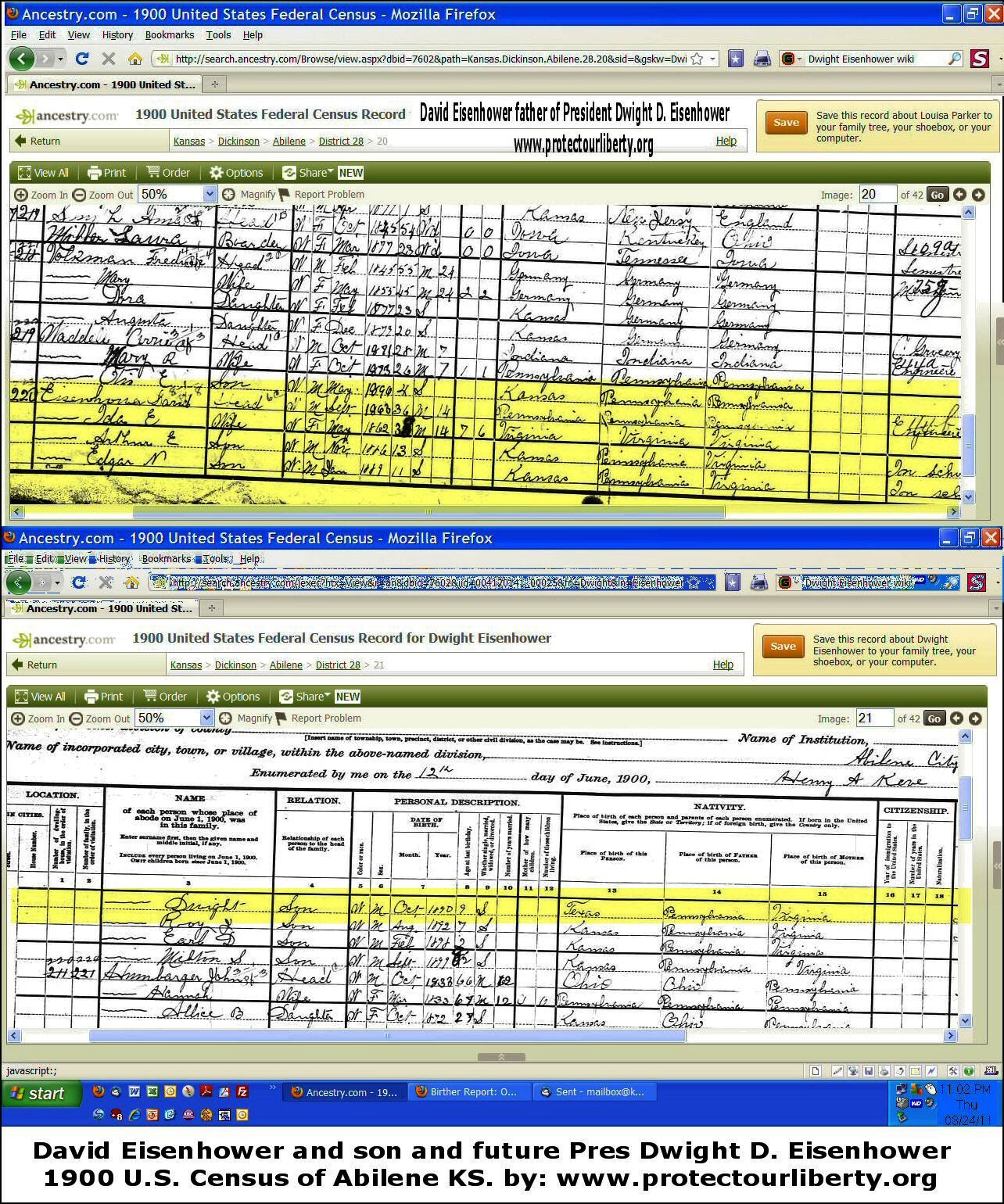
President Dwight Eisenhower Had to File a Birth Certificate to Run for President - Unlike Obama, Ike had nothing to hide!

Via Sonoran News; - Ike needed birth certificate to run for president - ‘Ike had nothing to hide!’ -

BY LINDA BENTLEY - CAVE CREEK – Glen Fairclough, a reader from Salt Lake City, Utah, sent us an e-mail last week to express his gratitude for publishing the recent article regarding President Obama’s Kenyan birth certificate.

And, while going through digital images online of his hometown newspaper, the Deseret News and Telegram, Fairclough forwarded us a United Press wire article from the Oct. 2, 1952 edition he thought we would find interesting.

The article appeared on page 6A with a dateline of Sherman, Texas. It was headlined: “General’s birth certificate officially filed,” and stated, “A certificate recording Dwight Eisenhower’s birth in Denison on Oct. 14, 1890, was filed Wednesday [Oct. 1, 1952] in the Grayson County Clerk’s office. Read more ...

Read rest of the story via the link and for further information about Ike's proven natural born Citizenship status upon his birth in Texas in Oct 1890 to two U.S.
citizen parents, unlike Obama who claims he was born in Hawaii but whose father was a foreign national and was not even an immigrant to the USA. And also unlike Ike, Obama has relatives, African newspapers, and government officials in Kenya saying he was born there and not in the USA. Ike never had relatives and government officials in foreign countries stating repeatedly that he was born in their country. Thus, the logical justification to ask to see Obama's original long form birth registration documents in Hawaii, and any amendments to same. This is logically needed to verify that he indeed was physically born there and not just had a false birth registration done in Hawaii via sworn affidavit of a birth at home with no independent witnesses and submitted by mail by his maternal grandmother who lived there in order to get U.S. Citizenship for her foreign born grandson. Birth registration fraud was easy in Hawaii in 1961 due to the very lax laws in the new state.

Regardless of the lack of claims of foreign birth about Eisenhower, Ike was still required to file a copy of his birth certificate with controlling legal authorities upon running for election as President. So Whoopi Goldberg, was it racist to ask Ike to file a certified paper copy of his birth certificate with controlling legal authorities in order to run for President. Ike wasn't allowed to just show a picture of it on television. He had to provide a certified paper copy of his birth certificate to the authorities. What is racist about having to prove you are constitutionally eligible to run for President? What is racist about the rule of law of which our U.S. Constitution is the fundamental law of the land. Read more here: http://obamareleaseyourrecords.blogspot.com/2011/03/reminder-dwight-d-eisenhower-had-to.html

CDR Charles Kerchner (Ret)
http://www.protectourliberty.org
http://puzo1.blogspot.com
####

P.S. If Whoopi Goldberg needs another example of others being asked to show documents and birth certificates to prove they are eligible to run for President, she should read about the challenges made to John McCain's natural born Citizen status in the 2008. John McCain was sued in NH by a man named Hollander charging he was not a natural born Citizen. The Senate Judiciary Committee chaired by Senator Leahy, and of which Barack Obama and Hillary Clinton were voting members, investigated McCain in response to citizen requests. He was required to show his paper certified copy of his birth certificate to them in executive session. But for similar requests in much larger numbers calling for the investigation of Obama's eligibility, and with lawsuits filed charging Obama was not eligible, that was all ignored by the Democratic Party lead Senate. That is lack of due process and unequal protection under the law of land and the U.S. Constitution. So Whoopi Goldberg's charges of racism on The View TV show are completely groundless and show her ignorance of history or her willingness to go to the lowest level of politics and debate, and shout and yell and act absurd on air ... and play the race card and call and imply that anyone who questions Obama's eligibility is a racist. See this blog post in late February 2008 and early March 2008 by Professor Jonathan Turley questioning McCain's eligiblity who along with mysteriously simultaneously appearing articles in the New York Times (looks to me like they were started based on orders from Hillary Clinton operatives) started the investigation of John McCain under constitutional grounds which ultimately lead to the Senate investigation and resolution in April 2008: http://jonathanturley.org/2008/03/06/the-supreme-redux-is-john-mccain-ineligible-to-be-president/ and http://jonathanturley.org/2008/02/29/mccains-constitutional-dilemma-native-son-but-not-natural-born/ . And this one: http://birthers.org/misc/FOMB.html
####

Saturday, March 12, 2011

Atty Mario Apuzzo & CDR Charles Kerchner (Ret) were on the Hagmann-McLeod Report on CFP Radio tonight - Saturday 12 Mar 2011 8:00 p.m. EST


Atty Mario Apuzzo & CDR Charles Kerchner (Ret) were on the Hagmann-McLeod Report on CFP Radio tonight - Saturday 12 Mar 2011 8:00 p.m. EST

The topic will be the Obama eligibility issue. See this link for a copy of Atty Mario Apuzzo's "Catalog of Evidence" as to Obama's Hawaiian birth nativity story: http://puzo1.blogspot.com/2010/05/catalog-of-evidence-concerned-americans.html
See this page for more details on the Hagmann-McLeod Report on Canada Free Press (CFP) Radio: http://canadafreepress.com/index.php/article/34352

Listen to the show via podcast at:
http://www.blogtalkradio.com/cfp-radio/2011/03/13/hagmann-mcleod-report

Posted by:
CDR Charles Kerchner (Ret)
http://www.protectourliberty.org
http://puzo1.blogspot.com
####

Friday, March 11, 2011

The States Have the Constitutional Power to Pass Legislation Prescribing Presidential Ballot Access Requirements Including Determining Whether a Candidate Meets the Eligibility Requirements of Article II, Section 1, Clause 5

The States Have the Constitutional Power to Pass Legislation Prescribing Presidential Ballot Access Requirements Including Determining Whether a Candidate Meets the Eligibility Requirements of Article II, Section 1, Clause 5

by Mario Apuzzo, Esq.
March 11, 2011

Article II, Section 1 of the U.S. Constitution tells us that the Electoral College is the mechanism used to elect the President. 3 U.S.C. Sec. 4. Article II, Section 1 also tells us how the Electoral College is filled. It says that the states shall appoint the electors who will make up the Electoral College, determining the manner of electing them and the quantity to be elected. The rest of Article II, Section 1 was changed by the Twelfth Amendment which now prescribes how the voting is done, how the votes are tallied and transmitted to Congress, and how Congress confirms those votes and declares who shall be President. Further state authority over federal elections is found in Article I, Section 4, Clause 1, which delegates to the state legislatures the initial authority for the "Times, Places and Manner" of elections to Congress, with Congress having residual authority to make such regulations. Hence, the Constitution gives to the states the authority over federal elections and specifically to appoint its electors and decide how their votes are processed for the purpose of determining who shall be President. There is therefore no question that states have the power to run their own presidential and vice-presidential elections. Storer v. Brown, 415 U.S. 724, 730 (1974) (the Election Clause, Article I, Section 4, Clause 1 which applies to Congress was intended to grant states authority to protect the integrity and regularity of the election process by regulating election procedure). As part of that process, states must also have the authority over who shall be placed on any ballot to run for president and vice-president.

This state mechanism has been recently confirmed by an April 3, 2009 Congressional Research Service Memo by Legislative Attorney, Jack Maskell, entitled, “Qualifications for the Office of President of the United States and Legal Challenges to the Eligibility of a Candidate,” wherein he stated:

“The mechanics of elections of federal officials within the several states are administered under state law. [footnote 4] The quadrennial presidential election, although required since 1845 to be held on the same day in each state [footnote 5] is, in an administrative and operational sense, fifty-one separate elections in the states and the District of Columbia for presidential electors. States generally control, within the applicable constitutional parameters, the administrative issues, questions, and mechanisms of ballot placement and ballot access. [footnote 6]

State election officials under some state ballot laws might thus require candidate "statements" or "declarations" of candidacy attesting to and/or certifying certain facts as a condition to be on the ballot; in other states, representatives of the established political parties may certify names to the Secretary of State, or the designated elections official may place viable or "recognized" candidates on the presidential preference ballots. [footnote 7] In such cases, opposing political candidates or political parties may have "standing" to legally challenge the placement of a name of an opponent on the ballot, [footnote 8] or state law may specifically provide for a procedure for timely protests to be filed concerning the qualifications of candidates. [footnote 9] Additionally, the relevant election official in the state, such as the Secretary of State, may have authority to exercise discretion to challenge a self-certification or a certification by a political party of a candidate whom the election official believes is not eligible for the office. It would appear to be a matter of state law and interpretation as to whether election officials in a particular state have discretionary authority to question the certification of a party's nominated candidate, or even a self-certification of a candidate, if such election officials were presented with actual probative, documentary evidence to rebut any presumed or self-certified eligibility. In Keyes v. Bowen, the California Supreme Court dismissed a suit against the Secretary of State which challenged President Obama's eligibility and the California electoral votes for him, finding that: "Petitioners have not identified any authority requiring the Secretary of State to make an inquiry into or demand detailed proof of citizenship from Presidential candidates," and thus mandamus (a writ of mandate) was not granted. [footnote 10] However, although no "ministerial duty" or mandatory requirement exists to support a mandamus action, there may still exist discretionary authority in such elections official." [footnote 11]. 11 See, for example, unreported case of Cleaver v Jordan, Case no. 7838 (Calif. Supreme Court minutes, Sep. 26, 1968), cert. denied, 393 U.S. 810 (1968), where California court reportedly upheld discretionary authority of Secretary of State not to list ineligible candidate for President on the ballot; and Jenness v Brown, also unreported, case no. civil 72-204 (S.D. Ohio Sep. 27, 1972), concerning ballot placement of an ineligible candidate in Ohio.”

But the states’ power to regulate election procedure is not without limitations. As the Court explained in Texas Democratic Party v. Benkiser, 459 F.3d 582 (5th Cir. 2006):

“States, through the Elections Clause, exercise some regulatory authority over federal elections because "as a practical matter, there must be a substantial regulation of elections if they are to be fair and honest and if some sort of order, rather than chaos, is to accompany the democratic processes." Storer, 415 U.S. at 730. This authority, however, is not unlimited. Any regulation of time, place, and manner must not violate other portions of the Constitution. See, e.g., Smith v. Allwright, 321 U.S. 649, 661-62, 64 S. Ct. 757, 88 L. Ed. 987 (1944) ("Texas is free to conduct her elections and limit her electorate as she may deem wise, save only as her action may be affected by the prohibitions of the United States Constitution . . . ."). In addition, "while states enjoy a wide latitude in regulating elections and in controlling ballot content and ballot access, they must exercise this power in a reasonable, nondiscriminatory, politically neutral fashion." Miller v. Moore, 169 F.3d 1119, 1125 (8th Cir. 1999).” Id. at 590.

Discussing the qualification clause for Representatives and Senators found at Article I, Section 3, Clause 3 and Article I, Section 2, Clause 2, respectively, in U.S. Term Limits v. Thornton, 514 U.S. 779 (1995), the U.S. Supreme Court stated that "the text and structure of the Constitution, the relevant historical materials, and, most importantly, the 'basic principles of our democratic system' all demonstrate that the Qualifications Clauses were intended to preclude the States from exercising any such power and to fix as exclusive the qualifications in the Constitution." The Court said that a state has no authority to change, add to, or diminish the age, citizenship, and residency requirements for members of Congress specified in their Qualification Clause found at Article I, Section 2, Clause 2 and Article I, Section 3, Clause 3. See also Powell v. McCormack, 395 U.S. 486 (1969) (relying on historical analysis and democratic principles held that the qualifications for Congress are “fixed” in the Constitution and cannot be supplemented by Congress). As Congress is limited in changing, adding to, or diminishing constitutional eligibility requirements for members of Congress, so are the states. See Texas Democratic Party v. Benkiser, 459 F.3d 582 (5th Cir. 2006) (same). The same reasoning would necessarily apply to the Presidential eligibility clause found at Article II, Section 1, Clause 5. Under well-established precedent, this qualification clause is exclusive and cannot be changed by a state in definition or application in a way that is contrary to the Constitution. Id. at 589. So we can see that states are not allowed to make their own definitions of eligibility for public office which violate the Constitution. A state can only apply that definition for eligibility as is prescribed by the applicable qualification clause of the Constitution.

“If a statute is unconstitutional as applied, the State may continue to enforce the statute in different circumstances where it is not unconstitutional, but if a statute is unconstitutional on its face, the State may not enforce the statute under any circumstances.” Women's Medical Professional Corp. v. Voinovich, 130 F.3d 187, 193 (6th Cir. 1997). In deciding who shall get on its election ballot, a state has to also make sure that it also complies with its own state statutes and laws. Texas Democratic Party, 459 F.3d at 592.

Mr. Maskell states in his CRS memo that there is no “formal administrative or legal requirement or oversight at the federal level, or specific state requirement to produce a birth certificate for ballot placement.” Hence, several states are now working on legislation the purpose of which is to make sure that presidential candidates who would win an election and assume the Office of President and Vice-President are eligible to hold those offices under Article II, Section 1, Clause 5. As we know, under the “natural born Citizen” clause, no one who is not a “natural born Citizen", 35 years old, and a 14-year resident may be President. Since the federal government does not require it, the states should demand to see documentary evidence showing that a candidate who intends not only to run for such office but also to assume the powers of that office should he or she win the election meets those three requirements and is therefore qualified according to the Constitution. On being a “natural born Citizen” and for those candidates who may have been born in a hospital, that would include, but not be limited to, the candidate producing a certified true copy of a valid long-form birth certificate which contains corroborating information which will enable the state to reasonably conclude that the candidate was born in the specified place and time. Such a requirement is within its powers to protect the integrity and regularity of the election.

Notwithstanding whatever powers the states may have retained under the Tenth Amendment, states cannot alter or add to the meaning of a “natural born Citizen.” As U.S. Term Limits explained in the context of qualifications for Congress, “[f]irst, we conclude that the power to add qualifications is not within the ‘original powers’ of the States, and thus is not reserved to the States by the Tenth Amendment. Second, even if States possessed some original power in this area, we conclude that the Framers intended [801] the Constitution to be the exclusive source of qualifications for Members of Congress, and that the Framers thereby "divested" States of any power to add qualifications. Id. at 800-01. Indeed, states cannot prescribe a presidential eligibility requirement that goes over and above that included in Article II, Section 1, Clause 5 itself. To do so would be unconstitutional. United States Term Limits, 514 U.S. at 807.

The Constitution does not provide a definition of the “natural born Citizen” clause. Nevertheless, the states can define the “natural born Citizen” clause based on:

(1) the text and structure of the Article II, Section 1, Clause 5 and other parts of the Constitution;

(2) the Founders’ and Framers’ intent in inserting the “natural born Citizen” clause in the Constitution which was for the safety and preservation of the nation by excluding foreign allegiance, influence, and attachment from the Office of President and Commander in Chief of the Military. On July 25, 1787, John Jay wrote a letter to General Washington, who was acting as president of the Constitutional Convention, stating: "Permit me to hint, whether it would not be wise & seasonable to provide a strong check to the admission of Foreigners into the administration of our national Government; and to declare expressly that the Command in chief of the american army shall not be given to, nor devolve on, any but a natural born Citizen" (“born” underlined in the original). http://rs6.loc.gov/cgi-bin/query/r?ammem/hlaw:@field%28DOCID+@lit%28fr00379%29%29 . On September 2, 1787, George Washington wrote a letter to John Jay the last line of which read: "I thank you for the hints contained in your letter." http://www.consource.org/index.asp?bid=582&fid=600&documentid=71483 . On September 4, 1787, about 6 weeks after Jay's letter and just 2 days after Washington wrote back to Jay, the "natural born Citizen" requirement appeared in the draft of the Constitution. The proposal passed unanimously without debate which does not mean that the proposal was not discussed, for the convention meetings were conducted in secrecy. From the chronology of these events, we can conclude that it was probably Jay’s letter to Washington and his concern about foreign influence infecting the office of the Commander in Chief which motivated the Founders and Framers to insert the clause as part of the eligibility requirements to be President and Commander in Chief.

(3) relevant historical materials such as Emer de Vattel’s, The Law of Nations, Section 212 (London 1797) (1st ed. Neuchatel 1758), who told us: “The citizens are the members of the civil society: bound to this society by certain duties, and subject to its authority, they equally participate in its advantages. The natives, or natural-born citizens, are those born in the country, of parents who are citizens. As the society cannot exist and perpetuate itself otherwise than by the children of the citizens, those children naturally follow the condition of their fathers, and succeed to all their rights. The society is supposed to desire this, in consequence of what it owes to its own preservation; and it is presumed, as matter of course, that each citizen, on entering into society, reserves to his children the right of becoming members of it. The country of the fathers is therefore that of the children; and these become true citizens merely by their tacit consent. We shall soon see, whether, on their coming to the years of discretion, they may renounce their right, and what they owe to the society in which they were born. I say, that, in order to be of the country, it is necessary that a person be born of a father who is a citizen; for if he is born there of a foreigner, it will be only the place of his birth, and not his country.”

Another historical reference is Founder historian, David Ramsay, who in his A Dissertation on the Manners of Acquiring the Character and Privileges of a Citizen (1789) told us that after July 4, 1776, birthright citizenship was preserved only for a child born to U.S. citizens, making no mention of place of birth. In his 1789 article, Ramsay first explained who the “original citizens” were and then defined the “natural born citizens” as the children born to citizen parents. He said concerning the children born after the declaration of independence, “[c]itizenship is the inheritance of the children of those who have taken part in the late revolution; but this is confined exclusively to the children of those who were themselves citizens….” Id. at 6. He added that “citizenship by inheritance belongs to none but the children of those Americans, who, having survived the declaration of independence, acquired that adventitious character in their own right, and transmitted it to their offspring….” Id. at 7. He continued that citizenship “as a natural right, belongs to none but those who have been born of citizens since the 4th of July, 1776….” Id. at 6. As we can see, Ramsay put forth a definition of a “natural born Citizen” that only depended upon the child being born to U.S. citizen parents with no mention of place of birth;

(4) interpretation of early Congressional Acts such as the Naturalization Acts of 1790, 1795, and others that followed. These Acts did not distinguish whether the child born to an alien was born in or out of the United States. In either case, the child was not a U.S. citizen and had to naturalize, either derivatively from the naturalizing parent if done before the child reached the age of majority or on his or her own if done thereafter. Since wives followed the national character of their husbands, this law meant that the father of a child born in the U.S. would have to naturalize which would cause both his child and his wife to then become “citizens of the United States,” not “natural born Citizens.  Also note that the 1790 Act used the language "natural born citizen" and the 1795 Act repealed the 1795 Act and replaced that clause with "citizen of the United States."  This clearly shows that the early Congresses, which included many Founders and Framers, recognized the critical difference between a "natural born Citizen" and a "citizen of the United States.  Additionally, Congress never again used the clause "natural born Citizen" in any of its Acts including the Civil Rights Act of 1866 and the 14th Amendment, using rather the clause "citizen of the United States;” and

(5) case precedent of the U.S. Supreme Court such as:

The Venus, 12 U.S. (8 Cranch) 253, 289 (1814): Chief Justice John Marshall, concurring and dissenting for other reasons, cited Vattel and provided his definition of natural born citizens and said: “Vattel, who, though not very full to this point, is more explicit and more satisfactory on it than any other whose work has fallen into my hands, says ‘The citizens are the members of the civil society; bound to this society by certain duties, and subject to its authority, they equally participate in its advantages. The natives or indigenes are those born in the country of parents who are citizens. Society not being able to subsist and to perpetuate itself but by the children of the citizens, those children naturally follow the condition of their fathers, and succeed to all their rights.’”

Inglis v. Sailors’ Snug Harbor, 28 U.S. 99, 3 Pet. 99, 7 L.Ed. 617 (1830): The majority, which included Chief Justice John Marshall, cited Vattel on the right of election to change one’s allegiance and thus citizenship in the context of the new nation being formed after revolution. The Court found on principles consistent with Vattel’s jus sanguinis and not on the English common law rule of jus soli, that simply being born in New York, after July 4, 1776 and before September 15, 1776, when the British took possession of New York, was not sufficient to establish one’s status as an American citizen, for a child of minor years is incapacitated from making any citizenship election but rather followed the citizenship held or chosen by the father. On the contrary, relying upon principles of the English common law, Justice Johnson and Justice Story, who wrote separate minority concurring opinions, would have found the child born in New York during the same time period a citizen of the State of New York or American citizen, respectively, regardless of the citizenship of his parents. Id. 136 and 164. This case shows what the majority rule was on citizenship and that it followed the Vattelian doctrine that a child when born took on the national character of his or her father (meaning father and mother under the doctrine of merger of the wife’s citizenship into the husband) and did not acquire his or her citizenship from the territory in which he or she was born.

Dred Scott v. Sandford, 60 U.S. 393 (1857): Justice Daniels concurring cited Vattel and The Law of Nations and provided his definition of natural born citizens and took out of Vattel’s definition the reference to “fathers” and “father” and replaced it with “parents” and “person,” respectively, and stated: “The citizens are the members of the civil society; bound to this society by certain duties, and subject to its authority, they equally participate in its advantages. The natives, or natural-born citizens, are those born in the country, of parents who are citizens. As society cannot perpetuate itself otherwise than by the children of the citizens, those children naturally follow the condition of their parents, and succeed to all their rights.” Again: I say, to be of the country, it is necessary to be born of a person who is a citizen; for if he be born there of a foreigner, it will be only the place of his birth, and not his country. . . .”

Minor v. Happersett, 88 U.S. 162, 167-68 (1875): Providing the same Vattelian definition without citing Vattel, and not in any way referring to the English common law, stated: “The Constitution does not in words say who shall be natural-born citizens. Resort must be had elsewhere to ascertain that. At common law, with the nomenclature of which the framers of the Constitution were familiar, it was never doubted that all children born in a country of parents who were its citizens became themselves, upon their birth, citizens also. These were natives or natural-born citizens, as distinguished from aliens or foreigners. Some authorities go further and include as citizens children born within the jurisdiction without reference to the citizenship of their parents. As to this class there have been doubts, but never as to the first. For the purposes of this case, it is not necessary to solve these doubts. It is sufficient, for everything we have now to consider, that all children, born of citizen parents within the jurisdiction, are themselves citizens.” Id., 169 U.S. at 679-80 (emphasis supplied).

Minor did not cite Vattel but as can be seen the Court’s definition of a “citizen” and a “natural-born citizen” are taken directly out of Vattel’s The Law of Nations, Section 212. Hence, when Minor said “common law,” it was not referring to the English common law but rather to American common law which had its basis in citizenship matters in natural law and the law of nations. Minor also distinguished between “natural-born citizens” and “citizens.” When Minor spoke of the common law, it referred to the “citizens” and the “natives or natural-born citizens,” explaining that there never has been any doubts that the children born in the country to “citizens” were the “natives or natural-born citizens.” Since Minor was being asked to apply the 14th Amendment, it then applied the common law rule to the 14th Amendment which only speaks of “citizens” and not “natives or natural-born citizens.” It then concluded that any person who is a “natural-born citizen” is necessarily also a “citizen.” The Court, was not, however, willing to go as far as to say that a child born in the country to parents who were not U.S. citizens was even a “citizen” under the 14th Amendment, let alone a “natural-born citizen.” The Court added that “there have been doubts” as to whether that child is even a “citizen.” Having decided that such a child is not a “natural-born citizen,” it left the question of whether such a child is a “citizen of the United States” under the 14th Amendment to another day.

It is important to understand that if the English common law prevailed in the United States to define national citizenship, the Court would not have stated that “there have been doubts” whether children born in the country to alien parents were citizens. Under English common law, there was no doubt that such children would have been “natural born subjects,” for under that law the citizenship of the parents was not a factor in determining subjectship when the child was born in the dominion of the King.

So Minor told us that a child born in the U.S. to non-U.S. citizen parents is not a “natural-born citizen” and that it was not necessary for it to decide whether that child was a “citizen” under the 14th Amendment because the plaintiff was born in the country to U.S. citizen parents, making her an Article II “natural-born citizen.” What is important about Minor is that the U.S. Supreme Court told us that the definition of a "natural born Citizen" is not contained in the Constitution, including the 14th Amendment, nor in any Act of Congress.  Rather, Minor defined a "natural born Citizen" under American common law which as we can see was based on natural law and the law of nations as presented by Vattel in Sections 212-217 of The Law of Nations and not under the English common law.  It also told us by implication that a child born in the country to parents who are not U.S. citizens is not a “natural-born citizen” and expressly told us that “there have been doubts” as to whether such a child is even a “citizen” under the 14th Amendment. If “there have been doubts” as to whether such a child was a “citizen” under the 14th Amendment, then given that pursuant to the grandfather clause of Article II, Section 1, Clause 5 the standard to be a “natural born citizen” was higher than that to be just a “citizen,” there is no way that such a child could be a “natural-born citizen.” After all, if one cannot satisfy the requirements to be a “citizen,” one surely cannot satisfy the requirements to be a “natural-born citizen." 

U.S. v. Wong Kim Ark, 169 U.S. 649, 708 (1898): The question that Minor did not answer was answered by U.S. v. Wong Kim Ark, 169 U.S. 649, 708 (1898), in which the United States argued that a child born in the U.S. to alien parents was not a “citizen of the United States” under the 14th Amendment. Ruling against the government, Wong Kim Ark declared a child born in the country to alien parents to be a “citizen of the United States” under the 14th Amendment. Wong Kim Ark, citing and quoting Minor and acknowledging its definition that a “natural-born citizen” was born in the country to citizen parents, in no way disturbed Minor’s definition of a “natural-born citizen,” for it was asked to decide only if Wong was a “citizen of the United States” under the 14th Amendment. Wong Kim Ark also allowed Wong to be a 14th Amendment “citizen of the United States” because it found that his parents, while not U.S. citizens, were, among other things, domiciliaries, residents of the United States, and not working in some foreign diplomatic capacity and therefore “subject to the jurisdiction” of the United States. So Wong Kim Ark only ruled that he was a “citizen” It never ruled that he was also “natural born.”   The Court cautioned in its opinion in the beginning and at its end that it was only deciding whether Wong was a “citizen of the United States” under the 14th Amendment and also informed us under what limited conditions (born in the U.S. to alien parents who were domiciled and residing in the U.S. and not employed in some foreign diplomatic capacity) it ruled that he so was.  It told us that concerning “natural born” status,  Wong, being born in the United States to domiciled and resident alien parents which made him born “subject to the jurisdiction thereof,” was as much a “citizen” as a “natural born” child born in the United States to “citizen” parents.  Hence, Wong Kim Ark told us that while Wong could be a “citizen” at birth, he could not be a “natural born Citizen.”  

Perkins v. Elg, 307 U.S. 325 (1939): Other than Minor v. Happersett, Perkins is the only Supreme Court decision to declare someone a “natural born Citizen.” The person was born in the United States to a naturalized U.S. citizen father and citizen mother through derivative citizenship.

The last word on the meaning of a “natural born Citizen” was provided by Minor v. Happersett. It is important to note that the Court decided Minor after the Fourteenth Amendment was passed which tells us that the Court gave us that definition knowing that the Fourteenth Amendment defined a “citizen of the United States” and not a “natural born Citizen.” This same definition had been stated by Rep. John Bingham, who in the House on March 9, 1866, in commenting on the Civil Rights Act of 1866 which was the precursor to the Fourteenth Amendment, stated Vattel’s definition thus: "[I] find no fault with the introductory clause, which is simply declaratory of what is written in the Constitution, that every human being born within the jurisdiction of the United States of parents not owing allegiance to any foreign sovereignty is, in the language of your Constitution itself, a natural born citizen. . . . ” John A. Bingham, (R-Ohio) US Congressman, March 9, 1866 Cong. Globe, 39th, 1st Sess., 1291 (1866), Sec. 1992 of U.S. Revised Statutes (1866). As we have seen, this definition was confirmed in U.S. v. Wong Kim Ark. Our Supreme Court has never changed this American common law definition and it prevails today. For more information on the meaning of a “natural born Citizen,” please see the many essays on its meaning at http://puzo1.blogspot.com and at www.protectourliberty.org.

While the Constitution does not define a “natural born Citizen,” the states can apply the definition of the “natural born Citizen” clause in keeping with the sources stated herein. What is imperative is that the states apply the “natural born Citizen” clause as intended by the Constitution. See Matter of Kryzan v. New York State Bd. of Elections, 2008 NY Slip Op 8354, 55 A.D.3d 1217, 865 N.Y.S.2d 793, 2008 N.Y. App. Div. LEXIS 8129 (the only requirement of New York’s election law that the candidate be a resident of the State did not violate the Constitution’s Congressional Qualification Clause). Applying the “natural born Citizen” clause in keeping with the Constitution will not violate the fundamental principle identified in Powell that in our representative form of government “the people should choose whom they please to govern them." Powell, 395 U.S. at 547. Applying the “natural born Citizen” clause pursuant to U.S. Supreme Court precedent and other sources herein identified does not create an absolute bar to any one person or a class thereof being able to be President any more than the Constitution itself requires.

The 2008 presidential election presented us with a situation in which putative President Obama has assumed and currently holds the great and singular civil and military powers of the President and Commander in Chief without proper vetting by our media and political institutions. To this date, even though there are millions of concerned Americans asking that Mr. Obama release to the public a certified copy of his long-form, hospital generated birth certificate which would conclusively prove that he was born in Hawaii, he just refuses to do so. These Americans are not satisfied with the electronic image of an alleged 2007 short-form Certification of Live Birth that Obama posted on the internet in 2008. Apart from the question of whether this computer image is authentic, this computer image does not contain the name of the birth hospital, the name of the delivery doctor, and names and signatures of persons who witnessed the birth in Hawaii. The State of Hawaii and the alleged birth hospital, Kapi’olani Medical Center for Women & Children (formerly known as Kapi’olani Maternity & Gynecological Hospital and which has neither affirmed nor denied Obama’s birth there), have also announced publicly that they cannot release Obama’s long-form, hospital generated birth certificate because of federal and state privacy laws and Obama has not given his consent to the release. How can our nation have gotten to the point where a person has been allowed to assume these great powers without having revealed to the people he is supposed to serve the necessary documents which would conclusively show that he was in fact born in Hawaii as he claims? How can a presidential candidate have any reasonable expectation of privacy in his or her birth certificate if the Constitution demands that the President be a “natural born Citizen?” Moreover, Mr. Obama was born a British subject/citizen and a "citizen of the United States" if born in Hawaii. Neither the federal authorities nor the states questioned whether a person born subject to a foreign allegiance, influence, and power can be an Article II "natural born Citizen." The states which have a constitutional duty to protect their citizens simply cannot allow a repeat of such a scenario to occur in the 2012 presidential election.

If any candidate feels damaged by a state’s application of the “natural born Citizen" clause, let that candidate file an action against the state and let the courts decide the issue. A court having to decide the issue will have to examine as the state would have done in applying the “natural born Citizen” clause the text and structure of the Constitution, the Founders’ and Framers’ intent in inserting the “natural born Citizen” clause in the Constitution, relevant historical materials, and case precedent of the U.S. Supreme Court.

Mario Apuzzo, Esq.
March 11, 2011
Revised March 22, 2013
http://puzo1.blogspot.com/
####

Copyright © 2011
Mario Apuzzo, Esq.
All Rights Reserved

Wednesday, March 9, 2011

Atty Mario Apuzzo & CDR Charles Kerchner (Ret) will be on the Revolution Radio Show hosted by Dr. Kate - Wed, 9 Mar 2011, 9:00 p.m. EST

Atty Mario Apuzzo & CDR Charles Kerchner (Ret) will be on the Revolution Radio Show hosted by Dr. Kate - Wed, 9 Mar 2011, 9:00 p.m. EST.

The topic will be the Obama constitutional eligibility issue, natural born Citizenship, and the two Obama appointee Supreme Court justices Sotomayer and Kagan not recusing themselves from the conferences about various cases involving the Obama eligibility issue given their direct financial conflict of interest in the outcome of such cases. Also the latest on states' efforts to tighten up the vetting process of candidates for President and Vice President as to determining their exact legal citizenship status before being placed on a ballot in the various states in future presidential elections. http://www.blogtalkradio.com/drkate/2011/03/10/drkates-revolution-radio-kerchner-apuzzo-return

Get a copy of Attorney Apuzzo's "Catalog of Evidence" report about Obama's Hawiian birth nativity story at SCRIBD. Also see the Kerchner v Obama Petition to the U.S. Supreme Court filed by Attorney Mario Apuzzo in September 2010.

Also read Dr. Kate's blog at: http://drkatesview.wordpress.com/2011/03/09/kerchner-apuzzo-return-to-revolution-radio/

Posted by:
CDR Charles Kerchner (Ret)
http://www.protectourliberty.org
http://puzo1.blogspot.com
####