Donate

Showing posts sorted by relevance for query Vattel. Sort by date Show all posts

Sunday, May 2, 2010

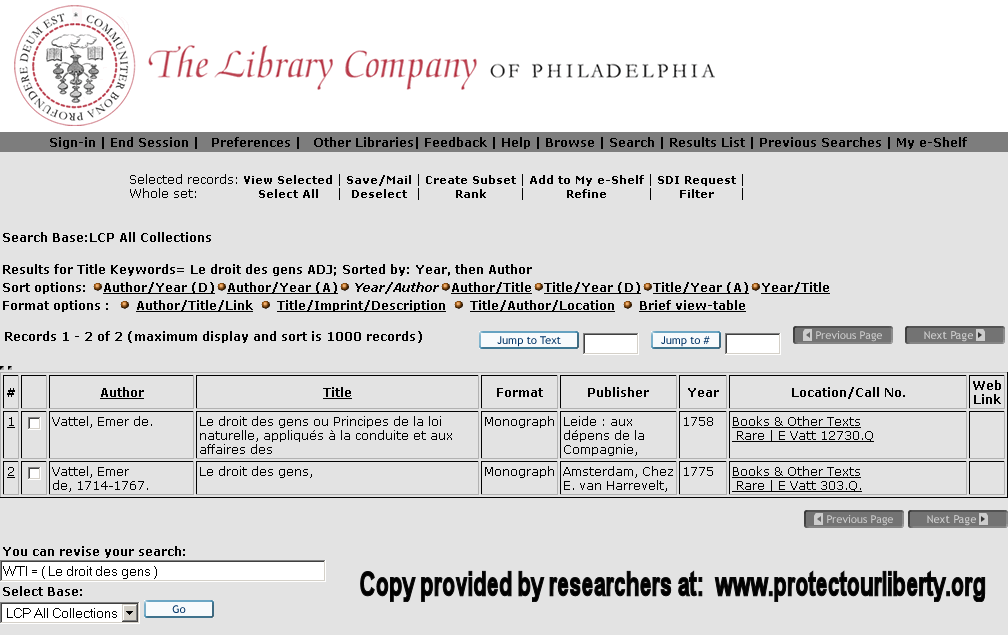
Thomas Jefferson a Founder of our Nation & Influential in Framing our Constitution used his personal copy of 1775 French edition of 'The Law of Nations or Principles of Natural Law' by Vattel

Thomas Jefferson a Founder of Our Nation and Influential in the Framing of Our Constitution used his personal copy of 1775 French edition of "The Law of Nations or Principles of Natural Law by Vattel", newly edited edition by Charles Dumas in 1775, to help write and influence others in the writing of the Founding Documents.

The founders and framers were fluent in French, the diplomatic language of the time, many having served as diplomats to France. Thomas Jefferson used his personal copy of the new 1775 French edition of the Vattel's Law of Nations or Principles of Natural Law to write the Declaration of Independence. He was also very influential in the creation of the U.S. Constitution. Quotations such as "life, liberty, and the pursuit of happiness", "Laws of Nature" and concepts for a new "more perfect" form of government with a written Constitution and independent Judiciary and the sovereignty of the People are right out of Vattel's Law of Nations or Principles of Natural Law. In 1776 Jefferson was tasked with primary responsibility for drafting the Declaration of Independence and if you read it after first reading Vattel's Law of Nations, Volume 1, you can see where he got his inspiration for many of the words and concepts. Jefferson was very influential via his correspondence to the Constitutional Convention in Philadelphia Pa in 1787 and in getting the Bill of Rights added. Read Vattel's Law of Nations, Volume 1 first. Then read the Constitution. We can see in the words of the Constitution the impact of Vattel and the Law of Nations once again in the words therein such as "in order to form a more perfect Union" (perfection of government to serve the people was a prime directive of Vattel). And the title of the book Law of Nations, the preeminent legal treatise of the time, is even mentioned in the Constitution in Article I, Section 8, in the enumerated and limited powers of the new federal republic form of government. The impact of Vattel and Volume 1 of his legal treatise The Law of Nations on his visions for a new form of government on the founders and framers of this nation and its founding documents cannot be overstated. Vattel was the keystone legal source for the new federal government established in 1789 when the new Constitution was ratified, the first of its kind in the world and a beacon of liberty to the rest of the world, with the ratification of the U.S. Constitution.

Jefferson's personal and well annotated in the margins copy of Vattel's Law of Nations or Principles of Natural Law 1775 French edition is now in the possession of the Library of Congress. I suspect that this copy was actually one of the 3 copies sent to Benjamin Franklin by Charles Dumas in 1775. Franklin's personal copy of the 1775 edition was never found in history. We also know that Franklin also had a copy of an earlier edition of Vattel. I suspect he loaned one of the 3 newly received 1775 editions of Vattel to Jefferson for use in the writing of the Declaration of Independence and that is how that copy got to Jefferson. The other two copies of the 1775 edition sent to Franklin ended up with one copy in the Library in Philadelphia for use by the Congress meeting in Philadelphia and the other in library of "College of Massachusetts Bay" in Massachusetts. So maybe I've solved the mystery of what happened to the 3rd copy sent by Dumas, Franklin's personal copy of the 1775 Dumas edition of the Law of Nations or Principles of Natural Law.

Charles Kerchner, Commander USNR (Retired)
Lead Plaintiff, Kerchner v Obama & Congress
http://puzo1.blogspot.com
http://www.protectourliberty.org

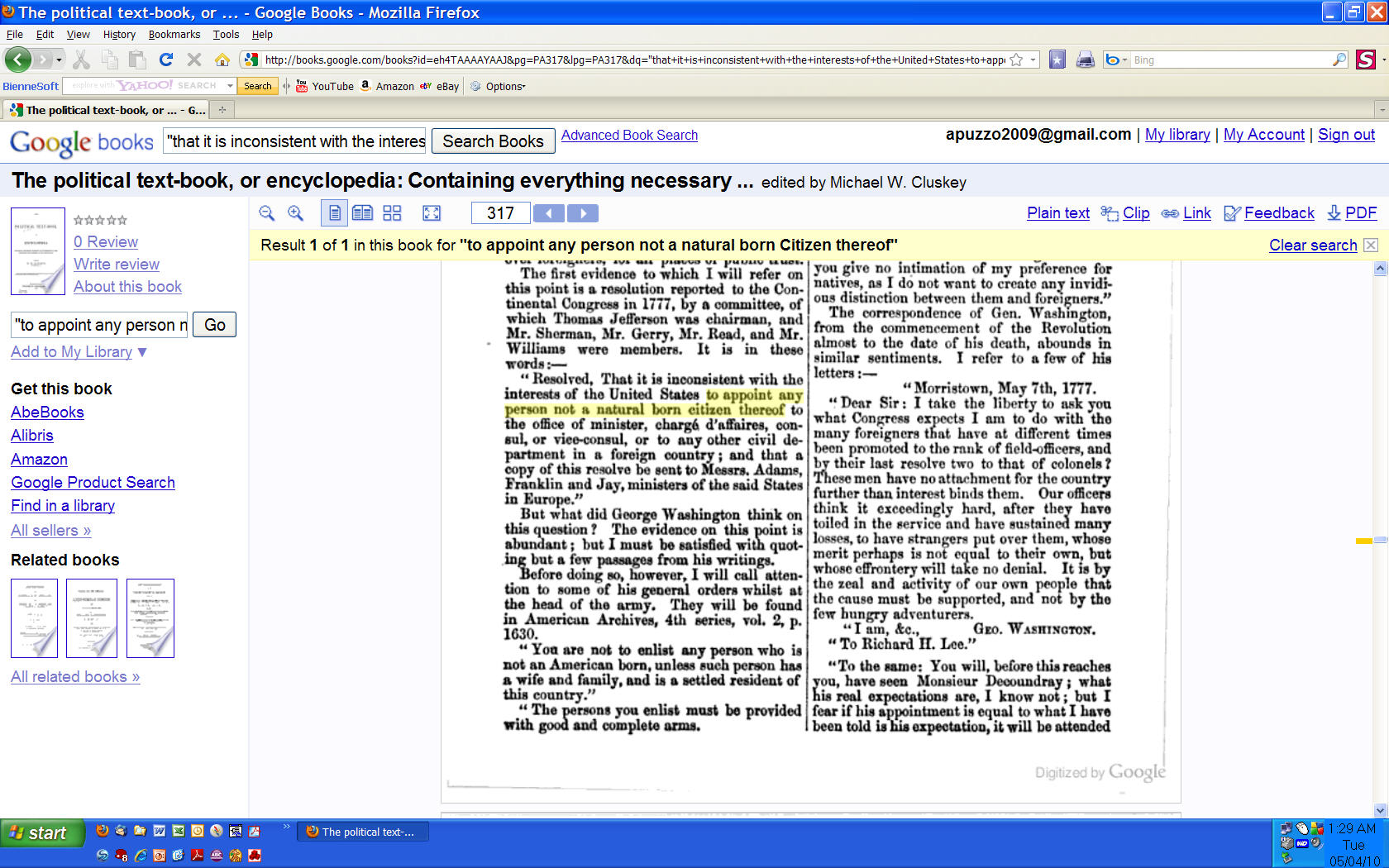
P.S. Thomas Jefferson was one of the first founders that I have found a written record of as using the term "natural born Citizen" in his writings. See this account in 1777.

P.P.S.: See more about the founders and framers use of The Law of Nations or Principles of Natural Law to write the founding documents for our Constitutional Republic in the links below. The legal treatise, The Law of Nations or Principles of Natural Law, known as the Law of Nations for short, clearly defined the term "naturel" or "natural born Citizen" as a person born in the country of parents (plural) who were Citizens of the country:
http://countryfirst.bravehost.com/phpBB3/viewtopic.php?f=105&t=1169

1. Benjamin Franklin in 1775 thanked Charles Dumas of the Netherlands for sending him 3 more copies of the newest 1775 French edition of Vattel's Law of Nations:
http://puzo1.blogspot.com/2010/04/benjamin-franklin-in-1775-thanks.html

2. President George Washington in 1789 consulted Vattel's legal treatise The Law of Nations as America's new President:
http://puzo1.blogspot.com/2010/04/george-washington-consulted-legal.html
####

Wednesday, November 28, 2012

Logic and Defining the "Natural Born Citizen" Clause


                         Logic and Defining the “Natural Born Citizen” Clause

                                              By Mario Apuzzo, Esq.
                                                 November 28, 2012

Father of Logic


I recently posted this comment to Keith at Dr. Conspiracy’s blog called, Obama Conspiracy Theories:

“You said: ‘[S]o he [Wong] was a born citizen and therefore he was a natural born citizen.’ This is so logically fallacious. Have you ever heard of the fallacy of affirming the consequent? First, the clause is ‘natural born Citizen,’ not ‘born Citizen.’ The clause ‘natural born Citizen’ has one and only one definition which is a child born in the country to ‘citizen’ parents. See Minor v. Happersett (1875); U.S. v. Wong Kim Ark (1898). Second, being a born citizen is a necessary condition of being a ‘natural born Citizen.’ It is not a sufficient condition, for the definition also includes birth in the country to citizen parents. Hence, you commit the fallacy of affirming the consequent when you state that if someone is a born citizen he is therefore a ‘natural born Citizen.’"

Then a commentator at Dr. Conspiracy’s blog by the name of dunstvangeet posted this reply to me: “Mario, you talk about logical fallacies. You commit the fallacy of Denying the Antecedent all the time. Your entire argument on Minor is a denial of the Antecedent. If A, then B. Not A. Therefore Not B. If someone is born to two citizen parents and born in the country, then they are a natural born citizen. A is not born to two citizen parents and born in the country, therefore A is not a natural born citizen. Classic case of denying the antecedent. So, you lecturing someone on logical fallacies just broke my irony meter.”

My advice to dunstvangeet which I posted in the same thread is that he should go back to logic school and get his irony meter fixed.

Then on November 27, 2012, Dr. Conspiracy, the owner of the blog, responded to my comment by posting this: “As someone with a graduate degree in mathematics and who has an article published in a scholarly journal on explosions (‘The explosion point characterization theorem’), I hereby issue this affidavit stating: dunstvangeet's comment is a proper application of logical theory to Mr. Apuzzo's comment, and I endorse his conclusion that Apuzzo's reading of the Minor [Minor v. Happersett (1875)] case involves the fallacy of Denial of the Antecedent. Is there a notary in the house?”

So there you have the posture of the question of whether Obama’s supporters and the courts have committed the fallacy of Affirming the Consequent or whether I have committed the fallacy of Denial of the Antecedent. I will now further demonstrate that I have not argued any fallacious position and that on the contrary, it is the Obama supporters who engage in tautological argument and commit the fallacy of Affirming the Consequent. Let us now examine these issues.

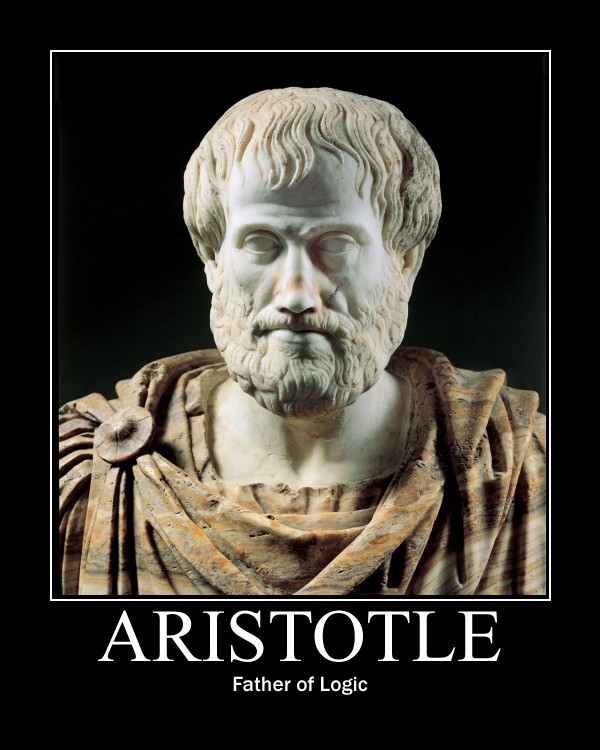
In order to properly analyze the logical question presented here, we have to start with whether there is any settled definition of a “natural born Citizen.” Indeed, there is only one definition of a “natural born Citizen.” That definition is a child born in a country to “citizen” parents. As the reader can see, I have chosen to insert a picture of Aristotle in this article because Aristotle is the Father of Logic. But there is another reason why Aristotle is relevant to this article. Actually, Aristotle also gave us a definition of a “natural born Citizen.” In “Politics, Book Three, Part II, Aristotle, writing in 350 B.C.E., as translated by Benjamin Jowett, gave us his definition of citizenship:

“Part II

But in practice a citizen is defined to be one of whom both the parents are citizens; others insist on going further back; say to two or three or more ancestors. This is a short and practical definition but there are some who raise the further question: How this third or fourth ancestor came to be a citizen? Gorgias of Leontini, partly because he was in a difficulty, partly in irony, said- 'Mortars are what is made by the mortar-makers, and the citizens of Larissa are those who are made by the magistrates; for it is their trade to make Larissaeans.' Yet the question is really simple, for, if according to the definition just given they shared in the government, they were citizens. This is a better definition than the other. For the words, 'born of a father or mother who is a citizen,' cannot possibly apply to the first inhabitants or founders of a state.

There is a greater difficulty in the case of those who have been made citizens after a revolution, as by Cleisthenes at Athens after the expulsion of the tyrants, for he enrolled in tribes many metics, both strangers and slaves. The doubt in these cases is, not who is, but whether he who is ought to be a citizen; and there will still be a furthering the state, whether a certain act is or is not an act of the state; for what ought not to be is what is false. Now, there are some who hold office, and yet ought not to hold office, whom we describe as ruling, but ruling unjustly. And the citizen was defined by the fact of his holding some kind of rule or office- he who holds a judicial or legislative office fulfills our definition of a citizen. It is evident, therefore, that the citizens about whom the doubt has arisen must be called citizens.”

http://classics.mit.edu/Aristotle/politics.html . Here we can see that Aristotle did not define citizenship like the English did in the English common law in which they did not give any relevancy to the citizenship of the child’s parents, provided the parents were not diplomats or military invaders. Aristotle included in the definition of a “citizen” a person “of whom both the parents are citizens.” As we shall see, it is this definition which was handed down through the millennia through the law of nations and which the Founders and Framers adopted for the new republic. We shall also see that Minor v. Happersett (1875) informed that a person who became a citizen by being born in the country to “citizen” parents was know in common law with which the Framers were familiar as a “natural-born citizen.” How do we know that the Founders and Framers looked to Aristotle’s view of citizenship? We learn from the historical record that Supreme Court Justice James Wilson wrote in 1791: “‘Generally speaking,’ says the great political authority, Aristotle, ‘a citizen is one partaking equally of power and of subordination.’ … In Wilson's view, "a citizen of Pennsylvania is he, who has resided in the state two years; and, within that time, has paid a state or county tax: or he is between the ages of twenty one and twenty two years, and the son of a citizen.” James Wilson, 1st commentaries on the Constitution. Here we clearly see Wilson referring to what could only be a “natural born Citizen” as "the son of a citizen."

What the Founders and Framers learned from Greek ancient history was confirmed by Roman ancient history. The Founders and Framers looked to ancient Roman history to learn how best to constitute a republican form of government. They also looked to ancient Roman law to understand the law of nature. Roman law provided: “Lex MENSIA, That a child should be held as a foreigner, if either of the parents was so. But if both parents were Romans and married, children always obtained the rank of the father, (patrem sequuntur liberi, Liv. iv. 4.) and if unmarried, of the mother, Uipian.” Alexander Adam, Roman antiquities: or, An account of the manners and customs of the Romans 210 (6th ed. corrected 1807). Cicero wrote in A Proposal:

“The Colophonians claim Homer as their own free Denizen, the Chians challenge him as theirs, the Salaminians demand him again for their own, but the Smyrneans assert him to be their natural born Citizen; and therefore have also dedicated a Temple to him in their Town of Smyrna. There are a great many besides at Daggers-drawing among themselves, and contend for him.”

A Proposal For Printing in English, The Select Orations of Marcus Tullius Cicero, According to the last Oxford Edition 17 (Henry Eelbeck trans. London 1720).

We also know that the Founders and Framers studied Roman law. The Framers were well read in the Roman and Greek classics as is expounded upon in their writings in the Federalist Papers. Jefferson and other Founders had a love for Roman history and education. The Founders and Framers were great admirers of Cicero and read many of his works. It is not inconceivable that they would have read this English translation of The Proposal and seen the clause “natural born Citizen.” This shows that they did not need to borrow the clause from the English common law’s “natural born subject.” Rather, they had sources which they read which contained the exact clause, “natural born Citizen,” which clause also had its own meaning which was different from that of an English “natural born subject” which allowed children born in the King’s dominion and under his allegiance to aliens to be English “natural born subjects.”

A definition of a “natural born Citizen” was also provided by the world-renowned, Emer de Vattel in his The Law of Nations, Section 212 (London 1797) (1st ed. Neuchatel 1758). Vattel had a great influence on the Founders and Framers in their constituting the new republic and writing the Constitution.  See, for example, J.S. Reeves, The Influence of the Law of Nature Upon International Law in the United States, 3 Am.J. Int’l L. 547 et. seq. passim (1909) (Vattel exerted such a profound political influence that it is often pointed out that his theories served as the backbone for American independence); Lee A. Casey, David B. Rivkin, Jr. and Darin R. Bartram, Unlawful Belligerency and Its Implications Under International Law, http://www.fed-soc.org/publications/PubID.104/pub_detail.asp (concerning U.S. constitutional analysis, “Vattel is highly important. He was probably the international law expert most widely read among the Framers”). In fact, Vattel continued to be practically applied in our nation for well over 100 years after the birth of the republic; F.S. Ruddy, The Acceptance of Vattel, Grotian Society Papers (1972) (Vattel was mainstream political philosophy during the writing of the Constitution. The Law of Nations was significantly the most cited legal source in America jurisprudence between 1789 and 1820). The Founders and Framers studied and were greatly influenced by Vattel. R.G. Natelson, The Original Constitution 49 and 69 (2010) (“Vattel was probably the Founders’ favorite authority on international law . . . .” and his, treatise, The Law of Nations, was their favorite).

“The fourth of the Four Horsemen of American liberty [Algernon Sidney, Samuel von Pufendorf, Jean Jacques Burlamaqui, and Emmerich de Vattel] is Emmerich de Vattel. Although last in this list of forgotten influences, it can be claimed, without exaggeration, that it is Vattel’s interpretations and writings on the subject of the proper constitution of government that was most influential on the Founders of the American Republic. As a matter of fact, Thomas Jefferson, indisputably one of the lead framers of our nation’s government, ranked Vattel’s seminal The Law of Nations, or the Principles of Natural Law as highly as similar treatises by Grotius and Pufendorf. Further proof of Vattel’s impression on the Founders is the fact that Vattel’s interpretations of the law of nature were cited more frequently than any other writer’s on international law in cases heard in the courts of the early United States, and The Law of Nations was the primary textbook on the subject in use in American universities.”

Joe Wolverton, II, Forgotten Influences of the Founders (December 24, 2009), http://www.thenewamerican.com/index.php/history/american/2606-forgotten-influences-of-the-founders .

One more source among many more deserves to be cited to show the authority that Vattel carried with the Founders and Framers on matters of citizenship. During the 1789 Ramsay-Smith congressional debate on whether Representative William Smith was at least a “Citizen of the United States” for seven-years so as to be eligible to be a representative under Article I, Section 2, Smith relied upon Vattel to show that he was such a “citizen.” Smith argued that he was a “citizen.” Smith did not refer to the English common law to show that he was a “citizen of the United States” for the requisite 7 years. Rather, he cited Emer de Vattel for support and said he did not have enough money to come back to America. In his own defense William Smith quotes Emer de Vattel:

“The Doctor [Ramsay] says the circumstances of birth do not make a citizen–This I also deny. Vattel says: 'The country of the father is that of the children and these become citizens by their tacit consent.' I was born a Carolinian [before the Declaration], and I defy the Doctor to say at what moment I was disenfranchised. The revolution which took place in America made me a citizen, though then resident at Geneva…. There was never a moment when I was a citizen of any other country.”

So we can see that William Smith, during a debate on the floor of the House of Representatives in 1789, cited Emer de Vattel in defense of his own citizenship to show that he was eligible to be a Representative of the United States under our Constitution.

Smith said that Vattel said: "The country of the father is that of the children and these become citizens by their tacit consent." Madison said: "Mr. Smith founds his claim upon his birthright; his ancestors were among the first settlers of that colony." The case for Vattel's "citizen" was clearly made. Smith, in defining his own citizenship did not mention the English common law, but rather looked to Vattel and the law of nations.

Having shown the influence that Vattel had over the Founders and Framers on matters of citizenship, let us now examine what Vattel wrote regarding a “citizen” and a “natural born Citizen.” Here is the full text of Vattel’s Section 212:

“The citizens are the members of the civil society: bound to this society by certain duties, and subject to its authority, they equally participate in its advantages. The natives, or natural-born citizens, are those born in the country, of parents who are citizens. As the society cannot exist and perpetuate itself otherwise than by the children of the citizens, those children naturally follow the condition of their fathers, and succeed to all their rights. The society is supposed to desire this, in consequence of what it owes to its own preservation; and it is presumed, as matter of course, that each citizen, on entering into society, reserves to his children the right of becoming members of it. The country of the fathers is therefore that of the children; and these become true citizens merely by their tacit consent. We shall soon see, whether, on their coming to the years of discretion, they may renounce their right, and what they owe to the society in which they were born. I say, that, in order to be of the country, it is necessary that a person be born of a father who is a citizen; for if he is born there of a foreigner, it will be only the place of his birth, and not his country.”

Indeed, Vattel defined a “citizen” as simply a member of civil society. He then said that “[t]he natives, or natural-born citizens, are those born in the country, of parents who are citizens.” There is little doubt that in this statement Vattel confirmed the definition of a “natural born Citizen” and told us what a “natural-born citizen” was, saying that the “natural-born citizens, are . . .” Hence, he did not only provide a situation among many which defined a “natural-born citizen.” Rather, providing the only definition of the clause, he provided the sufficient and necessary conditions to be met in order for one to be a “natural-born citizen.”

Historical and legal evidence demonstrates that the Founders and Framers adopted this ancient definition as the only definition of a “natural born Citizen.” First, the Founders and Framers put forth in Article II, Section 1, Clause 5 presidential eligibility requirement. The clause reads: “No person except a natural born Citizen, or a Citizen of the United States, at the time of the Adoption of this Constitution shall be eligible to the Office of President; neither shall any person be eligible to that Office who shall not have attained to the Age of thirty five Years, and been fourteen Years a resident within the United States.” Like they made a bright line rule as to 35 years of age and 14 years residency, they did the same with the definition of a “natural born Citizen.” There is no evidence in the historical record that has come to light which suggests that the Founders and Framers did not agree on what the definition of a “natural born Citizen” was or that someone during the drafting and ratifying conventions took issue with the then existing definition. The Founders and Framers simply would not have used a clause in the Constitution for presidential eligibility purposes the meaning of which was not settled and not debated that meaning during those constitutional conventions. It is therefore absurd to think that there were other hidden definitions of the “natural born Citizen” clause which were yet to be discovered and confirmed in the future or that there could be other persons who could also be “natural born Citizens” but about whom there were doubts whether they were.

Second, there are various U.S. Supreme Court decisions which cited and quoted or paraphrased Vattel and his definition of a “natural-born citizen” and therefore recognized a “natural born Citizen” to be a child born in the country to “citizen” parents. For example, see The Venus, 12 U.S. 8 Cranch 253, 289 (1814) (C.J. Marshall concurring) (Founder Chief Justice John Marshall, concurring and dissenting for other reasons in a prize case the resolution of which depended upon the citizenship status of the parties, cited Vattel and provided his definition of natural born citizens and said: “Vattel, who, though not very full to this point, is more explicit and more satisfactory on it than any other whose work has fallen into my hands, says ‘The citizens are the members of the civil society; bound to this society by certain duties, and subject to its authority, they equally participate in its advantages. The natives or indigenes are those born in the country of parents who are citizens. Society not being able to subsist and to perpetuate itself but by the children of the citizens, those children naturally follow the condition of their fathers, and succeed to all their rights.’”); Inglis v. Sailors’ Snug Harbor, 28 U.S. 99 (1830) (held that a child born in the United States inherits the citizenship of his parents); Shanks v. Dupont, 28 U.S. 242, 245, 252 (1830) (providing the same Vattelian definition without citing Vattel, Justice Story stated: “If she was not of age, then she might well be deemed under the circumstances of this case to hold the citizenship of her father, for children born in a country, continuing while under age in the family of the father, partake of his national character as a citizen of that country.” Justice Story in Shanks confirmed the common law maxim that existed in the colonies and during the Founding. That maxim was “partus sequitur patrem” or children follow the condition of their father. “Partus” is defined as “child” or “offspring.” Black’s Law Dictionary 1010 (5th ed. 1979). “Sequitur means to follow. “Patrem” means father. Justice Johnson in his dissent in Shanks further confirmed it when he explained that a “leading maxim[] of common law” then prevailing was “proles sequitur sortem paternam.” “Proles” is defined as [o]ffspring; progeny; the issue of a lawful marriage. In its enlarged sense, it signifies any children.” Black’s Law Dictionary 1091 (5th ed. 1979). Hence, the maxim means children follow the condition of their fathers); Minor v. Happersett, 88 U.S. 162, 167-68 (1875) (the unanimous U.S. Supreme Court paraphrased Vattel almost word for word when defining a “natural-born citizen” thus: “At common-law, with the nomenclature of which the framers of the Constitution were familiar, it was never doubted that all children born in a country of parents who were its citizens became themselves, upon their birth, citizens also. These were natives or natural-born citizens, as distinguished from aliens or foreigners.” Id. at 167-68); Ex parte Reynolds, 20 F.Cas. 582, 5 Dill. 394, No. 11,719 (C.C.W.D.Ark 1879) (cited and quoted Vattel’s definition of a “natural-born citizen”); United States v. Ward, 42 F.320 (C.C.S.D.Cal. 1890) (same); and U.S. v. Wong Kim Ark, 169 U.S. 649, 708 (1898) (cited, quoted, and affirmed Minor’s definition of a “natural-born citizen” and held that a child born in the United States to domiciled and resident alien parents was a “citizen of the United States” from the moment of birth under the Fourteenth Amendment). There has never been any other definition of a “natural born Citizen” articulated by our U.S. Supreme Court, from the early years of the republic down to the present. The same definition of a “natural born Citizen” has been repeated many times by our U.S. Supreme Court. Hence, this one definition can be the only one that the Founders and Framers used. So, there has never been any other definitions or classes of “natural born Citizens.” With a “natural born Citizen” having only one definition and therefore containing no subsets, it cannot by analogy be compared to animals, plants, or automobiles which each contain many subsets.

From these historical and legal developments, we can express the one and only definition of a “natural born Citizen” thus:

If and only if A is born in the country to citizen parents, then A is a "natural born Citizen."

Or

If A is a "natural born Citizen," then A is born in the country to citizen parents.

Neither of these statements commits what dunstvangeet and Dr. Conspiracy call the fallacy of Denying the Antecedent, for being born in the country to citizen parents are not only sufficient or necessary conditions, but both sufficient and necessary conditions. They are sufficient because if both exist, then one is a “natural born Citizen.” And they are necessary because if one or both conditions do not exist, one cannot be a “natural born Citizen.” The logical error that Obama’s supporters like dunstvangeet and Dr. Conspiracy commit is in not giving the “natural born Citizen” clause a specified and limited meaning. They want to treat a “natural born Citizen” like they would treat animals, plants, and automobiles. Yes, we can agree that the following represents the fallacy of Denying the Antecedent: If Bill owns a dog, he owns an animal. Bill does not own a dog, therefore Bill does not have an animal. The argument is fallacious because Bill could own a cat which is also an animal. But the problem with this simplistic approach is that there is not more than one class of “natural born Citizens” like there is animals which break up into subsets called dogs, cats, horses, cows, pigs, etc. As we have seen, the clause “natural born Citizen” has only one definition. Hence, the factors found in that definition which go to define the clause become both sufficient and necessary. A finding that one’s birth circumstances is missing any one of the necessary constituent factors, i.e., birth in the country or birth to “citizen” parents, is a sufficient basis for us to validly conclude that one is not a “natural born Citizen.” The logical error that Obama’s supporters like dunstvangeet and Dr. Conspiracy commit is in not realizing that because the “natural born Citizen” clause has only one definition, when we say that if a person is born in the country to “citizen” parents, that person is a “natural born Citizen,” we are really saying “if and only if” (expressed as “iff” in logic, and not just “if”) that person is born in the country to “citizen” parents, that person is a “natural born Citizen.”

Now let us examine how Obama’s supporters, in arguing that Obama is a “natural born Citizen,” arrive at their conclusion by way of tautology and the fallacy of Affirming the Consequent. Jack Maskell, in 2011 wrote a CRS memo entitled, “Qualifications for President and the ‘Natural Born’ Citizenship Eligibility Requirement, Jack Maskell, Congressional Research Service, November 2011, which can be read at http://www.fas.org/sgp/crs/misc/R42097.pdf . Mr. Maskell concludes that a "natural born Citizen" is any person who, under the Fourteenth Amendment or any Congressional Act, becomes a “citizen of the United States” "at birth." A handful of courts that have reached the merits of the meaning of a “natural born Citizen” and whether President Barack Obama meets that definition have adopted Mr. Maskell’s thesis and ruled that any child born in the United States who is a “citizen of the United States” under the Fourteenth Amendment is a “natural born Citizen,” regardless of the citizenship of the parents, simply because such a child is a “born citizen,” “citizen at birth,” or “citizen from birth.” But upon close scrutiny, we can see that there are some grave legal and logical problems with such a simplistic argument.

First, the argument that a “natural born Citizen” is any child that is a “born citizen” is a tautology. The argument is nothing but a repetition of part of the clause we are defining, “natural born Citizen,” with the word “natural” left out in order to make it look like one has actually unlocked some secret to defining the clause and provided a definition of the whole clause. But the definition provided, “born citizen,” or its equivalent, “citizen at birth” or “citizen from birth,” add absolutely no information to defining “natural born Citizen.” Of course, a “natural born Citizen” is a “born citizen,” or “citizen at birth,” or “citizen from birth.” The clause itself tells us that a “natural born Citizen” could not be one who is a citizen not from birth. But simply acknowledging the moment in time at which a “natural born Citizen” comes into being does not provide any definition of the clause, for the statement does not identify what conditions must be satisfied in order for such a person to be a citizen from the moment of birth. So, the Founders and Framers could not have had such a tautological statement in mind as the definition of a “natural born Citizen.” They had to have had a definition in mind that contained real conditions which when satisfied made one a “natural born Citizen.” We have seen above that that definition was a child born in the country to “citizen” parents.

Second, Mr. Maskell and the courts, like Keith, not only engage in reasoning that is tautological, but also commit the fallacy of Affirming the Consequent. dunstvangeet and Dr. Conspiracy did not address my argument concerning Keith committing the Fallacy of Affirming the Consequent. Let us examine this fallacy and how it is found in the argument that, Obama is a “natural born Citizen” because he is a U.S. “citizen” “at birth.” In the correct application and understanding of the statement: If one is a “natural born Citizen,” then one is a “citizen at birth,” the condition of being a “citizen at birth” is only a necessary consequence of being a “natural born Citizen.” “Citizen at birth” is not a factor which alone makes one a “natural born Citizen.” Being the necessary consequence of being a “natural born Citizen,” it is not a sufficient condition for becoming a “natural born Citizen,” for we have seen that what is also necessary is birth in the country to “citizen” parents which are the necessary conditions which produce the consequence of being a “citizen at birth.” So, to simply say that all those who are born in the United States and who are “born citizens,” “citizens at birth,” or “citizens from birth” are “natural born Citizens” is not only a tautology, but is also a case of the fallacy of affirming the consequent.

To further illustrate this, we can agree what champagne is. Champagne is defined as a sparkling wine produced from grapes that are grown in the Champagne region of France by using certain fermentation rules. Now let us go from this definition to this true statement: If wine is Champagne, then it was “made from grapes grown in the Champagne region of France.” Now let us assume that someone comes along and wants to prove that his sparkling wine is Champagne. He argues that his wine must be Champagne because it was “made from grapes grown in the Champagne region of France.” We scientifically examine his claim and learn that the sparkling wine was “made from grapes grown in the Champagne region of France,” but the producer did not use certain fermentation rules. Actually, “[s]ome use the term champagne as a generic term for sparkling wine, but many countries reserve the term exclusively for sparkling wines that come from Champagne and are produced under the rules of the appellation (footnotes omitted). http://en.wikipedia.org/wiki/Champagne . Did you see that? The wine must also be made under rules of the appellation which is an additional necessary factor to be satisfied in order for any given wine to be Champagne. We must therefore reasonably conclude that the wine is in fact not Champagne because the producer did not use certain fermentation rules which are a requirement to be met if the wine is to be Champagne. So, even though our person’s sparkling wine was “made from grapes grown in the Champagne region of France,” his wine was still not Champagne. That is because having a sparkling wine “made from grapes grown in the Champagne region of France” is a necessary consequence of producing Champagne wine, but it is not a sufficient condition for its creation, for the wine maker must also use certain fermentation rules. So, likewise, being a “born citizen,” or “citizen at birth” or “citizen from birth,” is only a necessary consequence of being a “natural born Citizen,” but it is not a sufficient condition for that type of citizen’s creation, for the age-old definition of the clause also requires birth in the country to “citizen” parents.

From this logical reasoning we conclude that even though Barack Obama may have been born in Hawaii, a fact which he has not yet conclusively proven, which would make him under the Fourteenth Amendment a “born Citizen,” or a “citizen at birth,” or a “citizen from birth,” he is still not a “natural born Citizen” because he was not born to “citizen” parents, meaning a U.S. “citizen” father and mother, which is what the American common law definition requires. And not being an Article II “natural born Citizen,” he is not eligible to be President and Commander in Chief of the Military.

For a more in-depth analysis of the meaning of a “natural born Citizen” and explanation of how the clause was defined under the law of nations and American common law rather than English common law, see Mario Apuzzo, “Barack Obama Is Ineligible to be President, For He Is Neither a ‘Natural Born Citizen’ Nor a ‘Citizen of the United States, at the time of the Adoption of this Constitution,’” accessed at http://puzo1.blogspot.com/2012/10/barack-obama-is-ineligible-to-be.html .

For an explanation of how the fallacy of Affirming the Consequent was recently used by the Vermont Superior Court to dismiss the Vermont ballot challenge of H. Brooke Paige v. Barack Obama, see Mario Apuzzo, “The Vermont Court Errs in Dismissing Presidential Ballot Challenge H. Brooke Paige v. Barack Obama, accessed at http://puzo1.blogspot.com/2012/11/the-vermont-court-errs-in-dismissing.html .

Mario Apuzzo, Esq.
November 28, 2012
http://puzo1.blogspot.com
####

Copyright © 2012
Mario Apuzzo, Esq.
All Rights Reserved


Monday, November 2, 2009

Vattel Asked for History to Be His Judge

It was Emer de Vattel in his, The Law of Nations, Or Principles of the Law of Nature (1758 French edition) (1760 first English edition), who defined for the Framers what an Article II "natural born Citizen" is. It was Vattel, who stated in Section 212: "The citizens are the members of the civil society: bound to this society by certain duties, and subject to its authority, they equally participate in its advantages. The natives, or natural-born citizens, are those born in the country, of parents who are citizens. . . ." Vattel, Section 212 (1797 London edition)(and as translated by the United States Supreme Court in Minor v. Happersett, 88 U.S. 162, 167-68 (1875) (repeating Vattel's definition without citing him); The Venus, 12 U.S. (8 Cranch) 253, 289 (1814) (Marshall, C.J., concurring) (cites Vattel’s definition of "natives or indigenes" which is later translated to "natives or natural born citizens"); Shanks v. Dupont, 28 U.S. 242, 245 (1830) (same definition without citing Vattel); Ex parte Reynolds, 1879, 5 Dill., 394, 402 (repeating Vattel's definition and stating in referring to his definition: "The law of nations, which becomes, when applicable to an existing condition of affairs in a country, a part of the common law of that country, declares the same rule. . . This law of nature, as far as it has become a part of the common law, in the absence of any positive enactment on the subject, must be the rule in this case. . . ."); United States v. Ward, 42 F.320 (C.C.S.D.Cal. 1890) (citing and quoting the same Ex parte Reynolds references to natural law, the law of nations, and Vattel); U.S. v. Wong Kim Ark, 169 U.S. 649 (1898) (citing and quoting Minor and its recitation of Vattel's definition of "citizen" and "natural born citizen").

Rep. John Bingham, in the House on March 9, 1866, in commenting on the Civil Rights Act of 1866 which was the precursor to the Fourteenth Amendment, repeated Vattel's definition when he said: "[I] find no fault with the introductory clause, which is simply declaratory of what is written in the Constitution, that every human being born within the jurisdiction of the United States of parents not owing allegiance to any foreign sovereignty is, in the language of your Constitution itself, a natural born citizen. . . . ” John A. Bingham, (R-Ohio) US Congressman, March 9, 1866 Cong. Globe, 39th, 1st Sess., 1291 (1866), Sec. 1992 of U.S. Revised Statutes (1866).

Obama fails to meet Article II's “natural born Citizen” eligibility test because when he was born in 1961 (where ever that may be), he was not born to a United States citizen mother and father. At his birth, his mother was an United States citizen. But under the British Nationality Act of 1948, his father, who was born in the British colony of Kenya, was born a Citizen of the United Kingdom and Colonies (CUKC) which by descent made Obama himself a CUKC. Prior to Obama’s birth, Obama’s father neither intended to nor did he become a United States citizen. Being temporarily in the United States only for purpose of study and with the intent to return to Kenya, his father did not intend to nor did he become even a legal resident or immigrant to the United States.

At best, Obama may be a plain born “citizen of the United States” under the 14th Amendment (if he was born in Hawaii). But he is not an Article II "natural born Citizen," for upon Obama's birth his father was a British subject and Obama himself by descent was also the same. Hence, Obama was born subject to a foreign power. Obama lacks the birth status of natural sole and absolute allegiance and loyalty to the United States which only the President and Commander in Chief of the Military and Vice President must have at the time of birth. Being born subject to a foreign power, he lacks Unity of Citizenship and Allegiance to the United States from the time of birth which assures that required degree of natural sole and absolute birth allegiance and loyalty to the United States, a trait that is constitutionally indispensable in a President and Commander in Chief of the Military. Like a naturalized citizen, who despite taking an oath later in life to having sole allegiance to the United States cannot be President because of being born subject to a foreign power, Obama too cannot be President.

Our nation is now debating what a “natural born Citizen” is and whether Obama meets that definition which would make him eligible to be President and Commander in Chief of the Military. We have seen above that, even if he was born in Hawaii, he does not meet that test and is therefore not eligible for the Office of President. Concerned citizens asked Obama to clear this matter up but he has refused all such requests and rather litigated at great expense against the interest of the nation that he is suppose to represent. These concerned citizens then asked both Congress and the Judiciary to resolve the debate. But neither of these two branches of government has so far wanted to get involved. What else are the people to do to have their grievances brought to justice and heard?

Whatever the outcome of the debate, Vattel expressed his sentiments perfectly. I want to share with you what he wrote in the Preface to his 1758 first edition which he wrote in French:

"As to the rest, I have, both in these examples and in my reasonings studiously endeavoured to avoid giving offence; it being my intention religiously to observe the respect due to nations and sovereign powers: but I have made it a still more sacred rule to respect the truth, and the interests of the human race. If among the base flatterers of despotic power, my principles meet with opponents, I shall have on my side the virtuous man, the friend of the laws, the man of probity, and the true citizen.

I should prefer the alternative of total silence, were I not at liberty in my writings to obey the dictates of my conscience. By my pen lies under no restraint, and I am incapable of prostituting it to flattery. I was born in a country of which liberty is the soul, the treasure, and the fundamental law; and my birth qualifies me to be the friend of all nations. These favourable circumstances have encouraged me in the attempt to render myself useful to mankind by this work. I felt conscious of my deficiency in knowledge and abilities: I saw that I was undertaking an arduous task; but I shall rest satisfied if that class of readers whose opinions are entitled to respect, discover in my labours the traces of the honest man and the good citizen." http://www.constitution.org/vattel/vattel-01.htm

Indeed, Vattel wrote with a clear conscience and pure purpose and asked for history to be his judge.

Mario Apuzzo, Esq.
185 Gatzmer Avenue
Jamesburg, New Jersey 08831
http://puzo1.blogspot.com/
November 2, 2009

Monday, April 26, 2010

Benjamin Franklin in 1775 thanks Charles Dumas of the Netherlands for sending him 3 more copies of the newest 1775 edition of Vattel's Law of Nations

Another founder of our nation and framer of our Constitution, Benjamin Franklin, was also quite familiar and well versed with the writings of Vattel. He had his own personal copy prior to the advent of the Revolution. And in 1775 he wrote to Charles Dumas an editor and journalist in the Netherlands and thanked him for sending Franklin 3 copies of the newest edition of Vattel (published in French). Franklin commented to Dumas that his personal copy was in heavy demand by the other delegates to the Continental Congress meeting in 1775. Dumas was the Editor for the newly published 1775 edition of Vattel's Law of Nations (in the original French) in the Netherlands. Franklin and most of the founders were fluent in French which was the diplomatic language of that time. Dumas also made comments in his writings to Franklin about Vattel's enlightened writings and vision for a new form of government for a nation where the people were sovereign and the unique opportunity for its application to the affairs in America in the colonies splitting from Great Britain. The words found in our Declaration of Independence mentioning the "Laws of Nature" and the phrase mentioning unalienable rights such as "life, liberty, and pursuit of happiness" are right out of Volume 1 of Vattel. As are the words of seeking a more perfect union in the Preamble of our Constitution were also inspired by the teachings and writings of Vattel who wrote that government should always be striving to perfect itself to better serve the people. Thus it is quite evident that the founders read and used Vattel extensively. Here is a reprint of the letter from Franklin to Dumas thanking him for sending the books.

Benjamin Franklin to: Charles William Frederic Dumas
-----------------------------------------------------------------------

Dear Sir,
Philadelphia, 9 December, 1775.
I received your several favors, of May 18th, June 30th, and July 8th, by Messrs. Vaillant and Pochard;(1) whom if I could serve upon your recommendation, it would give me great pleasure. Their total want of English is at present an obstruction to their getting any employment among us; but I hope they will soon obtain some knowledge of it. This is a good country for artificers or farmers; but gentlemen of mere science in les belles lettres cannot so easily subsist here, there being little demand for their assistance among an industrious people, who, as yet, have not much leisure for studies of that kind.
I am much obliged by the kind present you have made us of your edition of Vattel. It came to us in good season, when the circumstances of a rising state make it necessary frequently to consult the law of nations. Accordingly that copy, which I kept, (after depositing one in our own public library here, and sending the other to the College of Massachusetts Bay, as you directed,) has been continually in the hands of the members of our Congress, now sitting, who are much pleased with your notes and preface, and have entertained a high and just esteem for their author. Your manuscript "Idee sur le Gouvernement et la Royaute" is also well relished, and may, in time, have its effect. I thank you, likewise, for the other smaller pieces, which accompanied Vattel. "Le court Expose de ce qui s'est passe entre la Cour Britannique et les Colonies," bc. being a very concise and clear statement of facts, will be reprinted here for the use of our new friends in Canada. The translations of the proceedings of our Congress are very acceptable. I send you herewith what of them has been farther published here, together with a few newspapers, containing accounts of some of the successes Providence has favored us with. We are threatened from England with a very powerful force, to come next year against us.(2) We are making all the provision in our power here to oppose that force, and we hope we shall be able to defend ourselves. But, as the events of war are always uncertain, possibly, after another campaign, we may find it necessary to ask the aid of some foreign power.
------------------------------------------------------------------------

Source: http://etext.lib.virginia.edu/etcbin/toccer-new2?id=DelVol02.xml&images=images/modeng&data=/texts/english/modeng/parsed&tag=public&part=459&division=div1

CDR Charles Kerchner
http://puzo1.blogspot.com
http://www.protectourliberty.org
####

P.S. President George Washington in 1789 consulted Vattel's legal treatise The Law of Nations as America's new President:
http://puzo1.blogspot.com/2010/04/george-washington-consulted-legal.html

P.P.S. The legal treatise, The Law of Nations or Principles of Natural Law, known as the Law of Nations for short, defined the term "naturel" or "natural born Citizen" as a person born in the country of parents (plural) who were Citizens of the country:
http://countryfirst.bravehost.com/phpBB3/viewtopic.php?f=105&t=1169

P.P.P.S. Thomas Jefferson also used Vattel's The Law of Nations to write the founding documents.
####

Tuesday, November 2, 2010

The Framers Used Emer de Vattel, Not William Blackstone to Define a “Natural Born Citizen”

The Framers Used Emer de Vattel, Not William
Blackstone to Define a “Natural Born Citizen”

by: Mario Apuzzo, Esq.

The question which has gripped our nation is whether Barack Obama is eligible to be President and Commander in Chief. Article II, Section 1, Clause 5 provides that: “No Person except a natural born Citizen, or a Citizen of the United States, at the time of the Adoption of this Constitution, shall be eligible to the Office of President; neither shall any person be eligible to that Office who shall not have attained to the Age of thirty five Years, and been fourteen Years a Resident within the United States.” The proper question under this clause is not whether Obama is a “Citizen of the United States.” Rather, the correct question is whether Obama is a “natural born Citizen” thereunder.

"It cannot be presumed that any clause in the constitution is intended to be without effect, and therefore such construction is inadmissible unless the words require it….” Marbury v. Madison. 5 U.S. 137, 174 (1803). In other words, the “natural born Citizen” clause of Article II must be given independent effect from the “citizen of the United States” clause of Article II itself and of the Fourteenth Amendment. All Presidents must qualify as Article II “natural born Citizens,” not as Fourteenth Amendment “citizens of the United States.” The two clauses have different and distinct meanings or they would not have their own independent life in the Constitution. Article II says “natural born Citizen” and the Fourteenth Amendment says “citizen of the United States.” If being a “citizen of the United States” had the same exact effect as being a “natural born citizen,” then the “natural born Citizen” clause would have no effect. Such a construction is not admissible. If we were not to give special meaning to the words “natural born” and conclude that “natural born Citizen” and “citizen of the United States” mean the same thing, the words “natural born” in the “natural born Citizen” clause of Article II would be superfluous. Our Supreme Court has consistently expressed "a deep reluctance to interpret a statutory provision so as to render superfluous other provisions in the same enactment." Pennsylvania Department of Public Welfare v. Davenport, 495 U.S. 552, 110 S.Ct. 2126, 2133, 109 L.Ed.2d 588 (1990); International Union, United Automobile, Aerospace and Agricultural Implement Workers of America, Uaw v. Johnson Controls, Inc, 499 U.S. 187, 111 S.Ct. 1196, 1204, 113 L.Ed.2d 158 (1991) . Hence, we have to give special meaning to the words “natural born.”

As so many scholars and commentators have asked, what does “natural born Citizen” mean? Why did the Framers distinguish in Article II between a “citizen of the United States” and a “natural born Citizen?” The Founders trusted the occupancy of the Office of President to those born on or inhabiting the soil of or to those who naturalized in the Colonies or new States, all of whom belonged to the original citizen class because, even though they were born subject to a foreign power, they had evidenced their loyalty and attachment to the United States by fighting for the American cause in the Revolution. Also, for those born “natural born subjects” of the British Crown, through the Treaty of Peace of 1783, England absolved its subjects of the natural allegiance that they owed to it. But the Founders knew that there would be other foreigners coming to live in America in the future. The allegiance and loyalty of these future foreigners would not have been tested or even absolved in some manner as had occurred under the Treaty of Peace of 1783. The Founders feared foreign influence infecting the administration of the government. It was the fear of foreign influence invading the Office of Commander in Chief of the military that prompted John Jay, our first U.S. Supreme Court Chief Justice, to write to General George Washington the following letter dated July 25, 1787: “Permit me to hint, whether it would be wise and seasonable to provide a strong check to the admission of Foreigners into the administration of our national Government; and to declare expressly that the Commander in Chief of the American army shall not be given to nor devolve on, any but a natural born Citizen” (underlying in the original). Note that Jay wanted a “strong” check that would prevent a foreigner from becoming the Commander in Chief. Hence, any definition of “natural born Citizen” must provide our nation with the strongest check possible on foreign influence invading the Office of President and Commander in Chief of the Military. The Framers found the definition of “natural born Citizen” that would suit their purpose of protecting the future of and preserving the new nation not in the English common law and William Blackstone but in natural law and the law of nations as commented upon by Emer de Vattel, in his treatise, The Law of Nations, or Principles of the Laws of Nature, Applied to the Conduct and Affairs of Nations and Sovereigns, bk. 1, c. 19, sec. 212 (original French in 1758 and first English in 1759). This law became American common law. See my article entitled, 'The Law of Nations or Principles of Natural Law' as U.S. Federal Common Law Not English Common Law Define What an Article II Natural Born Citizen Is, found at http://puzo1.blogspot.com/2009/08/law-of-nations-and-not-english-common.html.

As James Brown Scott has correctly stated: "It is therefore to be expected that, when terms of municipal law are found in the Constitution, they are to be understood in the sense in which they were used in Blackstone's Commentaries; and when the law of nations is referred to, that its principles are to be understood in the sense in which Vattel defined them." James Brown Scott, The United States of America: A Study in International Organizations 439 (1920). There is little doubt that citizenship properly falls under the law of nations which became U.S. national law and not under the rules of municipal law. Citizenship has always been recognized as a topic that affects United States relations with other nations. On the question of national citizenship, Lynch v. Clarke, 1 Sand. Ch. 583, 3 N.Y. Leg. Obs. 236, 244 (1844), http://books.google.com/books?id=ERgvAAAAIAAJ&pg=PA251&dq=%22Natural+born+citizen%22#v=onepage&q=%22Natural%20born%20citizen%22&f=false (whose finding that Julia Lynch, born in New York to “alien parents, during their temporary sojourn” there, was a citizen of the United States, was in effect overruled by a 1860 New York state statute which provided at Sec. 5 that “[t]he citizens of the state are: 1. All persons born in this state and domiciled within it, except the children of transient aliens and of alien public ministers and consuls”), stated that how we define citizenship "has an essential bearing in our intercourse with other nations and the privileges conceded by them to our citizens; is therefore, not a matter of mere state concern. It is necessarily a national right and character. It appertains to us, not in respect to the State of New York, but in respect of the United States. . . ." Given that citizenship affects "the behavior of nation states with each other," Sosa v. Alvarez-Machain, 542 U.S. 692 (2004), the Founders would have looked to the law of nations to define it for the needs of the new nation. Clearly, citizenship is both a national and international matter which affects the relations among nations. The Founders and Framers would have looked to the law of nations to define citizenship in the new nation and not the English common law.

The Founders and Framers relied upon Cicero, Grotius, Pufendorf, Locke, and Emer de Vattel (to name a few) in identifying and describing natural law and the law of nations. But they mostly looked to Emer de Vattel and his treatise, The Law of Nations, or Principles of the Laws of Nature, Applied to the Conduct and Affairs of Nations and Sovereigns, bk. 1, c. 19, sec. 212 (original French in 1758 and first English in 1759, and other subsequent French and English editions for not only authority on the meaning of natural law and the law of nations but also in constituting the new Constitutional Republic and in writing the new Constitution. The 1759 (aka 1760) edition was published in London in English. An explanation of the various editions is provided by Colonial Society of Massachusetts, Publications of the Colonial Society of Massachusetts, Volume 20 (A. Matthews ed. 1920). http://books.google.com/books?id=svE7AAAAIAAJ&pg=PA5&dq=benjamin+franklin+vattel&ei=W-yPStrRNaf4ygS12bC3Bw#v=onepage&q=benjamin%20franklin%20vattel&f=false

Vattel clearly distinguished between “citizens” (“citoyens” in French) and “naturals” (“naturels” in French). His title for Section 212 is “Des citoyens et naturels” (“Of citizens and naturals” which the English translators called "Of the citizens and natives"). He referred to the “citoyens” who were translated to “citizens” and “naturels” who were later translated to “natural-born citizens.” The “naturels” were the children of the “citoyens.” He therefore saw that there is a difference between the two types of citizens. He explained that difference thus: “The citizens are the members of the civil society: bound to this society by certain duties, and subject to its authority, they equally participate in its advantages. The natives, or indigenes, are those born in the country of parents who are citizens”. Id. bk. 1, c. 19, sec. 212. In the 1797 English edition, the translator replaced the word “indigenes” with “natural-born citizens.” Hence, it read: “The citizens are the members of the civil society: bound to this society by certain duties, and subject to its authority, they equally participate in its advantages. The natives, or natural-born citizens, are those born in the country, of parents who are citizens.” Hence, while the definition of a “natural born citizen” never changed in Vattel’s texts, the term to express it was changed from “indigenes” to “natural-born citizens.” That the French word "naturels" was understood by the founders and framers to mean "natural born" prior to the writing of the Constitution and prior to the second English translation of Vattel's Law of Nations in 1797 is confirmed by the record of the Journal of the Continental Congress is 1781. Thus in 1787 John Jay clearly knew what the term "natural born Citizen" meant when he wrote his letter to George Washington suggesting it be added to the eligibility clause as to who can be President and Commander of our military since John Jay was an ardent supporter of Vattel's concepts and natural law and was an advocate for the Law of Nations as the new common law of the new U.S. federal government. John Jay became the first Chief Justice of the U.S. Supreme Court.

There exists evidence contemporaneous to the Founding that the Founders relied upon concepts of natural law, the law of nations, and Vattel to define national citizenship in the new republic and not English common law and Blackstone. Founder and highly respected historian, David Ramsay, who in 1789 wrote, A Dissertation on the Manners of Acquiring the Character and Privileges of a Citizen, defined the original citizens and while not using the term nevertheless provided a Founding period contemporaneous definition of a “natural born Citizen,” as well and in so doing relied upon a definition of an original “citizen” and a “natural born citizen” as given by Vattel and not upon one provided by the English common law or Blackstone (both of which defined a “natural born subject” and not a “natural born Citizen” and did not distinguish between a “subject” and a “natural born subject”). Additionally, Rep. William Smith during the 1789 Congressional hearings on whether he was a “citizen of the United States” of seven years (not to be confused with an Article II “natural born Citizen”) which status he needed under Article I, Section 2, Clause 2 to be eligible to sit as a member of the House of Representatives, cited Vattel and espoused and relied upon his definition of a “citizen” and not upon that provided by the English common law or Blackstone to define citizenship in the United States and as authority to prove that he was a “citizen of the United States” of seven years.

During the Founding, the English common law was selectively adopted only by the states and applied there to resolve local issues such as arising in contracts, inheritance, property, torts, matrimony, criminal procedure, etc. But that common law was not adopted on the national level. National law only included the "Constitution, the Laws of the United States, and Treaties..." Article III, Section 2, Clause 1. We know from Article I, Section 8, Clause 10 that the Framers included "the Law of Nations" as part of "the Laws of the United States." While the Founders and Framers relied heavily upon Emer de Vattel for justification for the revolution and in writing the Constitution, this reference is to the body of law then called the law of nations, not Vattel's treatise called, The Law of Nations," which explains how the law of nations is based on natural law and presented what that law was. The law of nations which was relevant on relations among nations specifically addressed what a "citizen" and "natural born citizen" was. The English common law did selectively make its way into the Constitution by way of the Bill of Rights (the first ten Amendments) which was ratified on December 15, 1791. But the Bill of Rights did not address citizenship or nationality as did the law of nations.

The following United States Supreme Court cases and cases from other courts have confirmed that national citizenship has been defined under American common law which has had its genesis in natural law and the law of nations as explicated by Vattel and not under the English common law or Blackstone: (1) The Venus, 12 U.S. (8 Cranch) 253, 289 (1814) (Chief Justice John Marshall, concurring and dissenting for other reasons, cited Vattel and provides his definition of natural born citizens); (2) Shanks v. Dupont, 28 U.S. 242, 245 (1830) (provided the same Vattelian definition without citing Vattel); (3) Dred Scott v. Sandford, 60 U.S. (19 How.) 393 (1857) (Daniels, J., concurring, cited Vattel and The Law of Nations and provided his definition of natural born citizens and took out of Vattel’s definition the reference to “fathers” and “father” and replaced it with “parents” and “person,” respectively); (4) Slaughter-House Cases, 83 U.S. 36, 21 L.Ed. 394, 16 Wall. 36(1872) (in explaining the meaning of the Fourteenth Amendment clause, “subject to the jurisdiction thereof,” said that the clause “was intended to exclude from its operation children of ministers, consuls, and citizens or subjects of foreign States born within the United States”); (5) Minor v. Happersett, 88 U.S. 162, 167-68 (1875) (provided the same Vattelian definition without citing Vattel); (6) Ex parte Reynolds, 20 F.Cas. 582, 5 Dill. 394, No. 11,719 (C.C.W.D.Ark 1879) (provided the same Vattelian definition and cites Vattel); (7) Elk v. Wilkins, 112 U.S. 94 (1884) (“the children of subjects of any foreign government born within the domain of that government, or the children born within the United States, of ambassadors or other public ministers of foreign nations” are not citizens under the Fourteenth Amendment because they are not subject to the jurisdiction of the United States); (8) United States v. Ward, 42 F.320 (C.C.S.D.Cal. 1890) (provided the same Vattelian definition and cited Vattel); (9) U.S. v. Wong Kim Ark, 169 U.S. 649, 708 (1898) (distinguished between a “natural born Citizen” and a “citizen of the United States” and cited Vattel and quoted his definition of “natural born Citizen” as did Minor v. Happersett); (10) and Perkins v. Elg, 307 U.S. 325 (1939) (other than Minor v. Happersett, the only U.S. Supreme Court decision that declared someone a “natural born Citizen.” The person was born in the United States to a citizen father and citizen mother through derivative citizenship).

Further evidence that the English common law and Blackstone did not prevail in the United States to define national citizenship is the cases of Dred Scott v. Sandford, 60 U.S. (19 How.) 393 (1857), holding that blacks whether slaves or free did not acquire United States citizenship at birth even though they were born in the United States and Elk v. Wilkins, 112 U.S. 94, 102 (1884), holding that American Indians did not acquire United States citizenship at birth even though they were born in the United States. English common law, with the exception for children of diplomats and invading armies, only required birth within the dominion without any reference to the citizenship status of the parents to grant “natural born subject” status. Yet, under these early decisions of our Supreme Court both Indians and blacks even if born in the United States were denied initial membership in the United States.

There does not exist one U.S. Supreme Court decision that defined national citizenship under English common law as commented upon by Blackstone, except for U.S. v. Wong Kim Ark, 169 U.S. 649, 708 (1898). This decision defined a Fourteenth Amendment born “citizen of the United States” (not to be conflated with an Article II “natural born Citizen”) under colonial English common law rather than under natural law, the law of nations, and American common law which up to that time the Supreme Court had always relied upon to define national citizenship in the United States. There was no need for Wong Kim Ark to resort to the English common law, for Vattel tells us in Section 215 that if the father [meaning parents because of unity of husband and wife] has [have] “entirely quitted his [their] country in order to settle elsewhere,” i.e., has [have] become a “perpetual inhabitant” of that other country, and has [have] a child in that other country, the father [those parents] will become a member [members] of that other society and his [their] child born in that country will follow his [their] condition and also become a member of that same society. Vattel considered these children to be only “members” of that country which under Section 212 translates to “citizens” and not “natural-born citizens.” He did not say that they become “natural born citizens” of that country. Vattel clearly distinguished between the two, with initial “members” of a society being just “citizens,” not “natural-born citizens.” This dichotomy of citizenship is consistent with the views of Samuel von Pufendorf who divided born citizens into two categories, the original citizens and their descendents. Note that he called the children of the original citizens “Indigenes, or Natives.” He stated: “Citizens are either Originally so; that is, such as are born in the Place, and upon that Account claim their Privileges; Or else, Adscititious; that is, such as come from Foreign Parts. Of the first Sort, are either those who at first were present and concerned in the forming of the said Society, or their Descendants, who we call Indigenes, or Natives. Of the other Sort are those who come from Foreign Parts in order to settle themselves there. As for those who come thither only to make a short Stay, although they are for that Time subject to the Laws of the Place; nevertheless, they are not looked upon as Citizens, but are called Strangers or Sojourners.” The Whole Duty of Man According to the Laws of Nature (William Tooke trans., Ian Hunter & David Saunders, eds., Liberty Fund 2003, Book II, Chapter 6, xiii, 1691).

Given that Wong Kim Ark found that Wong was born in the United States to alien parents who were domiciled in the United States, the Court could have also found that Wong’s parents were “perpetual inhabitants” of the United States and that Wong was born a member of American society (born subject to the jurisdiction of the United States) and thus a born “citizen of the United States” under the Fourteenth Amendment by using Vattel and the law of nations. Under such a scenario, Wong would be treated the same as an original citizen. We can only speculate why Justice Gray did not use natural law, the law of nations, and American common law (meaning Vattel’s rules on citizenship) to declare Wong a “citizen of the United States” like Chief Justice Waite did in Minor to show that Happersett was a “natural-born citizen.” One thing that comes to mind, however, is that if Justice Gray would have relied upon Vattel and American common law rather than English common law to declare Wong a “citizen of the United States,” if the public knew of Arthur's alien birth circumstances, and if someone would have raised the issue, he would have had to acknowledge that President Chester Arthur, the President who appointed him to the Supreme Court in 1881, was not eligible to be Vice-President or President because he was born in the United States to an alien father and mother (his U.S. born mother also became an alien through then merger of citizenship into the alien father) and at most he would have been a born “citizen of the United States” but not an Article II “natural born Citizen.” Apart from the fact that the American electorate and public was not aware back then that Arthur was born to a non-citizen father, application of the English common law further obscured Arthur's ineligibility.  In this connection, we should also consider Senate Resolution 511, passed by the Senate on April 30, 2008, to declare Senator John McCain a “natural born Citizen” and the legal analysis of Theodore Olson (former Solicitor General) and Laurence Tribe (Harvard Law School Professor) on which the U.S. Senate relied to come to its conclusion regarding McCain status and which Senator Leahy requested be printed in the Record. Olson and Tribe did not use Vattel’s Section 217’s born abroad to citizen parents while serving “in the armies of the state” as a ground to declare Senator John McCain a “natural born Citizen.” Their using Vattel would have exposed Putative President Obama’s ineligibility to be President the same as Justice Gray using Vattel would have shown President Arthur’s ineligibility for that same office. 

It is critical to understand that Wong Kim Ark did not define a “natural born Citizen,” for the Court recognized that Minor v. Happersett had already done that in 1875 and did not object to that definition. Rather, the Court defined a born “citizen of the United States” under the Fourteenth Amendment which only defines initial membership in American society and did not amend Article II, Section 1, Clause 5’s definition of a “natural born Citizen” which is that status reserved to those children born in the United States to a citizen father and citizen mother which makes them second generation United States citizens who are born with unity of citizenship and sole allegiance to the United States and who are therefore eligible to be President. Hence, Wong Kim Ark did not change the definition of an Article II “natural born Citizen.”

In addition to these Supreme Court cases, there exists other cases and historical evidence which show that the Founders and Framers rejected the English common law and Blackstone as a basis for rules of decision for the new federal government and nation. For sake of brevity, that evidence will not be discussed here. The Founders and Framers would not have rejected the English common law and Blackstone at the federal level and then at the same time relied upon those sources to define generally who the people of the new nation were going to be and specifically who among those people could hold the highest offices in government including the office of President and Commander in Chief of the Military.

Minor told us that “At common law, with the nomenclature of which the framers of the Constitution were familiar, it was never doubted that all children born in a country of parents who were its citizens became themselves, upon their birth, citizens also. These were natives or natural-born citizens, as distinguished from aliens or foreigners. Some authorities go further and include as citizens children born within the jurisdiction without reference to the citizenship of their parents. As to this class there have been doubts, but never as to the first.” Minor, 169 U.S. at 679-80. So we can see that the legal and political battles over citizenship have not been over the meaning of a “natural born Citizen. Rather, they have been over who can be a “citizen of the United States” or in other words, who can be accepted as an initial member of the political society known as the United States. The battle over who can be an initial member of American society has existed in our history because the United States is the product of conquest (of the American Indians), revolution ( against Great Britain), and immigration (involving not only “white” Europeans but also Asians and others who fell outside that description). This battle has also raged because the institution of slavery involving blacks brought to the colonies from Africa existed at the time of the Founding and up to 1865 when the Civil War ended. Hence, because of this historical development, the United States has found itself populated with people of different races, colors, national origins, religions, and ethnicities. In the early years of the English colonies, even religion was a factor that could prevent one from becoming a citizen. James Kettner, The Development of American Citizenship, 1608-1879 (1978). The problem for defining an Article II “natural born Citizen” is that we have lost sight of the fact that historically our courts and political institutions have struggled to define a “citizen of the United States” or who can be a member of the political society called the United States and not a “natural born Citizen.” It is this struggle that produced the Civil Rights Act of 1866, the Fourteenth Amendment, and other special Congressional acts and treaties allowing American Indians to become citizens at birth.

The Constitution should be honored and enforced in the way that it was written and originally intended by the Framers rather than in a way that pleases political parties or some political majority. Needed changes to it brought about by social evolution should not be made for political expediency by political parties or voting majorities without going through the formal amendment process prescribed by the Constitution itself in Article V. It has always been Emer de Vattel that provided our nation with the definition of an Article II “natural born Citizen’ and not William Blackstone. It is this definition that the Founders and Framers used to define the clause and it is this definition which should be enforced for the national security reasons of it being there if we are to be true to the Constitution and the rule of law.

Obama fails to meet this definition because if he was born in Hawaii, he was born to a British father and a U.S. citizen mother and he himself was born a British citizen under the British Nationality Act of 1948, causing him to be born with allegiance to Great Britain and to the United States. The U.S. State Department has confirmed that Obama was born with dual allegiances. Leventhal cites FactCheck.org to state, "Obama was originally both a U.S. citizen and a citizen of the United Kingdom and Colonies from 1961 to 1963 given that his father was from Kenya, which gained its independence from the British Empire in 1963. Upon independence, Obama became both a U.S. and Kenyan citizen from 1963 to 1982 [should be 1984], and solely a U.S. citizen after that." The entry "The Obama Birth Controversy" was written by Todd Leventhal, the chief of the Counter-Misinformation Team for the U.S. Department of State.

While today our law does not provide for merger of the wife’s citizenship into that of the husband, Obama was still born to an alien father and as a British citizen himself, thereby causing him to lack unity of citizenship and sole allegiance to the United States at birth, necessary conditions to be an Article II “natural born Citizen.” It should be noted that Obama's father was in the United States on a temporary student visa and he returned to Kenya after his studies were complete. Hence, he never had an intention to become domiciled in the United States. On the other hand, Obama's mother was not only a U.S. citizen but also domiciled in the United States. Assuming that Obama’s parents were domiciled in the United States and that he was born in the United States (a fact which he has yet to conclusively prove), which would arguably all make him “subject to the jurisdiction thereof,” he was at most born a “citizen of the United States” under the Fourteenth Amendment and a citizen of Great Britain under the British Nationality Act of 1948. While such dual citizenship creates dual allegiances, under current interpretation of the Fourteenth Amendment’s “subject to the jurisdiction thereof” clause, such dual allegiances would not prevent him from being a born “citizen of the United States.” But they would prevent him from being an Article II “natural born Citizen,” which constitutional status does not produce dual allegiances at birth. Obama is therefore not eligible to be President.

Finally, if Obama was not born in the United States, he would not even be a “citizen of the United States” under the version of Section 301(g) of the Immigration Nationality Act that was in effect in 1961 because his 18-year-old U.S. citizen mother was too young when he was born to pass her U.S. citizenship to him under that law as it existed then.

Mario Apuzzo, Esq.
http://puzo1.blogspot.com/
November 1, 2010
####

Sunday, December 11, 2011

Emer de Vattel, Adolf Hitler, America’s Youth, and the Natural Born Citizen Clause

                  Emer de Vattel, Adolf Hitler, America’s Youth, and the Natural Born Citizen Clause


                                                            Mario Apuzzo, Esq.
                                                            December 11, 2011

I read with interest the story published on December 10, 2011 at WND entitled, “4th-graders brainwashed with Occupy 'propaganda'-Student's dad complains to Scholastic News publisher."  The 4th grade child’s father, who I will call “father Edward,” complained to Scholastic because in his view the publisher only provided one side of the “Occupy Wall Street” debate, only putting forth the view that those who are protesting are innocent victims of American society’s oppression but not reporting the conduct of those protesters and who is politically behind those protesters. Read more: 4th-graders brainwashed with Occupy 'propaganda' http://www.wnd.com/?pageId=376177#ixzz1gFmocVmk.  One probably would then say why would I write about that and how does the title to his article really all stay together. Well, let us take a look at how such events are really part of a much bigger picture and why I used the title that I did.

Emer de Vattel, gave us a time-honored definition of a “natural born Citizen” which the Founders and Framers used when drafting the Constitution. That definition is a child “born in the country, of parents who are citizens.” Emer de Vattel, The Law of Nations, Section 212-231 (London 1797) (1st ed. Neuchatel 1758). Accepting natural law and the law of nations of which Vattel wrote and reported, the Founders and Framers gave the critical task of being President and Commander in Chief only to future “natural born Citizens.” These were to be the children born in the United States to parents who were born or naturalized Citizens of the United States.

This natural law and law of nations definition has been adopted as part of American common law as confirmed by the following decision of our United States Supreme Court and lower courts:

(1) The Venus, 12 U.S. (8 Cranch) 253, 289 (1814): Chief Justice John Marshall, concurring and dissenting for other reasons, cites Vattel and provides his definition of natural born citizens and said: “Vattel, who, though not very full to this point, is more explicit and more satisfactory on it than any other whose work has fallen into my hands, says ‘The citizens are the members of the civil society; bound to this society by certain duties, and subject to its authority, they equally participate in its advantages. The natives or indigenes are those born in the country of parents who are citizens. Society not being able to subsist and to perpetuate itself but by the children of the citizens, those children naturally follow the condition of their fathers, and succeed to all their rights.’”

(2) Inglis v. Sailors’ Snug Harbor, 28 U.S. 99, 3 Pet. 99, 7 L.Ed. 617 (1830): The majority cited Vattel on the right of election to change one’s allegiance and thus citizenship in the context of the new nation being formed after revolution. The Court found on principles consistent with Vattel’s jus sanguinis and not on the English common law rule of jus soli, that simply being born in New York, after July 4, 1776 and before September 15, 1776, when the British took possession of New York, was not sufficient to establish one’s status as an American citizen, for a child of minor years is incapacitated from making any citizenship election but rather followed the citizenship held or chosen by the father. On the contrary, relying upon principles of the English common law, Justice Johnson and Justice Story, who wrote separate minority concurring opinions, would have found the child born in New York during the same time period a citizen of the State of New York, regardless of the citizenship of his parents. Id. 136 and 164. This case shows what the majority rule was on citizenship and that it followed the Vattelian doctrine that a child when born took on the national character of his or her father (meaning father and mother under the doctrine of merger of the wife’s citizenship into the husband) and did not acquire his or her citizenship from the territory in which he or she was born.

(3) Shanks v. Dupont, 28 U.S. 242, 245 (1830): same Vattelian definition without citing Vattel, stated: “If she was not of age, then she might well be deemed under the circumstances of this case to hold the citizenship of her father, for children born in a country, continuing while under age in the family of the father, partake of his national character as a citizen of that country.”

(4) Dred Scott v. Sandford, 60 U.S. 393 (1857): Justice Daniel concurring cites Vattel and The Law of Nations and provides his definition of natural born citizens and takes out of Vattel’s definition the reference to “fathers” and “father” and replaced it with “parents” and “person,” respectively, stated: “The citizens are the members of the civil society; bound to this society by certain duties, and subject to its authority, they equally participate in its advantages. The natives, or natural-born citizens, are those born in the country, of parents who are citizens. As society cannot perpetuate itself otherwise than by the children of the citizens, those children naturally follow the condition of their parents, and succeed to all their rights.” Again: I say, to be of the country, it is necessary to be born of a person who is a citizen; for if he be born there of a foreigner, it will be only the place of his birth, and not his country. . . .”

(5) Minor v. Happersett, 88 U.S. 162, 167-68 (1875): Even though the Fourteenth Amendment had already been passed, Minor did not rely upon that amendment to define either a “natural born Citizen” or a “citizen.” Rather, it applied the American “common-law” definition of those terms. Providing Vattel’s law of nations definition of a “natural-born citizen,” but without citing Vattel, and not in any way referring to the English common law, it laid down the definition of a “natural-born citizen” as follows:

“The Constitution does not in words say who shall be natural-born citizens. Resort must be had elsewhere to ascertain that. At common-law, with the nomenclature of which the framers of the Constitution were familiar, it was never doubted that all children born in a country of parents who were its citizens became themselves, upon their birth, citizens also. These were natives or natural-born citizens, as distinguished from aliens or foreigners. Some authorities go further and include as citizens children born within the jurisdiction without reference to the citizenship of their parents. As to this class there have been doubts, but never as to the first. For the purposes of this case, it is not necessary to solve these doubts. It is sufficient, for everything we have now to consider, that all children, born of citizen parents within the jurisdiction, are themselves citizens.” Id., at 167-68.

(6) Ex parte Reynolds, 20 F.Cas. 582, 5 Dill. 394, No. 11,719 (C.C.W.D.Ark 1879): same Vattelian definition and cites Vattel, said: “[T]he offspring of free persons…follows the condition of the father, and the rule partus sequitur patrem prevails in determining their status. 1 Bouv. Inst., 198, § 502; 31 Barb. 486; 2 Bouv. Law Dict. 147; Shanks v. Dupont, 3 Pet. [28 U.S.] 242. This is the universal maxim of the common law with regard to freemen -- as old as the common law, or even as the Roman civil law… No other rules than the ones above enumerated ever did prevail in this or any other civilized country. In the case of Ludlam v. Ludlam, 31 Barb. 486, the court says: ‘The universal maxim of the common law being partus sequitur patrem, it is sufficient for the application of this doctrine that the father should be a subject lawfully, and without breach of his allegiance beyond sea, no matter what may be the condition of the mother.’ The law of nations, which becomes, when applicable to an existing condition of affairs in a country, a part of the common law of that country, declares the same rule. Vattel, in his Law of Nations (page 101), says: ‘As the society cannot exist and perpetuate itself otherwise than by the children of the citizens, these children naturally follow the condition of their fathers and succeed to their rights. * * * The country of the father is, therefore, that of the children, and these become true citizens merely by their tacit consent.’ Again, on page 102, Vattel says: ‘By the law of nature alone, children follow the condition of their fathers and enter into all their rights.’ This law of nature, as far as it has become a part of the common law, in the absence of any positive enactment on the subject, must be the rule in this case.”

(7) Ludlam v. Ludlam, 26 N.Y. 356 (1883): In this case, it appeared that Richard L. Ludlam, a citizen of the United States domiciled in New York, went at the age of eighteen to Peru for business purposes, but took no steps toward naturalization in Peru, or toward a permanent change of domicil. He remained in Peru fourteen years and when in Peru married a Peruvian woman, who also was a native of that country. A child was born to him in Peru. This child was held by the Court of Appeals to be a citizen of the United States, domiciled in New York. From the opinion of the court which was delivered by Selden, J., we learn the following:

"It seems to me to result of necessity from these principles, that the children of English parents, though born abroad, are nevertheless regarded by the common law as natural born citizens of England. The decision upon the plea in Calvin's case, which was merely repeating what was decided in Cobbledike's case, as early as the reign of Edw. I, see Calvin's case, p. 9 b., necessarily implies that a child may owe allegiance to the king (i.e., not merely local or temporary, but natural and permanent allegiance), although born out of the king's dominions; and also that this was a broad general rule, not confined to a few exceptional cases, because if this was an exception the plea could not have been held bad on demurrer, as it was in both Cobbledike's and Calvin s cases; but the exception must have been pleaded.

Now, upon what ground can allegiances in such cases be claimed ? If natural allegiance or allegiance by birth, does not depend upon boundaries or place, as Calvin's case asserts, upon what does it depend? There can be but one answer to the question. It is impossible to suggest any other ground for the obligation than that of parentage. It must, I apprehend, be transmitted from the parents to the child, or it could not exist. This being then the nature of permanent allegiance, it follows that the king of England may properly claim allegiance from the children of his subjects, wherever born. If then the child of English parents, though born abroad, is subditus natus a born subject of the king, he must also be a born citizen of the kingdom. Allegiance and citizenship are as we have seen, correlative terms, the one being the consideration of the other. So long therefore as the parents continue to owe allegiance to the crown of England, so long will their children, by the rules of the common law, whether born within or without the kingdom, owe similar allegiance, and be entitled to the corresponding rights of citizenship.

* * * *

I suppose the doctrine that children, if legitimate, follow in regard to their political rights and duties, the condition of their fathers, to be found in natural law, and to be substantially the same in most, if not all, civilized countries. Vattel says: " Society not being able to subsist and perpetuate itself, but by the children of its citizens, those children naturally follow the condition of their fathers and succeed to all their rights." B. 1, ch. 19, § 212. In a subsequent action the same author says: " It is asked whether the children born of citizens in a foreign country are citizens, the laws have decided this question in several countries, and it is necessary to follow their regulations. By the. law of nature alone, children follow the condition of their fathers, and enter into all their rights. The place of birth produces no change in this particular, and cannot of itself furnish any reason for taking from a child what nature has given him. I say of itself, for the civil law, or politics, may order otherwise from particular views. Id., § 215.

It is shown by Vice Chancellor Sandford, in Lynch v. Clark, 1 Sandf. Ch. 583, 675, that the law of France, Spain, and Portugal is in accordance with this doctrine, by express enactment it is true, as it is now in England and in this country. But the uniformity goes to show that it is founded upon a law of nature, and of course prevails in every country, unless, as Vattel says, it is changed from the municipal law from particular views.”

(8) Elk v. Wilkins, 112 U.S. 94 (1884): “This section [Section 1 of the Fourteenth Amendment] contemplates two sources of citizenship, and two sources only: birth and naturalization. The persons declared to be citizens are 'all persons born or naturalized in the United States, and subject to the jurisdiction thereof.' The evident meaning of these last words is, not merely subject in some respect or degree to the jurisdiction of the United States, but completely subject to their political jurisdiction, and owing them direct and immediate allegiance. And the words relate to the time of birth in the one case, as they do to the time of naturalization in the other. Persons not thus subject to the jurisdiction of the United States at the time of birth cannot become so afterwards, except by being naturalized, either individually, as by proceedings under the naturalization acts; or collectively, as by the force of a treaty by which foreign territory is acquired.”

(9) United States v. Ward, 42 F.320 (C.C.S.D.Cal. 1890) (same Vattelian definition and cites Vattel): “At common law, with the nomenclature of which the framers of the Constitution were familiar, it was never doubted that all children, born in a country of parents who were its citizens, became themselves, upon their birth, citizens also. These were natives, or natural-born citizens, as distinguished from aliens or foreigners.”

(10) U.S. v. Wong Kim Ark, 169 U.S. 649, 708 (1898): It distinguished between an Article II “natural born Citizen” and a Fourteenth Amendment “born . . . citizen of the United States.” It relied on the English common law and Calvin’s Case (1608) to hold that a child born in the United States to domiciled alien parents was a “born . . . citizen of the United States” under the 1868 Fourteenth Amendment. But concerning a 1787 Article II “natural born Citizen,” it cited Minor and quoted its American common law definition of a “natural-born citizen.”

Minor, clearly stating what the firmly established American common law rule (not the British common law rule) was by which the Founders and Framers were guided, had no doubts about who a "natural-born citizen" was, defining one as a child born in the country to citizen parents. Minor said that under that same American common law rule there were doubts as to whether a child born in the United States to alien parents is even a "citizen." Wong Kim Ark resolved those doubts and held that Wong, who was born in the United States to domiciled alien parents, was a Fourteenth Amendment "born . . . citizen of the United States." But in so doing, it did not alter or amend the original and long-standing American common law rule of what a “natural born Citizen” was and therefore did not hold that Wong was an Article II "natural born Citizen." There is no other U.S. Supreme Court case following Wong Kim Ark which changed the Minor original American common law definition of a "natural-born citizen."

We have seen that Vattel informed us what a “natural born Citizen” is and, as our U.S. Supreme Court and some lower courts have confirmed throughout the span of American history, our Founders and Framers, when drafting the presidential eligibility requirements included in Article II, Section 1, Clause 5, adopted that definition. But there is another important message in what Vattel wrote which is really the basis for the Founders and Framers choosing Vattel’s definition of a “natural born Citizen.” Vattel also warned us that we cannot preserve our society but through the children of its citizens. Vattel said in Section 212 The Law of Nations that a society cannot fundamentally preserve itself other than through the children of its citizens who he calls the “natives, or natural-born citizens.” Vattel told us that it is the youth of any society that will eventually, upon reaching the age of majority (then it was 21 and today it is 18), assume the power to administer and preserve that society. Vattel was perfectly correct in what he said and Adolf Hitler knew it also.

Hitler, who was not born in Germany and was therefore not a "natural born citizen" of that nation, made his plans for the youth of Germany publicly known when he said: “He alone who owns the youth, gains the future.” -- Adolf Hitler, speech at the Reichsparteitag, 1935. "One of the most important functions of the Hitler Jugend was to prepare the youth for membership in the Party and its formations. Hitler said at the Reichsparteitag, 1935:

'He alone, who owns the youth, gains the Future! Practical consequences of this doctrine: The boy will enter the Jungvolk (boy 10-14) and the Pmpf (members of the Jungvolk) will come to the Hitler Youth, and the boy of the Hitler Youth will join the SA, the SS and the other formations, and the SA man and the SS man will one day join the Labor Service, and from there he will go to the Armed Forces, and the soldiers of the people will return again to the organization of Movement, the Party, the SA, the SS, and never again will our people be so depraved as they were at one time.' (2656-PS; 2401-PS). " 
http://www.nizkor.org/hweb/imt/nca/nca-0… Almost the same words were said by Vladmir Lenin, when he said: “Give me just one generation of youth, and I’ll transform the whole world.”

Hitler knew that it was not going to be easy for him to win the hearts of all Germans. “He realized that he would never be able to convert all Germans to National Socialism. He converted many, but many others saw through the official propaganda. The younger generation was a different matter. They came to the Hitler Youth as more of a clean slate which were much more vulnerable to ideological manipulation. He was skeptical about the schools, especially the schools he inherited in 1933. The Hitler Youth was a program that the NAZIs could completely control. Not only did the Hitler Youth provide the vehicle which the future generation of Germans could be shaped, but the youth could be used in many other ways by Hitler and the NAZIs.” http://histclo.com/youth/youth/org/nat/hitler/hitler.htm.

From what Vattel teaches, we can see that allegiances and values are nurtured in the family. And Hitler knew that, too. He also knew that “Youth is easily deceived, because it is quick to hope.”—Aristotle. The First Hitler Youth Law proclaimed: "The future of the German people depends on its youth. Therefore, all of the German youth must be prepared for its future duties." Two subsequent Hitler Youth Laws were designed mostly to prevent families from evading the requirement to enroll their children in the HJ. http://histclo.com/youth/youth/org/nat/hitler/hitler.htm.  In studying the Hitler Youth, we find that “[f]amily attitudes are especially interesting because part of the purpose of the HJ [Hitler Jugend] was to break down family allegiances and cement loyalty to the Party and Führer.” “The boys were encouraged to question or even reject some authority figures, such as parents or church leaders, which appealed to many boys. They were required, however, to accept NAZI principles without question.” http://histclo.com/youth/youth/org/nat/hitler/hitler.htm.

It also does not take much time to fundamentally transform a nation’s youth. NAZI youth organization began in 1922. The NAZIs seized power in 1933. Independent youth groups were absorbed into the Hitler Youth or abolished. The NAZIs by 1935 had enrolled 60 percent of Germany's youth into their youth movement. http://histclo.com/youth/youth/org/nat/hitler/hitler.htm.  The Hitler Youth consisted of two sections, the Deutsche Jugend for the younger (10-14) boys and the Hitler Jugend proper for the older (15-18) boys. “The Hitler Youth grew from a group with a handful of boys to one of the most important uniformed youth group in Europe. No group so thoroughly succeeded in their stated purpose. Had the NAZIs succeeded, the elite of Europe would have been raised and trained through the Hitler Youth. Membership increased from about 1,000 boys in 1923 to nearly 8 million in 1939 when Hitler launched World War II.” http://histclo.com/youth/youth/org/nat/hitler/hitler.htm.

Arthur Axmann, a Hitler Youth Leader, presented Hitler with a newly formed division--the 12th SS Panzer Division Hitlerjugend--on his birthday in April 1944. The Division was composed of HJ youth born in 1926, making them 17-18 years old. The senior NCOs and officers were mostly SS veterans from the Eastern Front. This Division played a prominent role in the Normandy fighting.

How does any of this relate to America? The message that we should learn is that we should not take so lightly the Occupy Wall Street, text messaging, text+, iPhones, YouTube, Facebook, Twitter, Tumblr, Droid, etc. movements and networks, especially if someone attempts to use those channels of education and communication to influence and manipulate American youth the way Hitler did German youth. While Scholastic states on its web site that it is committed to publishing all information for the sake of preserving a free society (see the WND article) and it has perceived that there is an important need to “educate” our children about the “Occupy Wall Street” movement, I have not seen one word in its publications about the ongoing national debate about whether President Obama is an Article II “natural born Citizen.” Omission of the “natural born Citizen” issue from its publications, but inclusion therein of the “Occupy Wall Street” movement, should surely raise grave suspicions on the part of any sound thinking concerned American.

What our nation’s youth learns through any medium is, indeed, vital to the survival of our nation as we known it. Therefore, let us be, as father Edward is, forever vigilant about what someone is trying to teach our children, no matter what that subject or the professed motivation for teaching that subject might be.

Mario Apuzzo, Esq.
December 11, 2011
http://puzo1.blogspot.com/
####

Copyright © 2011
Mario Apuzzo, Esq.
All Rights Reserved