Donate

Sunday, June 2, 2013

The Fallacies of Congressional Legislative Attorney Jack Maskell’s Definition of a “Natural Born Citizen”

The Fallacies of Congressional Legislative Attorney Jack Maskell’s Definition of a “Natural Born Citizen”

By Mario Apuzzo, Esq.
June 2, 2013


   Bob Quasius at CafĂ© Con Leche Republicans recently said: 

“The citizenship of Ted Cruz’s father is irrelevant. Ted Cruz was born a citizen of the United States based upon his mother’s citizenship and many years of residency in the U.S., per the federal statutes in effect at the time Ted Cruz was born. A natural born citizen is one who was born a citizen, as compared to someone not born a citizen and naturalized. Ted Cruz was born a citizen, and therefore he’s a natural born citizen.” 

Quasius’ argument is the classic example of Jack Maskell’s formal and informal logical fallacies of what the definition of a “natural born Citizen” is which are contained in his two Congressional Research (CRS) Memos.  Jack Maskell wrote in his CRS memo published in 2009: 

“[T]he weight of scholarly legal and historical opinion appears to support the notion that 'natural born citizen' means one who is entitled under the Constitution or laws of the United States to U.S. citizenship 'at birth' or 'by birth,' including any child born ‘in’ the United States (other than to foreign diplomats serving their country), the children of United States citizens born abroad of one citizen parent who has met U.S. residency requirements."


Then he wrote in his 2011 CRS memo: 

"The weight of legal and historical authority indicates that the term 'natural born' citizen would
mean a person who is entitled to U.S. citizenship 'by birth' or 'at birth,' either by being born
'in' the United States and under its jurisdiction, even those born to alien parents; by being born
abroad to U.S. citizen-parents; or by being born in other situations meeting legal requirements for
U.S. citizenship 'at birth.' Such term, however, would not include a person who was not a U.S.
citizen by birth or at birth, and who was thus born an 'alien' required to go through the legal
process of 'naturalization' to become a U.S. citizen."

http://www.fas.org/sgp/crs/misc/R42097.pdf  .

In this memo, he also added:  “there is no Supreme Court case which has ruled specifically on the presidential eligibility requirements, although several cases have addressed the term ‘natural born’ citizen. And this clause has been the subject of several legal and historical treatises over the years, as well as more recent litigation.”

Maskell made his 2009 statement with little force and certitude.  He said that this “scholarly legal and historical opinion” “appears to support the notion” as to what the “natural born Citizen” clause means.  A “notion” is defined, in relevant part, as:  “1.  A general idea  2.  a belief; opinion  3.  an inclination; whim.”  Webster’s  New World Dictionary of the American Language 410 (1983).  Here is another definition:  “1:  Idea, conception 2:  a belief held:  opinion, view  3:  whim, fancy.  The Merriam-Webster Dictionary 480 (1974).  And this “opinion” only “appears to support” that notion.  Here, we can see that Maskell did not give us a clear and definite statement as to what the definition of a “natural born Citizen” is.  Rather, he only put forth a theory that this “scholarly legal and historical opinion” supported this general idea, belief, or opinion of what the definition of a “natural born citizen” is. 

While his 2011 statement contained more force, Maskell still stated that a “natural born citizen” “would mean” any person who is a “citizen by birth” or “citizen at birth,” regardless of the means by which the person obtained that birth status.  Maskell said “would mean.”  That means that the meaning that he gave to a “natural born citizen” is conditioned upon something else also being true.  But he did not tell us what that something else is, let alone demonstrate that whatever it is, it is true.  He also stated that “there is no Supreme Court case which has ruled specifically on the presidential eligibility requirements.”  As we shall see below, this is not true, for there are U.S. Supreme Court cases which have addressed the “common-law” definition of a “natural-born citizen” and that is a presidential eligibility requirement.   

First, as to the formal logical fallacy, let us break down what Maskell and Quasius actually said into its logical form.  I will use the following symbols:  Natural born Citizen=NBC, and Citizen at birth=CAB

All NBCs are CABs.
All persons like Ted Cruz (born in Canada to a U.S “citizen” mother and non-U.S. “citizen” father) are CABs.
Therefore, all persons like Ted Cruz are NBCs.

First, it is a tautology to argue that a “natural born Citizen” is a born citizen.  Second, this argument commits the fallacy of affirming the consequent (affirming that one is a CAB does not prove that one is a NBC).  Third, this argument suffers from fallacy in that it violates the rule of the undistributed middle (the middle term CABs is not distributed in either the major or minor premise meaning the term has not been defined as belonging or not belonging within the class of NBCs).  So, while the major and minor premises are both true, the conclusion, which equates a CAB to a NBC is false.  We should see intuitively that the conclusion does not follow from the two premises.  An easy way to see the invalidity of the argument is the following: 

All poodles are dogs.
Bubbles is a dog.
Therefore, Bubbles is a poodle. 

We know that this argument is not valid because, with dogs being comprised of more than just poodles, Bubbles can be a German Shepherd or some other type of dog.    

Second, now let us examine the informal fallacy of the Maskell/Quasius statement.  Now we will test the truth of the major and minor premises of the argument.  To do that, we need to help Maskell and Quasius a little by converting their invalid argument into a valid one.  Here we go: 

All CABs are NBCs.
All persons like Ted Cruz are CABs.
All persons like Ted Cruz are NBCs. 

This argument is valid because if the major and minor premises are true, the conclusion must be true.  But while the argument is valid as to its logical form, it is not sound, meaning that the major or minor premise or both are false.  This adjusted Maskell argument is not sound because its major premise is false.  With the major premise being false, so is its conclusion.  Let me explain.  First, the major premise, all “citizens at birth” are “natural born Citizens” is false because the Founders, Framers, and Ratifiers of the Constitution did not so define a “citizens at birth” and there does not exist any evidence that they did.  Second, regardless of how a “citizen at birth” may be defined, the text of Article II specifically states “natural born Citizen,” not “Citizen at Birth” or some variant thereof.  Additionally, while it is true that all “natural born Citizens” are “citizens at birth,” it does not follow that all “citizens at birth” are “natural born Citizens.”  If I am wrong, Bob Quasius can cite for us an authoritative source which provides that all “citizens at birth” are “natural born Citizens.”  So there is the challenge.  Let Bob Quasius or anyone else who might want to come to his aid provide one authoritative source which demonstrates that all “citizens at birth” are “natural born Citizens.”  By doing this, he will also be proving that Jack Maskell is correct.   

Anticipating that Bob Quasius will not be able to provide any such source, I have therefore demonstrated how Jack Maskell is incorrect in what he stated to be the definition of a “natural born Citizen.”  Using their exact words, they made an invalid argument about who is included and excluded as a “natural born Citizen.”  Even adjusting what they said to make a valid argument, they made an unsound argument, for they provided a non-existent definition of a “natural born Citizen.”  Either way, Jack Maskell and Bob Quasius lose.   
Now as to the correct definition of a “natural born Citizen,” here it is:  A “natural born Citizen” is a child born in a country to parents who are its “citizens” at the time of the child’s birth.  This is the settled definition of the clause under American national common law.  See Emer de Vattel, The Law of Nations, Section 212 Citizens and natives (London 1797) (1st ed. Neuchatel 1758) (“The natives, or natural-born citizens, are those born in the country, of parents who are citizens”); The Venus, 12 U.S. 8 Cranch 253, 289 (1814) (C.J. Marshall concurring);  Inglis v. Sailors’ Snug Harbor, 28 U.S. 99 (1830); Shanks v. Dupont, 28 U.S. 242, 245 (1830; Dred Scott v. Sandford, 60 U.S. 393, 476-77 (1857) (J. Daniel concurring); Minor v. Happersett, 88 U.S. 162, 168-170 (1875); Ex parte Reynolds, 20 F.Cas. 582, 5 Dill. 394, No. 11,719 (C.C.W.D.Ark 1879); United States v. Ward, 42 F.320 (C.C.S.D.Cal. 1890); United States v. Wong Kim Ark, 169 U.S. 649, 679-80 (1898) (all confirmed Vattel’s Section 212 of the The Law of Nations (London 1797) (1st ed. Neuchatel 1758) definition of the “natural-born citizens” who “are those born in the country, of parents who are citizens”).  This is the only definition of the clause that has ever existed and which has been recognized by our U.S. Supreme Court.  The conditions of being born in the country to “citizen” parents are both necessary and sufficient conditions of being a “natural born Citizen.”  The definition of a “natural born Citizen” therefore excludes anyone who is either not born in the country (or its jurisdictional equivalent) or not born to parents (both parents) who are its “citizens” at the time of the child’s birth or both. 

Here is what this definition produces as logical statements:  I will use the following symbols:  Natural born Citizen=NBC; born in the country =BIC; and born to citizen parents=BCPs

All BIC and BCPs are NBC.

All Xs are BIC and BCPs.

Therefore, all Xs are NBC. 

If NBC, then BIC and BCPs.
X is not BIC and BCP.
Therefore, X is not NBC. 

If and only if BIC and BCP, then NBC.
X is not BIC and BCPs.
Therefore, X is not NBC. 

All NBCs are BIC and BCPs.
No Xs are BIC and BCPs.
Therefore, no Xs are NBC. 

The Founders, Framers, and Ratifiers required that future Presidents and Commanders in Chief of the Military be “natural born Citizens.”  They required this because they wanted to protect these unique and singular and all-powerful civil and military offices from monarchical and foreign influence.  For the sake of the safety of those offices and the national security of the nation, they wanted to make sure that all future Presidents and Commanders be born with sole allegiance, faith, and loyalty to the United States.  Barack Obama (maybe born in Hawaii, but born to a U.S. "citizen" mother and a non-U.S. “citizen” father), Ted Cruz (born in Canada to a U.S. “citizen” mother and a non-U.S. “citizen” father), Marco Rubio (born in Florida to two non-U.S. “citizen” parents), Bobby Jindal (born in Louisiana to two non-U.S. “citizen” parents), and Nikki Haley (born in South Carolina to two non-U.S. “citizen” parents) were not born in the country (BIC) to citizen parents (BCPs).  Because they acquired foreign allegiance from either being born to one or two alien parents (all of them) or from being born in a foreign nation (Cruz and maybe also Obama), none of them were born with sole allegiance, faith, and loyalty to the United States.   Under all of the above logical statements, none of these individuals are “natural born Citizens.” 

The inescapable conclusion is that since Obama, Cruz, Rubio, Jindal, and Haley are neither “natural born Citizens” nor “Citizens of the United States, at the time of the adoption of this Constitution,” they are not eligible to be President. 

Mario Apuzzo, Esq.
June 2, 2013
Updated April 14, 2014
####

Copyright © 2013
Mario Apuzzo, Esq.
All Rights Reserved


Monday, March 25, 2013

Senator Ted Cruz Is Not a “Natural Born Citizen” and Therefore Not Eligible to Be President


Senator Ted Cruz Is Not a “Natural Born Citizen” and Therefore Not Eligible
                                               to be President

                                           By Mario Apuzzo, Esq.
                                                 March 25, 2013

It is pretty amazing to see to what lengths some will go to convince us that their favorite political candidate is eligible to be President. Greg Conterio has written an article in which he concludes that Senator Ted Cruz, who was born in Canada to a U.S. citizen mother and non-U.S. citizen father, is eligible to be President. The article can be read at http://www.westernfreepress.com/2013/03/23/birtherism-and-the-tyranny-of-ignorance/?hubRefSrc=email#lf_comment=65580535 .

I do not object to Mr. Conterio having a view that is different from mine on the definition of a "natural born Citizen." What is most objectionable is how he goes about attempting to prove that he is correct and others are wrong. In referring to those who do not agree with him, Mr. Conterio uses language such as “ ‘Birtherism’ and the Tyranny of Ignorance,” (the title of his article), “resurgence of the ‘Birther’ phenomenon,” “depth of ignorance,” “false assertions,” “sort of thing,” “completely wrong,” “nonsense,” and “twist themselves into knots.” What is really amazing is that he also tells us that it only took him “a few minutes to do a quick internet search” to come up with the correct answer on the meaning of a “natural born Citizen” and how Ted Cruz meets that definition. And how could I not mention that he tells us that “[s]ome guy with a blog, or some attorney with some bizarre sounding legal theory are NOT authoritative sources.” I wonder what attorney Mr. Conterio has in mind.

Mr. Conterio’s sole source for his definition of a “natural born Citizen” is Congressional statutes (8 U.S.C. Sec. 1401 et seq.). He cites and quotes those statutes and while conceding that they at most only declare persons to be “citizens of the United States” at birth, he says that Congress’s expression has the equivalent constitutional meaning as a “natural born Citizen.” There are several problems with Mr. Conterio’s argument.

First, given that the Founders and Framers inserted the “natural born Citizen” clause into the Constitution and they must have had a purpose for doing so, the clause had to have a specific meaning. As we shall see below, that meaning was a child born in a country to parents who were its “citizens” at the time of the child’s birth. The fact that there was in the Constitutional Convention no debate on the meaning of the clause gives us more evidence that the clause must have had a settled meaning. We also know that the Founders and Framers relied upon the clause to keep foreign influence and royalty out of the office of President and Commander in Chief. The historical record shows that the Founders and Framers were most concerned about foreign influence invading the administration of our new government. So, while they did have a concern with royalty occupying the office of President, the purpose for using the “natural born Citizen” clause was broader. As John Jay stated in his famous July 25, 1787 letter to then-General George Washington, he proposed that the Commander in Chief of the Military be a “natural born Citizen” so as to provide a “strong check to the admission of Foreigners into the administration of our national Government.” The historical record contains statements from other Founders, Framers, and commentators as to the need to keep foreign influence out of the Office of President and Commander in Chief. Moreover, even assuming that the purpose was only to keep royalty out of the White House, the Founders and Framers would have required that a child be born to parents who were U.S. citizens to make sure that their child at the moment of birth did not inherit from either one of his parents titles of royalty or nobility.

So, we can see that the “natural born Citizen” clause, by requiring birth in the country to citizen parents, served a great purpose for the Founders and Framers. It not only was designed to keep foreign influence out of the Office of President and Commander in Chief. But it was also designed to make sure that those high and powerful civil and military offices would never end up in the hands of royalty or nobility. In short, the Founders and Framers through the clause sought to preserve the new constitutional republic not only for the present, but also for Posterity.

The historical record also shows that at first, the Framers were going to allow Congress to appoint the President. But they decided against that idea because they feared the foreign influence running rampant in Congress would spill over onto the office of President and Commander in Chief. So they decided on the Electoral College, a group of electors who would come together only once every four years to elect the President and then disband. The process was explained by Hamilton in Federalist No. 68: The Mode of Electing the President (Hamilton). In referring to the President, Alexander Hamilton described him as the “person to whom so important a trust was to be confided. . . .” He described the Office of President as “so important an agency in the administration of the government . . .” “Nothing was more to be desired than that every practicable obstacle should be opposed to cabal, intrigue, and corruption. These most deadly adversaries of republican government might naturally have been expected to make their approaches from more than one quarter, but chiefly from the desire in foreign powers to gain an improper ascendant in our councils. How could they better gratify this, than by raising a creature of their own to the chief magistracy of the Union?” Alexander Hamilton, Federalist, no. 68, 457-61 (12 Mar. 1788). So we can see why the Framers took it out of the hands of Congress to elect the President and why they gave that task to the Electoral College.

Yet, Mr. Conterio wants to give Congress the power, not to confirm what that settled meaning of a “natural born Citizen” was, but to actually change it as it wishes and when it wishes. On the contrary, Congress through Article I, Section 8, Clause 4 only has the power to make uniform the laws of naturalization. It would not only be contradictory to give Congress the power to change the meaning of “natural born Citizen” through its naturalization powers, but would also fly in the face of the Framers having taken away from Congress the power to elect the President and the reason for doing so.

Second, Mr. Conterio does not realize that by giving Congress the power to define a “natural born Citizen” as it wishes and when it wishes he is giving Congress the power to amend the Constitution without constitutional amendment. I wonder what Mr. Conterio would say if he knew that from 1802 to 1855, any child born out of the United States, even to citizen parents, was considered by Congress to be an alien. What does that do to Mr. Conterio’s thesis of Congress deciding by statute who is a “natural born Citizen?” What did Congress’s 1802 statute do to Ted Cruz’s eligibility to be President? We know that the citizens made the Constitution and not vice versa. But yet, Mr. Conterio would have Congress decide who is a “natural born Citizen,” even giving to it the power to deny that status to a child who inherits by nature from his or her parents the right to be born in a free and independent republican America.

Third, Mr. Conterio assumes without proving that a “citizen at birth” or “citizen from birth” is the constitutional equivalent to an Article II “natural born Citizen.” I have argued at length that the clause is “natural born Citizen” and not any other variation. I have also argued at length and historical sources, Acts of Congress, and U.S. Supreme Court precedent support me, that the phrases do not have the same constitutional meaning. Being a “citizen at birth” or “citizen from birth” is only one of the necessary conditions of being a “natural born Citizen.” The other two necessary conditions are birth place and birth parents. All three of these conditions, birth time, birth place, and birth parents are necessary and sufficient conditions to be a “natural born Citizen.” See Emer de Vattel, The Law of Nations, Section 212 (London 1797) (1st ed. Neuchatel 1758) (explained that the “natives, or natural-born citizens, are those born in the country, of parents who are citizens.” http://www.lonang.com/exlibris/vattel/vatt-119.htm .; Minor v. Happersett, 88 U.S. 162, 167-68 (1875) (“At common-law, with the nomenclature of which the framers of the Constitution were familiar, it was never doubted that all children born in a country of parents who were its citizens became themselves, upon their birth, citizens also. These were natives or natural-born citizens, as distinguished from aliens or foreigners”); U.S. v. Wong Kim Ark, 169 U.S. 649, 679-80 (1898) (same). Contra Ankeny v. Daniels; Tisdale v. Obama; Fair v. Obama (appeal pending); Farrar v. Obama; Galasso v. Obama; Jackson v. Obama; Paige v. Obama (appeal pending) (all found that mere birth in the United States is generally sufficient to make one a “natural born Citizen;” none of these Obama cases are decisions of our U.S. Supreme Court).

Fourth, Mr. Conterio totally discounts the source to which the Founders and Framers would have looked for their definition of a “natural born Citizen.” When the Framers adopted the Constitution in 1787, there were no acts of Congress in place. Hence, the Framers could not have possibly looked to Congressional Acts which came later in time for the meaning of the clause. They had to have looked somewhere else for their meaning. Minor told us what that source was. It said it was the common law. And under the definition that Minor gave us of a “natural-born citizen,” a concept that belonged to the nation to define and not to any one individual state, we know that that common law was not the English common law, which had application only in the states and which the U.S. Supreme Court many times when interpreting terms in the Constitution consulted on matters that affected state local issues, but rather American national common law which had its source in the law of nations as found in Vattel’s Section 212 of The Law of Nations.

Fifth, Mr. Conterio does not realize that all expressions of U.S. citizenship found in the positive laws such as the Fourteenth Amendment, Acts of Congress, and treaties are nothing but exceptions to the American national common law definition of a “natural born Citizen.” It is telling that none of these laws include within their text the words “natural born Citizen.” Rather, they all use “citizen of the United States.” As Minor also explained, at common law, anyone who did not meet the definition of a “natural-born citizen” was an “alien or foreigner.” Hence, citizens made through these other positive laws are not “natural born Citizens,” but rather “citizens of the United States,” either at birth or after birth. They are given that status by positive law creating exceptions to the American national common law rule. Those exceptions do not drive or become the definition of a “natural born Citizen.” Rather, they only allow the making of more “citizens of the United States" and in the end prove through the exceptions themselves what the correct definition actually is. See Wong Kim Ark (which created another exception under the Fourteenth Amendment to the general national common law definition of a “natural-born citizen” by distinguishing a child born in the country to alien parents from a “natural born” child born in the country to “citizen” parents and finding that the former, because of being born in the country was as much a “citizen” as the latter, found Wong, who was born in the United States to domiciled and resident alien parents who were “subject to the jurisdiction” of the United States, to be a “citizen of the United States” at birth by virtue of the Fourteenth Amendment (not to be conflated and confounded with a “natural-born citizen”)).

So, now we have Mr. Conterio trying to convince us that any argument on the meaning of a “natural born Citizen” that does not fit well with him can only come from someone or something that is not only not an “authoritative source,” but also a “tyranny of ignorance.” On the other hand, he tells us that he is an “authoritative source” and well-informed on the “natural born Citizen” clause. Readers can decide for themselves what are the authoritative sources, what is logical and based on reason, and from all that what is the correct meaning of an Article II “natural born Citizen.” A thoughtful and thorough analysis of all the historical and legal sources should lead the critical thinker to the unshakable conclusion that an Article II “natural born Citizen” is a child born in a country to parents who were it “citizens” at the time of the child’s birth.

Since Ted Cruz was not born in the country (he was born in Canada) and he was not born to “citizen” parents (his father was not a U.S. citizen at the time of his son's birth), he is not and cannot be a “natural born Citizen.” Under an Act of Congress (8 U.S.C. Sec. 1401(g)), he is a "citizen of the United States" at birth. This means for him that he is eligible to be a Senator, who at a minimum only has to be a “citizen of the United States” for nine years, but not eligible to be President, who must be a “natural born Citizen.”

Mario Apuzzo, Esq.
March 25, 2013
http://puzo1.blogspot.com
####


Tuesday, January 22, 2013

Barack Obama: The De Facto President of the United States-Maybe a Born Citizen But Not A "Natural Born Citizen"


           Barack Obama: The De Facto President of the United States-
              Maybe a Born Citizen But Not A “Natural Born Citizen”

                                         By Mario Apuzzo, Esq.
                                               January 21, 2013


The U.S. Constitution


Barack Obama eligibility supporters maintain that he is an Article II “natural born Citizen” and therefore eligible to be President. But to do so, they have blended together, through ignorance or intent, “citizen,” “born citizen,” and “natural born Citizen,” and denied that there is a critical constitutional distinction between these phrases. These supporters and enablers, who I call the citizen/born citizen/natural born citizen conflationists, in constitutionally supporting Barack Obama to be president, have allowed our Constitution, the rule of law, and our nation to be violated. Allow me to explain.

In order to understand the meaning of an Article II “natural born Citizen,” we have to understand the constitutional distinction between a “citizen,” “born citizen,” and “natural born Citizen.” The first constitutional distinction is between “citizen” and “natural born Citizen.” In Article II, Section 1, Clause 5 the Framers provided in pertinent part: “No person except a natural born Citizen, or a Citizen of the United States, at the time of the Adoption of this Constitution shall be eligible to the Office of President.” Here, we see the Framers distinguished between a “natural born Citizen” and a “Citizen of the United States.” There is no other type of “citizen” mentioned. So, our Constitution, Acts of Congress, and treaties, call “citizens,” or members of the United States, either “natural born Citizens” or “citizens of the United States.” As we shall see, the former are defined by American common law (the definition being based on natural law and the law of nations) and the latter by the Fourteenth Amendment (the definition being in part based on colonial English common law), Congressional Acts, or treaties. From this we can see that a “citizen” is either a “natural born Citizen” or a “citizen of the United States.” Because of the requirement of having to be born in the country to citizen parents, a “natural born Citizen” will necessarily also qualify under these sources as a “citizen of the United States.”

Article II refers to a “natural born Citizen,” but does not define it. In fact, the definition of a “natural born Citizen” is not found anywhere in the original or amended Constitution or any Act of Congress. Rather, it is found in the common law upon which the Founders and Framers relied at the time of the adoption and ratification of the Constitution. Under this common law, the three constituent elements of being a “natural-born citizen” are time (at the moment of birth), birth place (in the country), and birth parents (U.S. citizen parents), what I will call birth time, birth country, and birth parents. See Minor v. Happersett, 88 U.S. 162, 167-68 (1875) (the unanimous U.S. Supreme Court explained that the definition of a “natural-born citizen” is not found in the Constitution and confirmed that “[a]t common-law, with the nomenclature of which the framers of the Constitution were familiar, it was never doubted that all children born in a country of parents who were its citizens became themselves, upon their birth, citizens also. These were natives or natural-born citizens, as distinguished from aliens or foreigners”); United States v. Wong Kim Ark, 169 U.S. 649, 679-80 (1898) (the majority and dissent agreed on the Minor definition of a “natural-born citizen,” but they disagreed as to the definition of a Fourteenth Amendment “citizen of the United States” at birth). Given this settled common law definition of a “natural born Citizen,” these elements are both necessary and sufficient to make a “natural born Citizen.” In the definition, the parents have to have as a minimum the status of a “citizen” (“born citizen” or “natural born Citizen” is not necessary) in order to produce a “natural born Citizen.” Note that Minor said that at common law, if one was not a “natural-born citizen,” one was an alien or foreigner. This means that if these persons qualified, the Fourteenth Amendment, Act of Congress, or treaty could make them a “citizen of the United States.”

These historical and legal developments inform that at common law there is a critical distinction between a “citizen” and a “natural born citizen.” In fact, natural law and the law of nations have always recognized this distinction. See Emer de Vattel, The Law of Nations, Section 212 (London 1797) (1st ed. Neuchatel 1758) (“The citizens are the members of the civil society: bound to this society by certain duties, and subject to its authority, they equally participate in its advantages. The natives, or natural-born citizens, are those born in the country, of parents who are citizens.” http://www.lonang.com/exlibris/vattel/vatt-119.htm ). At common law, if one was a “citizen” but not a “natural born citizen,” then, except for the original “citizens” who became such by the Declaration of Independence and by adhering to the American Revolution, one had to have been alien born and become a “citizen” by naturalization statute. Natural law and the law of nations, along with both English and American common law, have also always recognized that a child gains allegiance and citizenship by either being born on the soil of a country (jus soli) or by being born to parents of that country (jus sanguinis). The Founders and Framers accepted the distinction between a “citizen” and a “natural born Citizen” and understood that birth country and birth parents produce in the child allegiance from the moment of birth. Because they expected the President and Commander in Chief of the Military to have absolute allegiance from birth only to the United States, they applied the distinction to the Office of President. In fact, they used it when they made the “natural born Citizen” clause a requirement of eligibility for the Office of President (the XII Amendment extends it to the Office of Vice-President) and for no other office, requiring, for those to born after the adoption of the Constitution and who would aspire to be President and Commander in Chief of the Military, that they be not only a “citizen,” but a “natural born Citizen.” (The grandfather clause of Article II, Section 1, Clause 5 allowed “Citizens of the United States” to be eligible to be President, provided they had that status “at the time of Adoption of this Constitution.”) The English did not nor did they have to demand such allegiance from their would-be Kings, for their Kings did not have to qualify from among the people. Rather, they lay their claim to the throne by royal blood. Rejecting as a requisite to be President royal blood, the Founders and Framers instead settled with the natural elements of birth time, birth country, and birth parents, and made their distinction between a “citizen” who was also a “natural born Citizen” and a “citizen” who was not. And it was the combination of these three elements at the time of birth which assured them that all means of inheriting allegiance and citizenship (birth country and birth parents) were united at the moment of birth to produce in the child absolute allegiance only to the United States.

The next constitutional distinction is between “born citizen” and “natural born Citizen.” These same Obama eligibility supporters add the word “born” to the word “citizen” and want us to accept that combination as the definition of a “natural born Citizen.” But those who assert that a “natural born Citizen” is just any “born citizen” commit two errors: a textual error of missing the point (or by refusing to see the point) that the clause is “natural born Citizen,” not “born citizen” and a definitional error of not understanding (or refusing to accept) that “born citizen” is neither a definition nor a description of the clause “natural born Citizen.”

First, regarding the textual error, as I have already explained in other articles such as Logic and Defining the “Natural Born Citizen” Clause, at http://puzo1.blogspot.com/2012/11/logic-and-defining-natural-born-citizen.html , we cannot define a clause by merely repeating parts of the clause itself. For example, if we wanted to know what the definition of a “natural born German Shepherd” is, we would not accept as a correct definition the answer that it is a “born German Shepherd.” To argue that a “natural born German Shepherd” is a “born German Shepherd” is tautological, for it only repeats part of the form of the clause and does not define the clause. Such an argument does nothing more than to state the obvious that a “natural born German Shepherd” is a “born German Shepherd.” Likewise, a “natural born Citizen,” is, of course, a “born citizen,” but saying so does not define the clause.

Second, in this “born German Shepherd” definition example, a rational person should also want to know what happened to the qualifier “natural” and its meaning. Does not that word tell us something about under what conditions the “born German shepherd” must come into existence? Likewise, those rational persons who want to know the meaning of a “natural born Citizen” should want to know what happened to the qualifier “natural,” and whether that qualifier also requires that certain conditions be met in order to have a “natural born Citizen.” Actually, these persons would be correct in raising such questions. Given the meaning of a “natural born Citizen,” with its three constituent elements of birth time, birth country, and birth parents, we know that the word “natural” when combined with “born citizen” demands that all three elements be satisfied in order to have a “natural born Citizen.” We might be willing to include others as “born citizens” and Congress has the naturalization powers to do so and has done so throughout our history. But that we are willing to tolerate by the application of some law certain persons as “born citizens” does not, given the applicable common law definition of the clause and its requirements, make them “natural born Citizens”

Regarding the definitional error, the clauses “natural born Citizen” and “born Citizen” are conclusions, birth statuses that do not provide sufficient factual information as to how one arrives at the conclusions or statuses themselves. Rather, to know if one satisfies the status of being a “natural born Citizen,” one must start with the definition of a “natural born Citizen,” identifying its constituent elements. If one satisfies those elements, then one is a “natural born Citizen.” And to know if one satisfies the status of being a “born citizen,” one must also start with the available definitions, however many there are and whether provided by the Fourteenth Amendment or Congressional Acts, of a “born citizen,” identifying their constituent elements. If one satisfies those elements, then one is a “born citizen.” But obviously, we are defining two different clauses which necessarily contain different definitions and requirements. The clause does not tell us how one arrives at being a “born citizen,” which process must be equivalent to the process by which one arrives at being a “natural born Citizen” if the two clauses are to mean the same thing. Hence, to simply use other legal mechanisms of citizenship which produce a “born citizen” and proclaim that they too produce a “natural born Citizen,” simply because they, like “natural born Citizens,” are “born citizens,” is to err. It is to err because being a “born citizen” is only a necessary consequent (a conclusion or status) of being a “natural born Citizen” and by itself, because it is based on a different definition, represents a different class of citizen, one produced by the Fourteenth Amendment or Congressional Act and not by American common law.

There is only one process or means by which one can be a “natural born Citizen,” i.e., by satisfying the necessary and sufficient conditions of birth time (at the moment of birth), birth country (born in the United States), and birth parents (born to U.S. citizen parents). Simply stated, any “born citizen” who does not satisfy these three conditions, while still being a “born citizen” under some legal mechanism (e.g., under the Fourteenth Amendment or Congressional Act), is not a “natural born Citizen” under American common law which is the natural law/law of nations-based law that provides the constitutional definition of the clause.

Minor v. Happersett confirms all this and United States v. Wong Kim Ark changes none of it.

Barack Obama maintains that he was born in Hawaii. With a dispute involving whether his birth certificate, social security number, and military draft registration are authentic still continuing and not having been definitively resolved through any legal process, we have yet to see conclusive legal proof of his place of birth. But even assuming for sake of argument that he was born in Hawaii, he is still not an Article II “natural born Citizen.” We have seen that the three elements of being a “natural born Citizen” are birth time, birth country, and birth parents. Minor; Wong Kim Ark. If Obama was born in Hawaii, he satisfies the birth country requirement. But while Obama was born to a U.S. “citizen” mother, his father never became nor did he strive to become a U.S. “citizen.” Rather, his father was born in the English colony of Kenya, was born a British citizen, and remained such until his death. Hence, Obama was not born to a U.S. “citizen” father. He therefore fails to satisfy the elements of being born to citizen parents at the moment of birth. This means that he can be a “born citizen” under the Fourteenth Amendment or Congressional Act, which provide a more relaxed allegiance standard , but he cannot be a “natural born Citizen” under Article II, which provides a more exacting allegiance standard for would-be Presidents and Commanders of the Military. This also means that because he is neither “a natural born Citizen” nor “a Citizen of the United States, at the time of the Adoption of this Constitution,” he is not eligible to be President.

On January 20, 2013, Barack Obama was again sworn in as the President of the United States. But because he is not an Article II “natural born Citizen,” he is at best a de facto President of the United States, not a constitutionally legitimate one.

Mario Apuzzo, Esq.
January 21, 2013
http://puzo1.blogspot.com
####

Copyright © 2013
Mario Apuzzo, Esq.
All Rights Reserved

Monday, December 31, 2012

Congress Should Not Confirm Barack Obama As President, For He Is Not an Article II "Natural Born Citizen"

Congress Should Not Confirm Barack Obama As President, For He Is Not an 
                                      Article II “Natural Born Citizen”


                                            By Mario Apuzzo, Esq.
                                               December 30, 2012


 A joint session of Congress meets to count the Electoral College vote from the 2008 presidential election the House Chamber in the U.S. Captiol
       The joint session of Congress meets to
count the 2008 Electoral College vote 


The issue of Obama’s eligibility to be President has always been whether he is an Article II “natural born Citizen.” And that issue has always been about answering two questions: (1) whether he was born in the United States and (2) whether at the time of his birth in the United States he was born to United States citizen parents, for a “natural born Citizen” is defined as a child born in a country to parents who were citizens of that country. See Mario Apuzzo, The Two Constitutional Obstacles Obama Has to Overcome to be President, at http://puzo1.blogspot.com/2008/12/two-constitutional-obstacles-obama-has.html (published on December 20, 2008).

Obama eligibility supporters like to focus on the first question, place of birth, for it lends to so much controversy, speculation, and confusion. The place of birth question raises concerns about whether Obama’s birth certificate, social security number, and draft registration card are false. Of course, for any of that to be true would necessitate conspiracy among many individuals employed by various state and federal government agencies. The charges of conspiracy gives Obama's supporters great opportunity to ridicule and mock concerned American citizens who--given that Obama has never released his original birth certificate to any controlling government authority, Obama still refuses to give his consent to release to the public his birth, education, travel, and work records, and some have uncovered unconfirmed information suggesting that Obama was born in Kenya--are still searching for a conclusive answer to the question of whether Obama was born in the United States. These Obama supporters bask in the ease by which they are able to attack those who, without any government or law enforcement assistance, are still investigating Obama’s place of birth with little resources available to them. These Obama eligibility supporters also like to make everyone think that the place of birth issue seals a victory for Obama and them. But such a statement is false.

These Obama eligibility supporters have not been able to adequately cast off either by way of any current well-researched and reasoned court decision or otherwise the other requirement for being a “natural born Citizen,” i.e., that the child must be born to parents who were citizens of the country when the child was born. As we can see below, there is a great amount of historical, U.S. Supreme Court, and Congressional sources that confirms this additional requirement which neither a handful of lower law and administrative courts--which have ruled that they have no jurisdiction or plaintiffs have no standing, but yet have still decided the merits of the question of whether Obama is a “natural born Citizen”--nor these Obama eligibility supporters have been able to adequately address.

What does all this mean for Congress which on January 4, 2013 will be counting the Electoral College votes and deciding whether President Elect Barack Obama is constitutionally qualified to be President? Under Article I, II, and III, the legislative, executive, and judicial branches of government are each given specific and exclusive powers. This is our separation of powers feature of our tripartite form of government. Under this doctrine, powers given to one branch are not to be exercised by any other. Under this scheme and specifically under Article III, the power to interpret the constitution is given solely to the judiciary. The Constitution does not textually commit the resolution of the question of what is a “natural born Citizen” to any specific branch of government other than the judicial branch. The question is no different from the question faced countless times by our nation’s federal and state courts when deciding what the applicable eligibility requirements for any given elected office are. Hence, the constitutional question of the meaning of a “natural born Citizen” is left to the judicial branch to resolve.

Article II, Section 1, Clause 5 provides: “No person except a natural born Citizen, or a Citizen of the United States, at the time of the Adoption of this Constitution shall be eligible to the Office of President; neither shall any person be eligible to that Office who shall not have attained to the Age of thirty five Years, and been fourteen Years a resident within the United States.” Hence, “natural born Citizen” is one of the three exclusive constitutional eligibility requirements to be President found in this article, with the other two being a minimum of 35 years of age and 14 years of U.S. residency. As Powell v. McCormack, 395 U. S. 486, 519 (1969) explained, to determine the nature and extent of constitutionally specified eligibility qualifications is within the court’s power to do. Id. at 522. Determining what a “natural born Citizen” is involves determining the meaning of a constitutional provision which is strictly within the power of the courts to decide. It is a constitutional birth status. The Constitution gives to the courts the authority and the specific task of interpreting the Constitution, which necessarily includes the words and clauses it uses. “Natural born Citizen” is a clause that exists in the Constitution. As Marbury v. Madison, 1 Cranch 163 (1803) long ago established, our judicial branch of government is duty bound to interpret the Constitution to provide meaning to its clauses and is well equipped to do so. In fact, the courts have been doing just that since the Founding. In fact, our judicial branch of government has for centuries engaged in judicial review of matters involving citizenship. The courts are therefore well equipped to interpret the Constitution which includes interpreting and applying the “natural born Citizen” clause, whose decision on the matter Congress must then respect.

In matter of citizenship, Congress has under Article I, Section 8, Clause 4, power only to make uniform the laws of naturalization. This power does not include the power to define an Article II “natural born Citizen.” To grant Congress the sole or any authority to decide what a “natural born Citizen” is would also defeat the U.S. Supreme Court’s constitutional mandate that it is the “ultimate interpreter of the Constitution.” Nixon v. United States, 506 U.S. 224, 237 (1993). Indeed, Congress is constitutionally bound to follow the lead of the U.S. Supreme Court on the meaning and application of the Constitution. Apart from the First Congress in the Naturalization Act of 1790 considering as a "natural born citizen" a person born out of the United States to U.S. citizen parents which the Third Congress changed to considered as a "citizen of the United States" in the Naturalization Act of 1795, and later Congresses just applying the already existing definition of the clause and providing a different definition of a “citizen of the United States” at birth under the Fourteenth Amendment, neither the Constitution nor historical practice show that Congress has ever taken it upon itself to define a “natural born Citizen.” Finally, for the Congress to take it upon itself to define a “natural born Citizen” in a manner that is not consistent with U.S. Supreme Court precedent would be an unconstitutional usurpation of judicial power which belongs only to the U.S. Supreme Court.

The Twentieth Amendment and 3 U.S.C. Sec. 1 et seq. provide a mechanism for Congress to follow when meeting in joint session for the purpose of counting the Electoral College votes and confirming the constitutional eligibility of a President Elect to actually hold that office. But while Congress surely has the power to count Electoral College votes and if necessary fully investigate the question of a President Elect’s constitutional eligibility to be President and make a decision based on its own investigation, the extent of its investigation can only go as far as its legislative and regulatory powers allow it to go. Again, Congress has no direct power to define a “natural born Citizen.” Defining a “natural born Citizen” also does not fall under any investigation in aid of any legislative function. Also, the Twentieth Amendment does not commit to Congress the task of determining what a “natural born Citizen” is, i.e., what is the definition of a “natural born Citizen.” See Nixon, 506 U.S. at 237 (“Our conclusion in Powell was based on the fixed meaning of ‘[q]ualifications’ set forth in Art. I, § 2. The claim by the House that its power to ‘be the Judge of the Elections, Returns and Qualifications of its own Members’ was a textual commitment of unreviewable authority was defeated by the existence of this separate provision specifying the only qualifications which might be imposed for House membership. The decision as to whether a Member satisfied these qualifications was placed with the House, but the decision as to what these qualifications consisted of was not” (citing and discussing Powell v. McCormack, 395 U.S. 486, 539 (1969)). See also Powell v. McCormack, 395 U.S. 486, 550 (1969) (in invalidating the House's decision not to seat a Member accused of misuse of funds, the Court held that “in judging the qualifications of its members Congress is limited to the standing qualifications prescribed in the Constitution"). Surely, if Congress cannot add to those constitutionally prescribed qualifications for its own members, it also cannot take away from them. Giving Congress the power to define a “natural born Citizen” with respect to presidential qualifications would do just that, either add to the definition or take away from it and thereby impact on the qualifications to be President. Hence, it is clear under Powell that it is the U.S. Supreme Court which must determine the meaning of a “natural born Citizen,” and not Congress.

When the matter in issue is eligibility for public office, the point is well made by Justice Stevens in his concurring opinion in Nixon v. United States:

“In Powell, the House of Representatives argued that the grant to Congress of the power to ‘Judge’ the qualifications of its members in Art. I, § 5, precluded the Court from reviewing the House's decision that Powell was not fit for membership. We held to the contrary, noting that, although the Constitution leaves the power to "Judge" in the hands of Congress, it also enumerates, in Art. I, § 2, the ‘qualifications’ whose presence or absence Congress must adjudge. It is precisely the business of the courts, we concluded, to determine the nature and extent of these constitutionally specified qualifications. Id., at 522. The majority finds this case different from Powell only on the grounds that, whereas the qualifications 246*246 of Art. I, § 2, are readily susceptible to judicial interpretation, the term ‘try’ does not provide an ‘identifiable textual limit on the authority which is committed to the Senate.’ Ante, at 238.”

Nixon, at 245-46 (J. Stevens, concurring). The Constitution under the Twentieth Amendment gives to Congress the authority to decide whether a President Elect is constitutionally qualified for that office. But it also specifies in Article II, Section 1, Clause 5 what “‘qualifications whose presence or absence Congress must adjudge.’” And it is “precisely the business of the courts . . . to determine the nature and extent of these constitutionally specified qualifications.” Indeed, these qualifications are “readily susceptible to judicial interpretation.” Id.

So, while the members of the Senate and the House of Representatives are well qualified to adjudicate any objections to ballots for allegedly unqualified candidates, it is first the courts, interpreting and applying the eligibility criteria found in Article II, Section 1, Clause 5, which includes the “natural born Citizen” clause, which must first inform them whether a President Elect is constitutionally qualified for that office. To hold that Congress alone is qualified to adjudicate objections to any “unqualified” president elect is simply to beg the question of that person’s eligibility for that office.

So, does a settled definition of an Article II “natural born Citizen” exist which Congress is constitutionally bound to apply when deciding whether Obama is Article II eligible to be President? While the Constitution does not provide any fixed meaning of the “natural-born Citizen” clause, there exist outside the Constitution specific standards for us to follow in deciding what the definition of a “natural born Citizen” is and whether Obama meets that definition. These standards exist in historical, U.S. Supreme Court, and Congressional sources. For example, Minor v. Happersett 88 U.S. 162 (1875) has held that a “natural-born citizen” is a child born in a country to parents who were its citizens when the child was born. The unanimous U.S. Supreme Court held there:

“The Constitution does not in words say who shall be natural-born citizens. Resort must be had elsewhere to ascertain that. At common law, with the nomenclature of which the framers of the Constitution were familiar, it was never doubted that all children born in a country of parents who were its citizens became themselves, upon their birth, citizens also. These were natives or natural-born citizens, as distinguished from aliens or foreigners. Some authorities go further and include as citizens children born within the jurisdiction without reference to the citizenship of their parents. As to this class there have been doubts, but never as to the first. For the purposes of this case, it is not necessary to solve these doubts. It is sufficient, for everything we have now to consider, that all children, born of citizen parents within the jurisdiction, are themselves citizens.”

Minor, at 167-68.

Then United States v. Wong Kim Ark, 169 U.S. 649, 693 (1898) held that a “citizen of the United States” under the Fourteenth Amendment is a child born or naturalized in the United States and “subject to the jurisdiction thereof,” but an Article II “natural born Citizen” is a child born in the United States to citizen parents, citing and quoting Minor v. Happersett and its definition of the clause. The question that Minor did not answer, i.e., whether a child born in the United States to alien parents is a Fourteenth Amendment “citizen of the United States,” was answered by Wong Kim Ark, wherein the United States argued that a child born in the U.S. to alien parents was not a “citizen of the United States” under the Fourteenth Amendment. Ruling against the government, Wong Kim Ark declared a child born in the country to domiciled and resident alien parents to be a “citizen of the United States” at birth under the Fourteenth Amendment. Wong Kim Ark, citing and quoting Minor and acknowledging its definition that a “natural-born citizen” was born in the country to citizen parents, in no way disturbed Minor’s definition of a “natural-born citizen,” for it was asked to decide only if Wong was a “citizen of the United States” under the Fourteenth Amendment. Wong Kim Ark also allowed Wong to be a Fourteenth Amendment “citizen of the United States” because it found that his parents, while not U.S. citizens, were, among other things, domiciliaries, residents of the United States, and not working in some foreign diplomatic capacity and therefore “subject to the jurisdiction” of the United States. So Wong decided only the “citizen” part of Wong’s status. It never decided whether he also had the “natural born” part. The Court cautioned in its opinion in the beginning and at its end that it was only deciding whether Wong was a “citizen of the United States” under the Fourteenth Amendment and also informed us under what limited conditions (born in the U.S. to alien parents who were domiciled and residing in the U.S. and not employed in some foreign diplomatic capacity) it ruled that he was. Hence, a Wong “citizen of the United States” at birth is not to be conflated or confounded with an Article II “natural born Citizen.”

For a full analysis and discussion of these and other sources which confirm that a “natural born Citizen” is a child born in a country to parents who were citizens of that country, see, among other sources such as the various briefs that I have filed with the courts in New Jersey (Kerchner v. Obama; Purpura and Moran v. Obama), Pennsylvania (Kerchner and Laudenslager v. Obama), Virginia (Tisdale v. Obama), and Vermont (Paige v. Obama), and the many articles that I have written at my blog, http://puzo1.blogspot.com/ , Mario Apuzzo, Barack Obama Is Ineligible to be President, For He Is Neither a “Natural Born Citizen” Nor a “Citizen of the United States, at the time of the Adoption of this Constitution,” at http://puzo1.blogspot.com/2012/10/barack-obama-is-ineligible-to-be.html (wherein I demonstrate that a “natural born Citizen” has always been defined in our nation as a child born in a country to parents who were citizens of the country and that that definition has never been changed by constitutional amendment or by the U.S. Supreme Court and that a “citizen of the United States” at birth under the Fourteenth Amendment and Wong Kim Ark is not to be conflated and confounded with a “natural born Citizen”) and Mario Apuzzo, Logic and Defining the “Natural Born Citizen” Clause, at http://puzo1.blogspot.com/2012/11/logic-and-defining-natural-born-citizen.html (where I show how some lower courts and Obama eligibility supporters have engaged in fallacious logical reasoning in how they have defined a “natural born Citizen”).

Having found and confirmed the time-honored definition of a “natural born Citizen,” Congress must then apply that definition to Obama. Assuming that Obama was born in Hawaii, the undisputed facts show the following:

“When Barack Obama Jr. was born on Aug. 4, 1961, in Honolulu, Kenya was a British colony, still part of the United Kingdom’s dwindling empire. As a Kenyan native, Barack Obama Sr. was a British subject whose citizenship status was governed by The British Nationality Act of 1948. [ http://www.uniset.ca/naty/BNA1948.htm ] That same act governed the status of Obama Sr.’s children:

British Nationality Act of 1948 (Part II, Section 5): ‘Subject to the provisions of this section, a person born after the commencement of this Act shall be a citizen of the United Kingdom and Colonies by descent if his father is a citizen of the United Kingdom and Colonies at the time of the birth.’

In other words, at the time of his birth, Barack Obama Jr. was both a U.S. citizen (by virtue of being born in Hawaii) and a citizen of the United Kingdom and Colonies (or the UKC) by virtue of being born to a father who was a citizen of the UKC.

Obama’s British citizenship was short-lived. On Dec. 12, 1963, Kenya formally gained its independence from the United Kingdom. Chapter VI, Section 87 of the Kenyan Constitution specifies that:

‘1. Every person who, having been born in Kenya, is on 11th December, 1963 a citizen of the United Kingdom and Colonies or a British protected person shall become a citizen of Kenya on 12th December, 1963…

2. Every person who, having been born outside Kenya, is on 11th December, 1963 a citizen of the United Kingdom and Colonies or a British protected person shall, if his father becomes, or would but for his death have become, a citizen of Kenya by virtue of subsection (1), become a citizen of Kenya on 12th December, 1963.’

As a citizen of the UKC who was born in Kenya, Obama’s father automatically received Kenyan citizenship via subsection (1). So given that Obama qualified for citizen of the UKC status at birth and given that Obama’s father became a Kenyan citizen via subsection (1), it follows that Obama did in fact have Kenyan citizenship after 1963.”

http://www.factcheck.org/2008/08/obamas-kenyan-citizenship/ . Todd Leventhal, the chief of the Counter-Misinformation Team for the U.S. Department of State, has accepted as true this description of Obama’s birth circumstances and so stated on a State Department web page, http://blogs.america.gov/rumors/2009/08/21/the-obama-birth-controversy/ , This site now reads: “This site has been archived or suspended.”

Factcheck, in its attempt to show that Obama is a “natural born Citizen,” added: “[T]he Kenyan Constitution prohibits dual citizenship for adults. Kenya recognizes dual citizenship for children, but Kenya’s Constitution specifies that at age 23, Kenyan citizens who possesses [sic] citizenship in more than one country automatically lose their Kenyan citizenship unless they formally renounce any non-Kenyan citizenship and swear an oath of allegiance to Kenya.

Since Sen. Obama has neither renounced his U.S. citizenship nor sworn an oath of allegiance to Kenya, his Kenyan citizenship automatically expired on Aug. 4, 1984.”

Id.

But that Obama may have lost his British/Kenyan citizenship after his birth (there is no evidence that Obama ever renounced his British birth citizenship), like an alien losing his or her native citizenship later in life and becoming a U.S. citizen after birth, does not nor can it change his birth circumstances. He still was not born a “natural born Citizen” and cannot become one later in life.

So, Obama, even if born in Hawaii in 1961, while born to a U.S. citizen mother, was not born to a U.S. citizen father. Under the British Nationality Act 1948, Obama’s father, being born in Kenya when it was a British colony, was a British/Kenyan citizen. While he traveled to the United States on a student visa to study, he never became a U.S. citizen. Under the same British Nationality Act 1948, Obama himself, through inheritance from his father, was born a British citizen. Under the Kenya Independence Act 1963, also became a Kenyan citizen as age 2.

The Founders and Framers demanded that future presidents, who also were to be our commanders in chief of the military, have allegiance and loyalty from birth only to the United States. Being born the citizen of a foreign country, like a person who is born a citizen of a foreign country and who naturalizes to become a “citizen of the United States” after birth and who we have always recognized as being eligible to be President only if born before the adoption of the Constitution, Obama was not born with sole allegiance and loyalty from birth to the United States. The practical consequence of his birth which no one can change is that he not only was not born with unity of allegiance and citizenship to the United States, but he also was not born within the full and complete political and military jurisdiction of the United States. So, Obama from birth was not fully committed both politically and militarily to the United States, nor could the United States expect such total commitment from him. Obama therefore cannot be an Article II “natural born Citizen,” which under our Constitution is required only of the President, who is also the Commander in Chief of the Military, and the Vice President. who stands to take over the President’s civil and military powers should the need arise.

Apparently, if he was born in Hawaii, Obama can meet the more liberal definition of a Fourteenth Amendment “citizen of the United States” at birth, i.e., born in the United States and “subject to the jurisdiction thereof.” Under this definition, a child born in the United States to domiciled and resident alien parents is a “citizen of the United States” at birth. Wong Kim Ark. But he cannot meet the more stringent definition of an Article II “natural born Citizen,” which only applies to presidential and vice presidential eligibility, born in the United States to citizen parents. Minor. Since, Obama is neither “a natural born Citizen” nor “a citizen of the United States, at the time of the adoption of this Constitution” (was adopted in 1787), Obama is not eligible to be President and Commander in Chief.

One might ask what Congress can possibly do at Obama’s January 4 confirmation hearing given that it has already once confirmed him to be eligible and he has already served one term as President. That Obama has been President for the last four years does not mean that he is a constitutionally legitimate president. Rather, given that Obama is not Article II eligible to be president, he has acted as a de facto president but not a de jure one. A de facto president is a president who is not constitutionally legitimate but who has usurped the office and its powers and who because of practical reasons is tolerated for the time he occupies and exercises the powers of the office, but who can be legally removed through a prescribed legal process. On the other hand, a de jure president is a president who is constitutionally legitimate. Needless to say, tolerating a de facto president (one that is not a “natural born Citizen”) rather than a de jure president not only renders Article II’s presidential eligibility requirement meaningless, flouts the rule of law, and is inimical to a constitutional republic such as the United States of America, but puts the safety and security of our nation at risk.

Our historical precedents have spoken as to who is a “natural born Citizen.” The U.S. Supreme Court has confirmed the definition to be a child born in the country to citizen parents. Congress is constitutionally bound to apply this definition to Obama. Congress’s failure to apply this definition to Obama and to again declare him President of the United States would amount to nothing more than treason upon the constitution and the nation by allowing a de facto president to continue in that all powerful office for a second term rather than a constitutionally legitimate one. The fate of the nation is in the hands of Congress on January 4, 2013.

Mario Apuzzo, Esq.
December 30, 2012
http://puzo1.blogspot.com
####

Copyright © 2012
Mario Apuzzo, Esq.
All Rights Reserved


Saturday, December 22, 2012

The Florida Courts Say that If Anyone Can Be Santa Claus, Barack Obama Can Be President

The Florida Courts Say that If Anyone Can Be Santa Claus, Barack Obama Can Be President

                                        By Mario Apuzzo, Esq.
                                           December 22, 2012


Circuit Judge, Kevin J. Carroll, of the Circuit Court of the Second Judicial Circuit in Leon County, Florida, has abruptly dismissed the state Obama eligibility case of Michael C. Voeltz v. Barack Hussein Obama (Case No. 2012-CA-3857). Judge Carroll had given the plaintiffs until December 23, 2012 to respond to Obama’s motion to dismiss the case. But he then changed his mind and on Thursday issued an order dismissing the case.

After stating that the same case was already decided by the Florida courts and that the Florida courts lacked subject matter jurisdiction to decide the case because it raised a political question, Judge Carroll said that the court was now presented with “Voeltz III.” He then said:

“This court notes that President Obama lives in the White House. He flies on Air Force One. He has appeared before Congress, delivered State of the Union addresses and meets with congressional leaders on a regular basis. He has appointed countless ambassadors to represent the interests of the United States throughout the world.” President Obama’s recent appointment of The Honorable Mark Walker, formerly a member of this Court, has been confirmed by the United States Senate. Judge Walker has been sworn in as a United States District Court Judge and currently works at the Federal Courthouse down the street. The Electoral College has recently done its work and elected Mr. Obama to be President once again.”

Judge Carroll then added:

“As this matter has come before the Court at this time of the year it seems only appropriate to paraphrase the ruling rendered by the fictional Judge Henry X. Harper from New York in open court in the classic holiday film ‘Miracle on 34th St.’ ‘Since the United States Government declares this man to be President, this Court will not dispute it. Case dismissed.’”

Judge Carroll’s order and decision can be read at http://www.wnd.com/files/2012/12/12CA3857.pdf

Again, our judiciary is disappointing. Judge Carroll could have just said that the matter was moot (the matter no longer presents a justiciable controversy in that the controversy no longer presents any practical consequences to be remedied by the court), res judicata (the matter has already been decided among the same parties and that decision is binding on those same parties in a later action raising the same issues), or the court lacked subject matter jurisdiction (power over the specific matter presented for judicial decision) because the case presented a political question (the Constitution specifically assigns the question of presidential eligibility only to Congress), and that would have ended the case with the appearance of having been decided judiciously. But the judge felt compelled to go further and inject mockery into a judicial decision. I will now only address that part of the decision because that is the part that, despite what might appear to be or passed off as humor of some sort, in a subtle way goes to the merits of the question of whether Obama is a “natural born Citizen” and is most damaging and prejudicial to the judicial process and the rule of law.

I have shown in my article entitled, Logic and Defining the “Natural Born Citizen” Clause, accessed at http://puzo1.blogspot.com/2012/11/logic-and-defining-natural-born-citizen.html how a handful of courts that have reached the merits of the question of what is an Article II “natural born Citizen” and whether Obama meets that definition have engaged in tautological reasoning (by concluding that a “natural born Citizen is any “born citizen”) and committed the fallacy of affirming the consequent (by arguing that a “natural born Citizen” is a “born Citizen” or anyone who becomes at once a citizen of the United States. Obama is a “born Citizen” or someone who became at once a citizen of the United States. Therefore, Obama is a “natural born Citizen”) to reach their conclusion that Barack Obama is an Article II “natural born Citizen.” Now we have the Florida court committing more logical fallacies. First, plaintiff Michael C. Voeltz’s constitutional challenge is that Obama is not an Article II “natural born Citizen.” Mr. Voeltz is correct. Among the briefs that I have filed with various courts and the many articles that I have written on the subject at my blog http://puzo1.blogspot.com , see Mario Apuzzo, Barack Obama Is Ineligible to be President, For He Is Neither a “Natural Born Citizen” Nor a “Citizen of the United States, at the time of the Adoption of this Constitution,” accessed at http://puzo1.blogspot.com/2012/10/barack-obama-is-ineligible-to-be.html (demonstrates based on historical, U.S. Supreme Court, and Congressional sources that a “natural born Citizen” is a child born in a country to parents who were citizens of that country and that Obama does not meet that definition). Judge Carroll’s logic and reasoning would have us accept that by Obama acting presidential and the “United States Government” simply saying he is eligible, Obama somehow magically becomes and proves that he is an Article II “natural born Citizen.” Anyone who engages in sound critical thinking should know that things do not become something else by simply acting like something else (cowbirds in other birds’ nests which act like the species of birds they have invaded do not thereby become those other species) or that something is so merely because someone says it is so. (“Unlike in ‘Alice in Wonderland,’ simply saying something is so does not make it so.” U.S. District Court Judge Clay Land in Rhodes v. MacDonald, 4:09-cv-106 (CDL) (U.S. Dist. Ct. of Georgia, Middle Dist., Columbus Div., Sept. 16, 2009). Coincidently, the novel was written by Lewis Carroll).  After all, did not the United States Government in U.S. v. Wong Kim Ark, 169 U.S. 649 (1898), say that Wong was not a U.S. "citizen," but the Court nevertheless ruled that he was. 

Second, Judge Carroll should study what a de facto officer is because that is exactly what he has used to conclude that Obama is a “natural born Citizen.” Following Judge Carroll’s logic, a de facto president, a president who is not constitutionally legitimate but who has usurped the office and its powers and who because of practical reasons is tolerated for the time he occupies and exercises the powers of the office but who can be legally removed through a prescribed legal process, would automatically be converted into a de jure president, a president who is constitutionally legitimate. Needless to say, such a result renders Article II’s presidential eligibility requirement meaningless and flouts the rule of law.

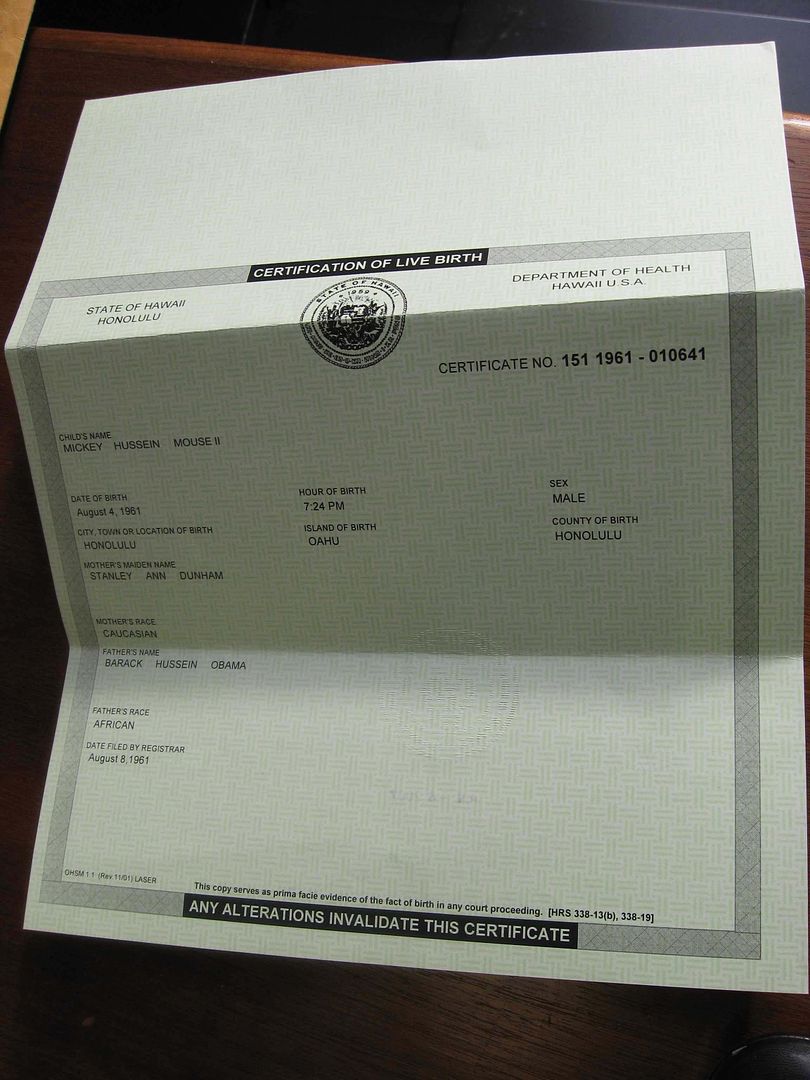
Third, Judge Carroll’s reliance on Miracle on 34th St. Judge Henry X. Harper is not only misplaced, but actually contradicts his own point. Judge Harper ruled that since the United States Government says that God exists (“In God We Trust”) without there being any evidence of God’s existence, defendant Santa Claus could publicly say he was Santa Claus even though he did not have any evidence to prove that he was in fact Santa Claus. Hence, he dismissed the charges brought against Santa Claus. Is Judge Carroll telling us that Obama can be President even though there does not exist any evidence of his being an Article II “natural born Citizen” just like Judge Harper found, the United States Government can say God exists even though there is no evidence of His existence or Santa Claus can say he is Santa Claus even though he does not have any evidence to prove that he is in fact Santa Claus? In this connection, I am reminded how New Jersey Administrative Law Judge, Jeff S. Masin, ruled in election ballot challenge, Purpura v. Obama, that Obama did not have to demonstrate who he is or where he was born to get on the New Jersey election ballot, for even Mickey Mouse can run for President, and who ruled that Obama was a “natural born Citizen” even after admitting that there was absolutely no evidence before him as to who Obama is, where he was born, or who his parents are. See, Mario Apuzzo, Update on the Purpura and Moran New Jersey Obama Ballot Access Objection, at http://puzo1.blogspot.com/2012/04/update-on-purpura-and-moran-new-jersey.html . Or how about federal Judge James Robertson, who dismissed an Obama eligibility case, Hollister v. Soetoro, 08-2254 (JR), (U.S. Dist. Ct., Dist. of Columbia, March 5, 2009), because as he said Obama’s eligibility to be President had been adequately proven through evidence on the internet and wrote: “The issue of the president’s citizenship was raised, vetted, blogged, texted, twittered, and otherwise massaged by America’s vigilant citizenry during Mr. Obama’s two-year campaign for the presidency.” What is ironic is that Judge Carroll, Judge Masin, and Judge Robertson have actually described the state of affairs as they presently exist regarding Obama’s eligibility to be President without intending to do so.

The American people should expect from our courts logical and well-reasoned decisions, based on adherence to due process and well-established legal principles and real evidence. A judge is supposed to be a neutral arbiter who is guided only by the applicable rules of law and equity and whose purpose is to do justice based on those rules and the evidence before him or her for not only the parties in the case but also for society as a whole. In fulfilling that moral and legal duty, he or she must find the facts and the applicable law, apply that law to those facts, and render a reasoned decision, all done without any bias or prejudice. In a constitutional republic such as the United States, merely saying that someone acts presidential or merely saying that someone is presidential cannot take the place of demonstrating based on real law and evidence that someone truly is presidential. Apart from failing to decide the question of whether Barack Obama is constitutionally eligible to be President based strictly on the Constitution, the rule of law, and real evidence, such mockery and illogical reasoning as we have seen from Judge Carroll and other courts bring only contempt upon our courts and is a mar upon the integrity and professionalism of the American judiciary.

Mario Apuzzo, Esq.
December 22, 2012
http://puzo1.blogspot.com
####

Copyright © 2012
Mario Apuzzo, Esq.
All Rights Reserved