Donate

Showing posts with label standing. Show all posts

Wednesday, June 29, 2011

Bond v. United States and Standing to Challenge Putative President Obama on His Eligibility to be President


Bond v. United States and Standing to Challenge Putative President Obama on His Eligibility to be President


                                                      By: Mario Apuzzo, Esq.
                                                              June 29, 2011

The U.S. Supreme Court on June 16, 2011 decided Bond v. United States, 564 U. S. ____ (2011). The Bond decision does not say anything that has not been expected regarding filing a case which can establish standing to challenge Putative President Barack Obama on his legitimacy to be President.  It has always been my position that a criminal defendant or someone being compelled to pay money challenging an Obama-endorsed Congressional statute which is the basis for the criminal charge against him or her or the money payment requirement will have standing to attack that law and in so doing also to challenge Obama's legitimacy to be President.  This is not to say that this is the only way that our courts should recognize someone like the plaintiffs I represented in Kerchner v. Obama, 612 F.3d 204 (3rd. Cir. 2010), cert. denied, 131 S.Ct. 663 (2010), who raised legitimate claims of injury to their Fifth Amendment right to life, liberty, safety, security, and tranquility, to have standing to file an action challenging Obama’s eligibility to be President under the “natural born Citizen” clause of Article II, Section 1, Clause 5.

In the Bond case, Congress passed 18 U. S. C. §229, a law regulating the possession and/or use of certain chemicals and passed to implement a chemical weapons treaty ratified by the United States. Bond argued that Congress sought to regulate conduct that is strictly local in nature and should be left to the States to control. Bond therefore argued that the federal statute violated the 10th Amendment and that Congress therefore had no right to regulate the conduct which the statute prohibited. That was the basis for the attack against the charging statute.

Both the District Court and the Third Circuit Court of Appeals found that Bond had no standing to challenge the statute because the State was not a party to the litigation. In the Supreme Court, the Government changed its position and conceded that Bond did have standing to challenge the criminal statute. The Supreme Court appointed an amicus curiae attorney to defend the position of the Third Circuit Court of Appeals that Bond did not have Article III standing. The U.S. Supreme Court, reversed, finding that Bond, a criminal defendant, has Article III standing to challenge that law in the District Court and on appeal to the Third Circuit. It said that "incarceration . . . constitutes a concrete injury, caused by the conviction and redressable by invalidation of the conviction.'”

Amicus curiae also argued that Bond was raising the rights of third parties (the State), and therefore principles of prudential standing also prevented the Court from exercising jurisdiction. The Supreme Court ruled that Bond actually sought to protect her own constitutional rights. Hence, it found that, even if State's rights were involved, she raised her own constitutional rights and so prudential standing was satisfied. The Court said that the key is whether a litigant can show that he or she has suffered an "injury that is concrete, particular, and redressable," regardless of the context in which the challenge is raised (i.e. 10th Amendment federalism or even separation of powers doctrine). The Court's discussion of separation of powers as we shall see below becomes very important in the context of challenging a law signed by Obama and thereby Obama himself.

Applying the Bond decision to a case challenging Obama's eligibility, one would have to be criminally charged or be compelled to pay money under a statute passed by Congress when Obama was President. One would argue that under Article I, Section 7, Clause 2, laws passed by Congress need the action or inaction of the President (the veto power) before they are allowed to become laws. This requirement satisfies separation of powers and checks and balances doctrine. One would argue that Congress passed the charging statute,  with the President's action or inaction. One would argue that a legitimate President must satisfy the eligibility requirements of Article II, Section 1, Clause 5, which contains the "natural born Citizen" clause. Then one would argue that the law is not valid because it never was presented to a legitimate President for consideration under Article I, Section 7, Clause 2, arguing that Obama is not a legitimate President because he does not meet the requirements of the "natural born Citizen" clause. Hence, one would argue that separation of powers and checks and balances have been violated. Obama's eligibility to be President under the "natural born Citizen" clause would be the basis for the attack against the charging statute. Since the office of the President is a constitutional office, the de facto officer doctrine (that we should treat Obama as the President by fact even though he is not by law) should not be an obstacle to this argument.

Support for this argument is found in the Court's explanation of how a litigant can file an action under a separation of powers argument. The Court said:

"In the precedents of this Court, the claims of individuals—not of Government departments—have been the principal source of judicial decisions concerning separation of powers and checks and balances. For example, the requirement that a bill enacted by Congress be presented to the President for signature before it can become law gives the President a check over Congress’ exercise of legislative power. See U. S. Const., Art. I, §7. Yet individuals, too, are protected by the operations of separation of powers and checks and balances; and they are not disabled from relying on those principles in otherwise justiciable cases and controversies. In INS v. Chadha, 462 U. S. 919 (1983), it was an individual who successfully challenged the so-called legislative veto—a procedure that Congress used in an attempt to invalidate an executive determination without presenting the measure to the President. The procedure diminished the role of the Executive, but the challenger sought to protect not the prerogatives of the Presidency as such but rather his own right to avoid deportation under an invalid order. Chadha’s challenge was sustained. A cardinal principle of separation of powers was vindicated at the insistence of an individual, indeed one who was not a citizen of the United States but who still was a person whose liberty was at risk."

It is important to understand that the Court is willing to grant standing in these situations because the litigant can show that he or she has otherwise suffered "justiciable injury." In the Bond case, the injury was the real potential for criminal conviction, incarceration, and the loss of liberty such government action brings.

But the Bond Court also cautioned so that its decision is not misinterpreted. It said:

"An individual who challenges federal action on these grounds is, of course, subject to the Article III requirements, as well as prudential rules, applicable to all litigants and claims. Individuals have “no standing to complain simply that their Government is violating the law.” Allen v. Wright, 468 U. S. 737, 755 (1984). It is not enough that a litigant “suffers in some indefinite way in common with people generally.” Frothingham v. Mellon, 262 U. S. 447, 488 (1923) (decided with Massachusetts v. Mellon). If, in connection with the claim being asserted, a litigant who commences suit fails to show actual or imminent harm that is concrete and particular, fairly traceable to the conduct complained of, and likely to be redressed by a favorable decision, the Federal Judiciary cannot hear the claim. Lujan, 504 U. S., at 560–561. These requirements must be satisfied before an individual may assert a constitutional claim; and in some instances, the result may be that a State is the only entity capable of demonstrating the requisite injury.

In this case, however, where the litigant is a party to an otherwise justiciable case or controversy, she is not forbidden to object that her injury results from disregard of the federal structure of our Government."

The Court also said that the ultimate issue of the statute’s validity turns in part on whether the law can be deemed “‘necessary and proper for carrying into Execution’” the President’s Article II, §2 Treaty Power and that the Court expressed no view on the merits of that argument which the Court of Appeals would address on remand.

So, in a Bond-like case, the law is attacked as invalid because Congress did not have constitutional power to pass it (relying on principles of federalism). In an Obama case, the law is attacked because it was never submitted to a legitimate President (relying on separation of powers and checks and balances principles). In both cases, the charging law is being attacked as unconstitutional. In both cases, the challenger, under threat of criminal indictment or having to pay money, being the basis of a threat to his or her individual constitutional rights, should have standing to attack the statute.

The point is that with Obama, one charged with a criminal offense or compelled to pay some money because of a law passed by Congress and allowed to pass into law by the action or inaction of Obama, acting as the President, would have standing to challenge the constitutionality of the law based on the law lacking the action or inaction of a legitimate President which is needed under Article I, Section 7, Clause 2 of the Constitution for laws to be passed. The standing argument would be made in the context of separation of powers and checks and balances.

Mario Apuzzo, Esq.
June 29, 2011
http://puzo1.blogspot.com/
####

Copyright © 2011
Mario Apuzzo, Esq.
All Rights Reserved

Wednesday, November 10, 2010

Daniel Webster Reveals that the Kerchner Petitioners Have Standing to Demand that Obama Show He Is A “Natural Born Citizen”

Daniel Webster Reveals that the Kerchner Petitioners Have Standing to Demand that Obama Show He Is A “Natural Born Citizen”

by: Mario Apuzzo, Esq.

Daniel Webster, known as the "Defender of the Constitution," was a famous orator and statesman. He argued cases before the U.S. Supreme Court, served as a U.S. Congressman, a U.S. Senator, and U.S. Secretary of State. In 1820, what later became known as the State of Maine separated from the Commonwealth of Massachusetts. This development caused the Commonwealth to seek to amend its constitution of 1780. The Commonwealth chose delegates to meet in convention for the purpose of amending its constitution. The town of Boston chose Mr. Webster as one of its delegates.

Mr. Webster served as chairman of the committee which was responsible for determining qualifications for those persons wanting to occupy public office. This committee recommended that “a simple oath of allegiance to the Commonwealth, together with the oath of office, should be taken by all persons chosen or appointed to office. . . . and that a profession of belief in the Christian religion no longer be required as a qualification for office.”

While his position related to retaining a profession of the belief in the Christian religion as a qualification for public office in Massachusetts, Mr. Webster’s statements go beyond just religion and the Commonwealth of Massachusetts, for they also apply to any qualification that the People may demand that a person meet in order to be eligible for any public office. Here are Mr. Webster’s words in convention as he comments on the committee’s report:

***

"Two questions naturally present themselves. In the first place, Have the people a right, if in their judgment the security of their government and its due administration demand it, to require a declaration of belief in the Christian religion as a qualification or condition of office? On this question, a majority of the committee held a decided opinion. They thought the people had such a right. By the fundamental principle of popular and elective governments, all office is in the free gift of the people. They may grant or they may withhold it at pleasure; and if it be for them, and them only, to decide whether they will grant office, it is for them to decide, also, on what terms and what conditions they will grant it. Nothing is more unfounded than the notion that any man has a right to an office. This must depend on the choice of others, and consequently upon the opinions of others, in relation to his fitness and qualification for office. No man can be said to have a right to that which others may withhold from him at pleasure.

There are certain rights, no doubt, which the whole people, or the government as representing the whole people, owe to each individual in return for that obedience and personal service, and those proportionate contributions to the public burdens which each individual owes to the government. These rights are stated with sufficient accuracy, in the tenth article of the Bill of Rights, in this constitution. " Each individual in society has a right to be protected by it in the enjoyment of his life, liberty, and property, according to the standing laws." Here is no right of office enumerated; no right of governing others, or of bearing rule in the State. All bestowment of office remaining in the discretion of the people, they have of course a right to regulate it by any rules which they may deem expedient. Hence the people, by their constitution, prescribe certain qualifications for office respecting age, property, residence, and taxation. But if office, merely as such, were a right which each individual under the social compact was entitled to claim, all these qualifications would be excluded. Acknowledged rights are not subject, and ought not to be subject to any such limitation. The right of being protected in life, liberty, and estate is due to all and cannot be justly denied to any, whatever be their age, property, or residence in the State.

These qualifications, then, can only be made requisite as conditions for office on the ground that office is not what any man can demand as matter of right but rests in the confidence and good-will of those who are to bestow it. In short, it seems to me too plain to be questioned that the right of office is a matter of discretion and option, and can never be claimed by any man on the ground of obligation. It would seem to follow, then, that those who confer office may annex any such conditions to it as they think proper. If they prefer one man to another, they may act on that preference. If they regard certain personal qualifications, they may act accordingly, and ground of complaint is given to nobody. . . .

Now, if the people may, without injustice, act upon this preference, and from a sole regard to this qualification, and refuse in any instance to depart from it, they have an equally clear right to prescribe this qualification beforehand as a rule for their future government. If they may do it, they may agree to do it. If they deem it necessary, they may so say beforehand. If the public will may require this qualification at every election as it occurs, the public will may declare itself beforehand and make such qualification a standing requisite. That cannot be an unjust rule, the compliance with which, in every case, would be right. This qualification has nothing to do with any man's conscience. If he dislike the condition, he may decline the office in like manner as if he dislike the salary, the rank, or any thing else which the law attaches to it. "

***

(Source: Daniel Webster, The Writings and Speeches of Daniel Webster, (Boston: Little, Brown, & Company, 1903), Vol. III, pp. 3-7.), accessed at http://www.wallbuilders.com/LIBissuesArticles.asp?id=68

Indeed, Webster expresses an opinion that, under a government characterized by popular and elective office, the People have a right to establish qualifications for their elected officials before they may occupy any such office, for such office is “the free gift of the people.” He explains that no man has a right to an office, for the office is granted at the pleasure of the People to those in whom they feel “confidence” and with whom they share a feeling of “good-will” because they believe that person to be both fit and qualified for that office. He adds that the same People can decide at their “discretion and option” to change those qualifications as they deem necessary for their own safety and security.

Mr. Webster then explains how each individual has a personal right to receive protection from his or her government. Mr. Webster explains that each individual in society has in accordance with a legal process a personal right to be protected by the whole People represented by his or her government in his or her life, liberty, and property in exchange for which the individual grants to the whole People and its representative government his or her obedience and personal service. He states that this right to protection “is due to all and cannot be justly denied to any” whatever their condition. He also explains that qualifications for office are for the safety and security of the individual and the nation as a whole. He believes that such qualifications should be retained in the constitution agreed upon by the People so as to provide to them the maximum protection.

This is the same argument that I have made before the U.S. Supreme Court to show that the Kerchner petitioners have standing to pursue their constitutional claims against Obama, Congress, Pelosi, and Cheney, claims in which they demand that Obama conclusively show that he is an Article II “natural born Citizen.” Petitioners have a right to demand that only a person who is a “natural born Citizen” occupy the Office of President and Commander in Chief of the Military. As Mr. Webster explains, it is the Kerchner petitioners personal right to demand it, for the Constitution has decreed it for the benefit of protecting the life, liberty, safety, security, tranquility, and property of every individual making up the People. Indeed, Obama has no right to the Office of President and Commander in Chief. He can only occupy that office at the pleasure, discretion, and option of the People which includes the Kerchner petitioners. And the Kerchner petitioners, showing that both Congress and the Executive have failed to protect them and their individual rights guaranteed to them under the U.S. Constitution and in their effort to therefore protect themselves, have every right to take their claims to a court of law for the purpose of enforcing their personal and individual right to that protection.

Mario Apuzzo, Esq.
November 10, 2010
http://puzo1.blogspot.com/
####

Thursday, July 22, 2010

The Third Circuit Court of Appeals Finds Attorney Apuzzo Not Liable for Obama's/Congress’ Damages and Costs Incurred by Them in Defending the Kerchner Appeal

On July 2, 2010, the U.S. Third Circuit Court of Appeals issued its decision affirming the New Jersey Federal District Court’s dismissal of the Kerchner et al v. Obama/Congress et al case for lack of Article III standing. The Court ordered that I show cause in 14 days why the Court should not find me liable for just damages and costs suffered by the defendants, not in having to defend against the merits of plaintiffs’ underlying claims that Putative President Obama is not an Article II “natural born Citizen,” that he has yet to conclusively prove that he was born in Hawaii, that Congress failed to exercise its constitutional duty to properly vet and investigate Obama’s “natural born Citizen” status, and that former Vice President and President of the Senate, Dick Cheney, and current Speaker of the House, Nancy Pelosi, were complicit in that Congressional failure, but rather in having to defendant against what the court considers to be a frivolous appeal of the District Court’s dismissal of their claims on the ground of Article III standing. On Monday, July 19, 2010, I filed my response. This afternoon, on July 22, 2010, the Third Circuit Court of Appeals issued its decision on whether it should impose the damages and costs upon me. The Court has decided not to impose any damages and costs upon me and has discharged its order to show cause. This means that the matter of damages and costs is closed. Here is the Court’s decision:

"ORDER (SLOVITER, BARRY and HARDIMAN, Circuit Judges) On July 2, 2010, this Court filed an Order to Show Cause directing Appellants’ counsel to show cause in writing why he should not be subject to an Order pursuant to F.R.A.P. 38 for pursuing a frivolous appeal. In response, Mario Apuzzo filed a 95-page statement that contains, inter alia, numerous statements directed to the merits of this Court’s opinion, which the Court finds unpersuasive. His request that the Court reconsider its opinion is denied, as the appropriate procedure for that issue is through a Petition for Rehearing. However, based on Mr. Apuzzo's explanation of his efforts to research the applicable law on standing, we hereby discharge the Order to Show Cause, filed. Sloviter, Authoring Judge. (PDB)."

I want to thank everyone who supported and encouraged me in this battle. This includes everyone who expressed their feelings on this matter through blog posts, articles, comments, and emails.

Mario Apuzzo, Esq.
July 22, 2010
http://puzo1.blogspot.com
###

Monday, July 19, 2010

The Kerchner et al v. Obama/Congress et al Appeal to 3rd Circuit - Attorney Apuzzo Files his Response to the Show Cause Order

The Kerchner et al v. Obama/Congress et al Appeal to Third Circuit - Attorney Apuzzo Files his Response to the Court's Order that he Show Cause Why the Court Should Not Impose Defendants' Damages and Costs Against Him

http://www.scribd.com/doc/34567772/03-09-4209-Appeal-Atty-Apuzzo-Files-Kerchner-Response-to-Court-s-Show-Cause-Order-for-Damages-Costs


Posted by:
Charles Kerchner, Commander USNR (Retired)
Lead Plaintiff, Kerchner et al v Obama & Congress et al
http://puzo1.blogspot.com/
http://www.protectourliberty.org/
July 19, 2010
###

Wednesday, June 30, 2010

The U.S. Third Circuit Court of Appeals Receives Kerchner v. Obama/Congress for Decision

As I have already reported, Charles F. Kerchner, Jr., Commander USNR (retired), Lowell T. Paterson, Darrell James LeNormand, and Donald H. Nelsen, Jr., have filed a legal action against Barack H. Obama II, in both his private and public capacity as putative President of the United States. They have included claims against Congress, former Vice-President, Dick Cheney, and current Speaker of the House, Nancy Pelosi.

First, they argue that the Founders' and Framers' definition of a "natural born Citizen" may be found in the law of nations as commented on by Emer de Vattel in his highly influential treatise, The Law of Nations, Or, Principles of the Law of Nature, Applied to the Conduct and Affairs of Nations and Sovereigns (1758 French edition, 1759 first English edition) and not in the inapplicable English common law. The Framers adopted the “Law of Nations” as part of Article III’s “Laws of the United States” but did not so adopt the English common law. We also know that under Article VI, the “Laws of the United States” which are made in pursuance of the Constitution “shall be the supreme Law of the Land.” Under the law of nations, a “natural born citizen” was a child born in the country to citizen parents, meaning both mother and father. Vattel, Sections 212-33. The Kerchner plaintiffs maintain that under the law of nations, Obama is not eligible to be President and Commander in Chief of the military because, being born with conflicting allegiance to Great Britain which he inherited from his non-United States citizen father and possibly to the United States if he was born in Hawaii as he claims but has not shown, he cannot meet the Founders’ and Framers’ constitutional definition of an Article II “natural born Citizen,” which requires the President and Commander in Chief of the Military to have unity of citizenship and allegiance from birth only to the United States which status is acquired at birth only if the child is born in the United States (or its equivalent) to a citizen mother and father.

Second, they also argue that Obama has not conclusively proven that he was in fact born in Hawaii or any other place in the United States and that even if he were born in the United States, at most he is a Fourteenth Amendment born "citizen of the United States" but not an Article II "natural born Citizen." At the time the Framers adopted the Constitution, they allowed persons who were "citizens of the United States" to be President, provided that they had that status as of the time the Constitution was adopted which we know was 1787. If a child did not have that status at that time, the Framers required that a would-be President be a "natural born Citizen." There is no denying from a simple reading of its text that the Fourteenth Amendment only grants to individuals, who can acquire by either birth or naturalization in the United States and being “subject to the jurisdiction thereof,” the equal status of a "citizen of the United States." The amendment makes no mention of a “natural born Citizen” and surely would not by implication equate a “citizen of the United States” with a “natural born Citizen” since the Framers in Article II were careful to make a distinction between the two types of citizens and we must give meaning to the words the Framers so chose and a naturalized citizen can be a “citizen of the United States” but cannot be a “natural born Citizen.” Hence, the Amendment only defined the Framers' "citizen of the United States," which status created doubts throughout our history but did not define the Framers’ "natural born Citizen" which never created any doubts as to its meaning and therefore needed no clarification through any constitutional amendment.

Hence, if Obama was born in Hawaii, he would fall under the Framers’ "citizen of the United States" status as later defined by the Fourteenth Amendment. But being a born "citizen of the United States" under the Fourteenth Amendment in 1961 is not sufficient to establish eligibility under Article II which now requires that Obama be a "natural born Citizen." There is also no denying that being born in 1961, Obama was not a “citizen of the United States” at the time the Constitution was adopted in 1787. Hence, to be eligible to be President, he must be a “natural born Citizen.” But if Obama was born in Hawaii which we know was to a non-U.S. citizen father and U.S. citizen mother, he would be a born "citizen of the United States" under the Fourteenth Amendment but not a "natural born Citizen" under Article II. So even if Obama was born in Hawaii, he would not be eligible to be President under Article II.

I have already reported that the U.S. Third Circuit Court of Appeals which sits in Philadelphia decided it did not need oral arguments on the Kerchner appeal to that Court and that the Court would receive the case on Tuesday, June 29, 2010 for decision on the briefs. I have also been informed that the Third Circuit Panel that will decide the appeal will be comprised of Circuit Judges Sloviter, Barry, and Hardiman. See the latest 3rd Circuit Court of Appeals Summary Docket for this case here.

Now we have to wait for the Court to render its decision. We do not know how long it will take to do so. We can only presume that the Court is aware of the critical importance of this issue and that my clients need to know as soon as possible where they stand. Hence, I believe that we can expect that the Court will provide us with its decision in the not too distant future.

If the Third Circuit Court of Appeals reverses the Federal District Court’s dismissal of the Kerchner case, the case will most likely return to that lower court for discovery and trial. On the other hand, if the Court affirms the lower court because of standing and/or political question, we will then file a petition for certiorari with the United States Supreme Court which will in any event provide the final judicial word on Obama’s eligibility to be President and Commander in Chief of the Military.

Mario Apuzzo, Esq.
June 30, 2010
http://puzo1.blogspot.com/
###

The Kerchner et al v. Obama/Congress et al Appeal to Third Circuit 'Submitted for Decision' 29 June 2010 on the Written Briefs with No Oral Argument

The U.S. Third Circuit Court of Appeals which sits in Philadelphia PA decided to not allow any Oral Argument on the Kerchner v Obama & Congress appeal to that Court. The case was officially "submitted for decision" on the written briefs on Tuesday, June 29, 2010. Our presence at the courthouse was not required.

The U.S. Third Circuit Panel of the Court that will decide the appeal will be comprised of Circuit Judges Sloviter, Barry, and Hardiman.  See the latest Appeal Court Docket entry here.

As we know in the lower court, the Federal District Court, Judge Simandle granted Obama’s/Congress’s motion to dismiss the plaintiffs' complaint/petition for lack of standing and political question. The Kerchner plaintiffs thus appealed that decision to the U.S. Third Circuit Court of Appeals. Legally, on a motion to dismiss the complaint on its face for lack of standing and political question, both the trial and the appeals courts are supposed to accept the facts alleged in the complaint/petition as true and in a light most favorable to the non-movant. We have alleged and shown the facts that Obama is not and cannot be an Article II "natural born Citizen" because he was born a subject of Great Britain through descent from his British subject/citizen father who was never a U.S. citizen, making Obama born with dual citizenship and conflicting allegiances if he was actually born in the U.S., or with sole allegiance to Great Britain if he was born in Kenya. We have also alleged and shown the facts that Obama has not conclusively proven that he was even born in Hawaii. Obama and Congress have presented no evidence or argument to the Federal District Court in Camden NJ or to the Court of Appeals in Philadelphia PA contesting these arguments. The issues of standing and political question are well briefed in the written briefs presented to both courts. We have presented in our briefs how the Kerchner plaintiffs have standing and how the Obama eligibility issue does not present any objectionable political question for the Court.

Of course, it is our hope that the U.S. Third Circuit Court of Appeals reverses the decision of the Federal District Court which dismissed the complaint/petition for lack of standing and political question and returns the Kerchner case to the District Court in Camden NJ for discovery and trial. If the Third Circuit Court affirms the District Court, thus denying our appeal, we will then be filing a Petition for Certiorari with the United States Supreme Court which will have the final word on this matter in any event.

Attorney Mario Apuzzo will likely post a statement on this matter later.

Charles Kerchner, Commander USNR (Retired)
Lead Plaintiff, Kerchner et al v Obama & Congress et al
June 30, 2010
http://puzo1.blogspot.com/
http://www.protectourliberty.org/
###

Saturday, June 19, 2010

The Kerchner v. Obama/Congress Case Is Not the Same as the Berg v. Obama Case
Despite the OBOT Minions' Talking Points Blogging/Claiming That It Is

On June 29, 2010, the U.S. Third Circuit Court of Appeals will receive for decision the Kerchner et al. v. Obama/Congress et al. appeal to that Court of the Federal District Court's dismissal of the case for what it said was lack of standing and political question.  Putative President Obama's supporters are out and about arguing that the Kerchner v. Obama/Congress case is exactly like the Berg v. Obama case and therefore the Third Circuit Court of Appeals should affirm the District Court's dismissal of the case for lack of standing. This is not only an incredible statement but an outright lie. First, while Berg focused only on the place of birth issue, Kerchner argues that Obama is not and cannot be President no matter where he was born because not being born to a citizen father which made him born a subject of a foreign power, he is not and cannot be an Article II “natural born Citizen.” Second, Berg sued candidate Obama before the general election but the Kerchner plaintiffs sued both President Elect Obama (after Congress confirmed him but before Chief Justice Roberts swore him in) and putative President Obama (after the Chief Justice swore him in). Third, Berg did not sue Congress but Kerchner did. Fourth, Berg did not argue like Kerchner does that based on the plaintiffs' individual Fifth Amendment right to protection of their life, liberty, safety, security, tranquility, and property, which protection they do not receive from a person who is not an Article II “natural born Citizen” and therefore is an illegal and illegitimate President and Commander in Chief of the Military. This lack of protection from their President and Commander in Chief to which each particular plaintiff is entitled under our Constitutional covenant between the People and the Government as conceived by the Founders and Framers is more than sufficient to show the Kerchner plaintiffs have standing. Fifth, there is also so much more to the Kerchner case. If one were to fully read both the Berg case and the Kerchner case, there is no way that one could honestly say that the cases are the same and that the Kerchner plaintiffs therefore do not have standing. Rather, such a reading will clearly show that Obama’s supporters are fully engaged in not only wishful thinking but also outright deceit. Only one driven by animosity or the deceit of party spirit which rears its head in various explicit and hidden forms rather than by the desire to protect the Constitution and the Constitutional Republic can come to the incredible conclusion that the Kerchner and Berg cases are the same.

Mario Apuzzo, Esq.
June 19, 2010
http://puzo1.blogspot.com/
####

Tuesday, June 15, 2010

The Kerchner et al v. Obama/Congress et al Appeal to the Third Circuit to Be Decided on the Briefs with No Oral Argument

The U.S. Third Circuit Court of Appeals which sits in Philadelphia has notified me today electronically by letter dated June 15, 2010 that there will not be any oral argument on the Kerchner appeal to that Court. The case will be submitted on the briefs on Tuesday, June 29, 2010. Our presence is therefore not required.

The Court also informed me that the Third Circuit Panel that will decide the appeal will be comprised of Circuit Judges Sloviter, Barry, and Hardiman.

The court can call for oral argument when it has questions. As we know, the Federal District Court granted Obama’s/Congress’s motion to dismiss the complaint/petition for lack of standing and political question. The Kerchner plaintiffs have appealed that decision to the Third Circuit Court of Appeals. On a motion to dismiss the complaint on its face for lack of standing and political question, both the trial and the appeals courts are supposed to accept the facts alleged in the complaint/petition as true and in a light most favorable to the non-movant. We have alleged and shown that Obama is not and cannot be an Article II "natural born Citizen" because he was born a subject of Great Britain through descent from his British subject/citizen father who was never a U.S. citizen, making Obama born with dual and conflicting allegiances if he was born in the U.S. or with sole allegiance to Great Britain if he was born in Kenya. We have also alleged and shown that Obama has not conclusively proven that he was even born in Hawaii. Obama and Congress have presented no evidence or argument to the Federal District Court or to the Court of Appeals contesting these arguments. The issues of standing and political question are well briefed. We have presented in our briefs how the Kerchner plaintiffs have standing and how the Obama eligibility issue does not present any objectionable political question for the Court. Hence, the Court might not have any questions and so it did not see any need for oral argument.

Of course, it is our hope that the U.S. Third Circuit Court of Appeals reverses the decision of the Federal District Court which dismissed the complaint/petition for lack of standing and political question and returns the Kerchner case to the District Court for discovery and trial. If the Third Circuit Court affirms the District Court, we will then be filing a petition for certiorari with the United States Supreme Court which will have the final word in any event.

Mario Apuzzo, Esq.
June 15, 2010
http://puzo1.blogspot.com/
###

Tuesday, March 23, 2010

Kerchner v Obama & Congress Appeal Reply Brief and Oral Argument Request Filed

I have completed filing the Kerchner Reply Brief and Request for Oral Argument. These documents may be accessed at the indicated links. All parties have completed filing all briefs and now we just need a decision from the Court. We will now wait and see if the Third Circuit Court of Appeals grants my request for oral argument and if so when the oral argument will be. If oral argument is granted, it will take place at the United States Court of Appeals Third Circuit, U.S. Courthouse, 601 Market Street, Philadelphia, Pennsylvania. The courthouse is located right across the street from Independence Hall and the Liberty Bell.

I want to thank all of my supporters on this blog and all those who visit here to find out what is going on with the Obama eligibility issue.

I will be posting more essays on natural law, the law of nations, Emer de Vattel, the Founders and Framers, the Courts, and the meaning of the "natural born Citizen" clause.

Kerchner v Obama & Congress Appeal Latest Filings:
Appellant's Reply Brief -- http://www.scribd.com/doc/28779811/Kerchner-v-Obama-Appeal-Appellant-s-Reply-Brief
Oral Argument Request -- http://www.scribd.com/doc/28781505/Kerchner-v-Obama-Appeal-Request-for-Oral-Argument

Mario Apuzzo, Esq.
March 23, 2010
http://puzo1.blogspot.com
####

Monday, March 8, 2010

Obama and Congress File Their Opposition Brief to the Kerchner Appeal

Today, March 8, 2010, putative President Barack Obama and Congress filed their Opposition Brief to the Kerchner appeal currently pending in the Third Circuit Court of Appeals in Philadelphia. The brief may be viewed at this link. We now have until March 22, 2010, to file our reply brief which will address the arguments the defendants have made in their opposition brief.

The defendants' brief is a presentation of general statements of the law of standing. Appealing to what other courts have done, the defendants basically tell the court that the Kerchner case should be dismissed because all the other Obama cases have been dismissed. Its main point is that the Kerchner plaintiffs have not proven that they have standing because they failed to show that they have suffered a concrete and particularized injury.

The brief does not even acknowledge our factual allegations against Obama which are that he is not and cannot be an Article II “natural born Citizen” because his father was a British subject/citizen and not a United States citizen and Obama himself was a British subject/citizen at the time Obama was born and that he has failed to even show that he is at least a “citizen of the United States” by conclusively proving that he was born in Hawaii. It is strange as to why the brief does not even contain these factual allegations within it, giving the appearance that the Justice Department does not want such allegations to be even included in any official court record.

Nor does the brief acknowledge let alone address what all our legal arguments are on the questions of standing and political question. Rather, it merely repeats what the Federal District Court said in its decision which dismissed the Kerchner case for what it found was lack of standing and the political question doctrine and asks the Court of Appeals to affirm the District Court’s decision dismissing our complaint/petition.

I will be filing my reply to the defendants’ brief on or before March 22, 2010.

Mario Apuzzo, Esq.
March 8, 2010
http://puzo1.blogspot.com/
####

Monday, February 22, 2010

Court Grants Motion for Leave to File Overlength Brief in Kerchner Appeal

On January 19, 2010, I filed the Appellants' Opening Brief in the appeal of Kerchner et al. v. Obama et al. which is currently pending in the Third Circuit Court of Appeals in Philadelphia. In that appeal, we maintain that the New Jersey Federal District Court erred in dismissing our case by ruling that plaintiffs do not have standing to challenge Obama's alleged eligibility to be President and Commander in Chief of the Military and that our case presents a non-justiciable political question. In our case, we have provided the Founder’s and Framers’ definition of an Article II “natural born Citizen” which is a child born in the country to citizen parents. We maintain that Obama is not an Article II “natural born Citizen” because he lacks unity of citizenship and allegiance from birth which is obtained when a child is born in the United States to a mother and father who are both United States citizens at the time of birth. Obama’s father was only a temporary visitor to the United States when Obama was born and never even became a resident let alone a citizen. Not being an Article II “natural born Citizen,” Obama is not eligible to be President and Commander in Chief.
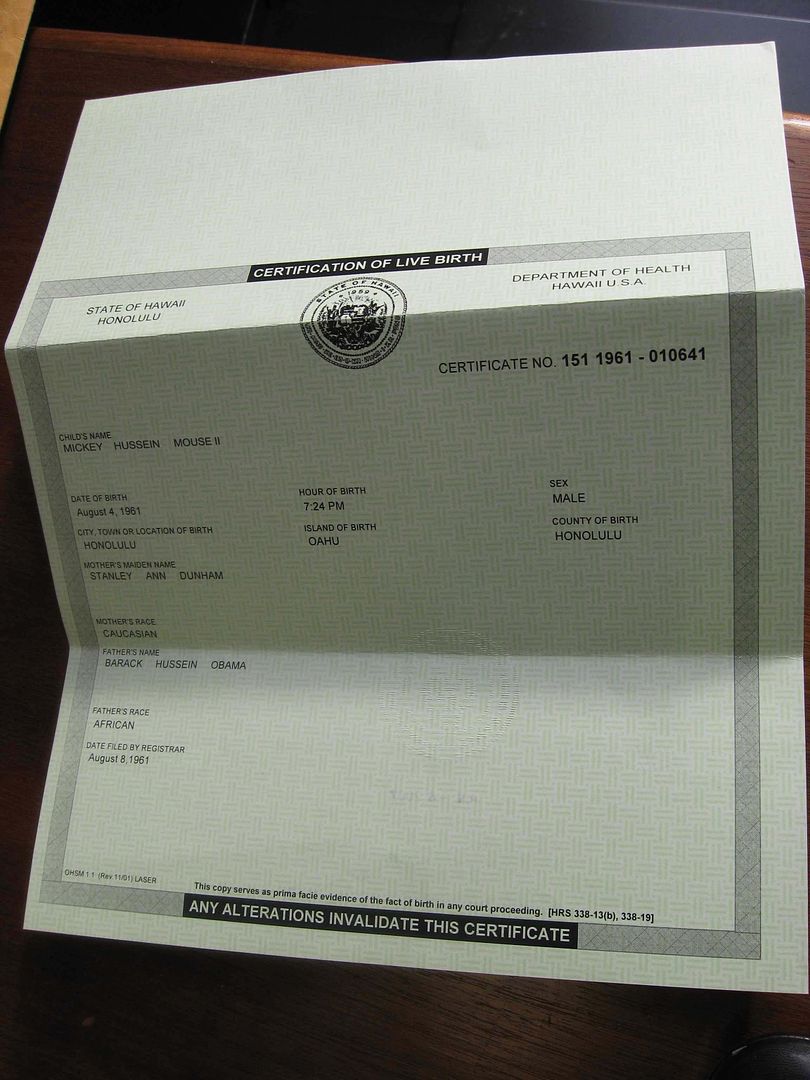
We also maintain that Obama has failed to conclusively prove that he was born in Hawaii by publicly presenting a copy of a contemporaneous birth certificate, a long-form birth certificate providing the name of the hospital in which he was born and other corroborating data which was generated when he was born in 1961 and not simply a digital image of computer generated Certification of Live Birth [COLB] allegedly obtained from the Hawaii Department of Health in 2007 which some unknown person posted on the internet in 2008, or other contemporaneous and objective documentation. At the bottom of Obama’s Certification of Live Birth (COLB), it states: "This copy serves as prima facie evidence of the fact of birth in any court proceeding." Under the concept of prima facie evidence, the presumption that the fact exists fails when evidence contradicting that fact is presented and in such case the interested party needs to present other competent evidence to prove the existence of that alleged fact. If he fails to do so, the alleged fact is not proven, even if the opposing party produces no further evidence. There exists a considerable amount of evidence which puts serious doubt on Obama’s allegation that he was born in Hawaii. To date, Obama has presented no additional evidence other than the internet image of his Certification of Live Birth (COLB) and two unreliable newspaper announcements regarding where he was born. Hence, the prima facie validity of the Certification of Live Birth (COLB) must fail and Obama should be compelled to produce other objective, credible, and sufficient evidence of where he was born such as a contemporaneous birth certificate from 1961. Having failed to meet his constitutional burden of proof under Article II, Section 1, Clause 5, we cannot accept Obama as a “natural born Citizen.”

Circuit Court of Appeals rules provide that an appellant’s opening brief is not to exceed 14,000 words. Because of the extraordinary nature and complexity of the question of whether putative President Barack Obama is an Article II “natural born Citizen” and therefore eligible to be President, whether my clients (the plaintiffs) have standing to bring an action against Obama and Congress in which they maintain that Obama is not a “natural born Citizen” and that Congress failed to meet its constitutional duty to protect my clients by assuring them that Obama is a “natural born Citizen,” and whether plaintiffs’ action presents a nonjusticiable political question which the courts cannot address, I was compelled to file a brief which contained 20,477 words. So that the Court would accept the overlength brief, I filed a motion with the Court for leave to file the overlength brief.

By order dated February 22, 2010, the Honorable Circuit Judge Michael A. Chagares on behalf of the Motion's Panel of the Third Circuit Court of Appeals granted plaintiffs’ motion for leave to file the overlength brief. This is great news because the case will now continue forward as scheduled. Obama’s and Congress’s opposition brief was initially due on February 22, 2010. The Department of Justice obtained a 14-day extension to file that brief, making the new due date March 8, 2010. After they file their opposition brief, I will then have 14 days within which to file a reply to that brief. All briefs will be posted at this blog and it is my hope that the public will read these briefs so as to stay fully informed on this issue that is critically important not only to my clients but also to our Constitutional Republic.

Mario Apuzzo, Esq.
February 22, 2010
http://puzo1.blogspot.com
####

Friday, February 12, 2010

Obama and Congress Request and Obtain Extension of Time to File Opposition Brief to Kerchner Appeal

On January 19, 2010, I filed the Appellants' Opening Brief in the appeal of Kerchner et al. v. Obama et al. which is currently pending in the Third Circuit Court of Appeals in Philadelphia. In that appeal, we maintain that the New Jersey Federal District Court erred in dismissing our case by ruling that plaintiffs do not have standing to challenge Obama's alleged eligibility to be President and Commander in Chief of the Military and that our case presents a non-justiciable political question. In our case, we have provided the Founder’s and Framers’ definition of an Article II “natural born Citizen” which is a child born in the country to citizen parents. We maintain that Obama is not an Article II “natural born Citizen” because he lacks unity of citizenship and allegiance from birth which is obtained when a child is born in the United States to a mother and father who are both United States citizens at the time of birth. Obama’s father was only a temporary visitor to the United States when Obama was born and never even became a resident let alone a citizen. Not being an Article II “natural born Citizen,” Obama is not eligible to be President and Commander in Chief.

We also maintain that Obama has failed to conclusively prove that he was born in Hawaii by publicly presenting a copy of a contemporaneous birth certificate (a long-form birth certificate generated when he was born in 1961 and not simply a digital image of computer generated Certification of Live Birth [COLB] allegedly obtained from the Hawaii Department of Health in 2007 which was posted on the internet by some unknown person in 2008) or through other contemporaneous and objective documentation. Having failed to meet his constitutional burden of proof under Article II, Section 1, Clause 5, we cannot accept him as a “natural born Citizen.”

The defendants had 30 days within which to file their opposition brief. Defendants have requested and obtained from the Court an extension of time to file their brief. The Court has granted them until March 8, 2010 to file it. After that filing, I will then have a chance to file a reply brief within the next 14 days.

You may obtain a copy of my brief at this site . We will be posting here the defendants' opposition brief after it is filed along with my reply brief. I hope that many of you will take the time to read these briefs so that you may learn first hand what the legal issues and arguments are regarding whether the plaintiffs have standing and/or are precluded by the political question doctrine to challenge Obama on his eligibility to be President and Commander in Chief, and what the meaning of an Article II “natural born Citizen” is.

Mario Apuzzo, Esq.
February 12, 2010
http://puzo1.blogspot.com
####

If you can, help the cause.
CDR Kerchner, Lead Plaintiff
http://www.protectourliberty.org
####

Monday, November 9, 2009

Quo Warranto and the Kerchner v. Obama and Congress Case

Leo Donofrio, Esq. wants the “right” plaintiff to bring a quo warranto action against putative President Obama under 16 D.C.Code Secs. 3501-3503 in the Federal District Court for the District of Columbia. He in effect maintains that quo warranto is an exclusive remedy available to remove Obama from office. He maintains that Obama may be removed from office only through a quo warranto action and that the DC District Court is the only court in the United States where such an action may be brought. I recently wrote an article about this issue, entitled The DC District Court Is Not the Only Court In Which to File a Quo Warranto Action. http://puzo1.blogspot.com/2009/10/dc-district-court-in-not-only-court-in.html. I explained that given the causes of action that I have raised in the Kerchner action, I can also file a quo warranto claim in the Third Circuit. Mr. Donofrio recently posted his disagreement with my article at his blog, http://naturalborncitizen.wordpress.com/2009/10/29/judge-carter-the-writ-of-quo-warranto-must-be-brought-within-the-district-of-columbia-because-president-obama-holds-office-within-that-district/. I will now address Mr. Donofrio’s response to my article.

Before we begin, we must understand that a quo warranto action is a direct attack on an office holder, questioning his qualifications to hold an office and therefore his warrant and authority to occupy that office. It does not challenge any action taken by that person while having been in office. This type of action is to be distinguished from one where the plaintiff brings an indirect attack (collateral attack) against that office holder, arguing that some action taken by him or her is invalid because he or she is not qualified to hold the office from which the action is taken. Nat’l Ass’n of Greeting Card Publishers v. U.S. Postal Service, 569 F.2d 570 (D.C.Cir.1976) (per curiam), vacated and remanded on other ground, 434 U.S. 884 (1977); Andrade v. Lauer, 729 F.2d 1475 (D.C.Cir.1984). As we shall see below, this distinction is important, for it can be argued that direct attacks must satisfy the requirements of a quo warranto action while indirect attacks must satisfy the requirements of the de facto officer doctrine. Mr. Donofrio does not explain which one of these approaches he proposes to take against Obama. The Kerchner action does not challenge any action taken by Obama. Rather it challenges his Article II eligibility (that he is not a “natural born Citizen”) to hold the office of President and Commander in Chief of the Military. Hence, it is a direct attack on Obama’s title to hold the Office of President, contending that he is not Article II eligible to occupy that office.

Since Mr. Donofrio is proposing a quo warranto action, he must be planning a direct attack against Obama. Mr. Donofrio fails to recognize the many problems that exist with the quo warranto procedure that he advocates. Under the common law, only the United States can bring a quo warranto action. Wallace v. Anderson, 18 U.S. 5 Wheat. 291, 292 (1820). Congress can, however, pass a statute allowing a private person to bring such an action. Johnson v. Manhattan Railway Co., 289 U.S. 479 (1933). Hence, it would appear that the DC District Code would solve the problem for a private person wanting to bring such an action against Obama. But the DC District Code presents a cumbersome procedure that has to be followed and which renders the very statute inapplicable to a quo warranto action against a sitting putative President such as Obama.

This procedure starts by requiring that the quo warranto issue in the name of the United States. It compels a concerned citizen to apply to the Attorney General or the United States Attorney to bring the action on his behalf in the District Court for the District of Columbia (16 D.C. Code Secs. 3501-3502. These officials have broad discretion. It is not realistic that they would file a quo warranto action in the name of the United States against a sitting putative President, their own boss and the same person who appointed them. It is also unrealistic that they would file such an action in a case in which among the list of defendants are the United States itself along with the U.S. Congress, Senate, and House of Representatives. Even appointing a special prosecutor would present a problem, for who would appoint him or her? We have already seen how the Executive and Congressional branches of government are both defending Obama’s stance that he is constitutionally eligible to be President. Especially shocking is how the Justice Department has taken the side of Obama rather than support and defend the Constitution and support the plaintiffs who argue that he is not an Article II “natural born Citizen” and therefore not eligible for the Office of President and Commander in Chief of the Military. How does Mr. Donofrio expect to get any cooperation from either of these two branches of government which he would need to sanction and support his quo warranto action?

It is true that the DC statute provides a private litigant with a mechanism by which he can still bring the quo warranto action even if the government refuses to do so. But if these government officials refuse to institute a quo warranto proceeding as they have thus far so demonstrated, only an “interested person” may petition the court for leave to have the writ issued in the name of the United States on the relation of the “interested person.” 16 D.C. Code Sec. 3503. At common law, a private person had no such right to bring the quo warranto action and this DC statute is the only statute passed by Congress that permits such a procedure. Blackburn v. O’Brien, 289 F.Supp. 289 (D.C.W.D.Va. 1968). Nevertheless, the court has broad discretion to deny the writ. Under the standard for being an “interested person” as pronounced by Newman v. United States ex rel. Frizzell, 238 U.S. 537 (1915), in a case involving a public office one would have to have “an interest in the office itself peculiar to himself…” and be filing an action against another who allegedly usurped that office. Indeed, Newman requires that the plaintiff be “actually and personally interested” in the office and that there be another person against whom the action is brought who has unlawfully occupied the office in question. In other words, the plaintiff must himself make a claim to the office in order to qualify to bring the action. Are there any available plaintiffs at this time who fill this bill or will there be any in the future who will do so? I know that Mr. Donofrio is now looking for a plaintiff to retain him to bring a quo warranto action in the DC District Court. But has he advised the public that any would-be plaintiff has to have an interest in the office itself peculiar to himself and that he be actually and personally interested in the office? We must keep in mind that the quo warranto action is only an attack on the title of the office holder and not an attack on any action taken by that person. A suit based on alleged illegal action taken by an office holder provides many more possibilities to establish standing (e.g. illegal firings from employment, illegal takings of property rights, breach of contract, etc.), but as we will see below must satisfy the requirements of the de facto officer doctrine, unless grounded on a constitutional violation in which case it does not. Even if the quo warranto plaintiff could show that he was an “interested person,” the court would still have to grant him its permission to bring the quo warranto action. Can we reasonably expect the DC District Court to give its permission to a plaintiff to bring an eligibility action against Obama whom as we have seen the court views to be a legitimate sitting President? For all of these procedural reasons, it is highly doubtful that the DC District Code even applies to a quo warranto action involving a President.

But there is a more serious problem with what Mr. Donofrio proposes and that is one of constitutional dimensions. Mr. Donofrio claims that Congress has delegated its powers to remove a sitting President to the DC District Court by passing the DC District Code statute. First, I maintain that Congress in passing the DC statute did provide private litigants with a statutory mechanism for bringing quo warranto actions in the DC District Court, but it did not intend for it to apply to ousting sitting Presidents. Under the Appointments Clause (Article II, Sec. 2, cl. 2), it is the President that is given the power to make, with the advice and consent of the Senate, appointments of “Officers of the United States” and other positions that are not considered inferior. Given the President’s power to fill these offices, it is doubtful that Congress meant to include the Office of the President itself when it wrote “public office of the United States” in Section 16-3501. Hence, as written and only interpreting it as though the Office of the President is not included in its sweep, the DC statute would pass constitutional muster. Second, if the DC statute were to be read as Mr. Donofrio does so as to be used as a tool to oust from office a sitting putative President, then I doubt such an application of that statute would be constitutional. It is highly doubtful that Congress, a co-equal branch of government to the Executive, has the constitutional power to pass a statute which would allow a federal district court to alone directly remove a sitting President. See Marbury v. Madison, 1 Cranch, 137 (1803) (shows that Congress in enacting laws must do so within the confines of power given to it in the Constitution and held that Congress had no power to give the Supreme Court original jurisdiction in cases not described in the Constitution). Surely, if Congress cannot give the Supreme Court power which the Constitution does not give to that Court, Congress also cannot give to a federal district court any power not belonging to it under the Constitution.

The Constitution itself textually provides the means by which to remove a sitting President and Congress has no constitutional authority to legislate a different way to do it. See Article I, Section 8 which prescribes the legislative powers given to Congress. The Constitution itself does not give Congress any authority to create by legislation any such quo warranto actions that may be used to oust a sitting President let alone any authority to delegate that removal power to the judicial branch of government. It is also doubtful that Congress would attempt such a delegation of power given that the Constitution itself provides for a mechanism to remove a President for misconduct or prevent a person from becoming or continuing as President who is not Article II qualified. The Constitution at Article I, Sec. 2 and 3 gives Congress the power to impeach the President which only applies to a duly elected and confirmed sitting President who is convicted of “Treason, Bribery, or other Crimes and Misdemeanors…” As we can see, impeachment would only apply to a duly elected President who has intentionally committed a serious criminal offense.

To prevent an ineligible person who has won the Electoral College vote from becoming President, the Constitution requires that Congress itself qualify and confirm a President Elect under the Twentieth Amendment. To remove a person who may have improperly gotten past Congress’s qualification and confirmation function, who is not eligible for the Office, and who has not necessarily intentionally committed any serious criminal offense, the Twenty Fifth Amendment provides a procedure for the Vice President and a majority of either the principal officers of the executive departments or of such other body as Congress may by law provide to initiate removal of the President should they deem him “unable to discharge the powers and duties of his office.” The amendment does not limit the scope of the President being “unable” to function, suggesting that such inability can included physical, mental, or legal inabilities. Inability to discharge the powers and duties of an office surely includes the lack of legal capacity to perform those powers and duties. Lack of legal capacity in that regard can be established if one is not qualified to hold that office. Lack of qualification surely includes not being eligible for an office. Not being Article II eligible to be President then shows that Obama is not qualified for the office, lacks legal capacity to perform what is required of him while occupying that office, and is therefore unable to discharge the powers and duties of his office.

A Court presented with a case or controversy could decided and declare that Obama is currently not Article II eligible to be President and therefore constitutionally unable to discharge the powers and duties of this office and transmit that declaration to the Vice President and a majority of the executive department officers who would then initiate the removal procedure prescribed by the Twenty Fifth Amendment. Such a procedure respects separation of powers concerns that a court may have with a notion as Mr. Donofrio espouses of being asked to directly remove a sitting putative President. This procedure, with both the judicial and legislative branches of government involved in the process, also provides checks and balances which are necessary to prevent one branch of government from abusing or usurping powers at the expense of the People. The Kerchner complaint/petition has asked the court to take this exact approach to the eventual removal of the Article II constitutionally ineligible Obama. This approach to Obama’s removal also shows that there is no redressablity (one of the Article III standing requirements) problem should the court want to act.

Mr. Donofrio insists that I file the quo warranto action in Washington. But as we have seen, Mr. Donofrio’s approach is fraught with procedural and constitutional obstacles which may be very difficult if not impossible to overcome in a case brought by a plaintiff who challenges the Article II constitutional eligibility of a sitting putative President and who brings his action in the United States District Court for the District of Columbia under the District of Columbia Code, but who does not have any personal interest in that Office. Indeed, even if a plaintiff is an “interested person,” such a plaintiff would probably be unsuccessful in utilizing that procedure to remove a sitting putative President because of the procedural requirements it demands. Finally, to use the DC District Code in the manner that Mr. Donofrio proposes is probably unconstitutional for want of power in Congress in passing such legislation if Congress intended the DC statutes to work as Mr. Donofrio would want them to work, for being an illegal Congressional delegation of powers to the judicial branch if Congress has such power and for being a violation of separation of powers. Hence, these obstacles would only prevent persons like the Kerchner plaintiffs and others who may be interested in pursuing the Obama eligibility issue from vindicating their individual constitutional rights under the due process clause of the Fifth Amendment to have only a constitutionally qualified President take action against them that significantly and profoundly affects their fundamental individual constitutional rights to liberty, safety, security, protection, and tranquility. Indeed, the technical statutory requirements and the unconstitutionality of a DC District Code quo warranto action against a sitting putative President would most likely render the constitutional eligibility requirements of Article II virtually unenforceable by a person injured thereby. These virtually insurmountable hurdles show that the DC District Code quo warranto action is not adequate for the Kerchner plaintiffs’ needs. Not being adequate it cannot be the exclusive procedure available to them. United States v. Machado, 306 F.Supp. 995 (D.C.N.D.Cal. 1969).

Our Constitutional Republic is based on the Constitution and the rule of law which guarantees individuals due process of law. A denial of all judicial forums and remedies may be a denial of due process. Hence, our judicial branch of government should not allow such a result and rather should use its Constitutional and equitable powers to give a deserving plaintiff the requested constitutional relief he or she seeks. Given these virtually insurmountable procedural and constitutional obstacles, I have therefore taken a different approach to the removal of the Article II ineligible Obama which Mr. Donofrio does not address or refuses to recognize. I have shown that the DC District Court would have exclusive original jurisdiction over a quo warranto petition only if a party is not able to prove that a district court other than the DC District Court has original jurisdiction in the case any other way. If a party wants to avoid having to file its action under the DC code in the DC District Court, a party must show the forum court that it has original jurisdiction by way of some other constitutional or federal statutory provision. If the party can prove that the court has original jurisdiction otherwise by showing that it has an underlying claim based on some other constitutional or federal statutory provision which gives that court original jurisdiction, the party is neither compelled to use the DC statute nor the DC District Court but rather can file the party’s common law quo warranto petition in any district of the United States seeking quo warranto remedies in conjunction with that underlying constitutional or federal statutory provision which is the basis for the court to assert original jurisdiction in the first instance. See F.R.C.P. 81(a)(2) (does not provide for a substantive quo warranto proceeding but rather only allows federal courts to use the already existing common law quo warranto action); See also Ames v. State of Kansas ex rel. Johnston, 111 U.S. 449, 471-72 (1884) (holding that quo warranto was a civil action properly heard by any federal court having federal question jurisdiction); Wilder v. Brace, 218 F.Supp. 860, 863-65 (D.Me. 1963) (a federal court with diversity jurisdiction can hear quo warranto action). Because of the unique nature of a Presidential constitutional eligibility action, the court should not require that a plaintiff bring the action in the name of the United States or that the Attorney General or the United States attorney institute the action or that the court itself grant the plaintiff leave to file the action. A quo warranto action when first created was a civil action, became a criminal one, and now is back to being a civil one. Also, the Kerchner plaintiffs are only asking for quo warranto remedies that will be exercised not directly by the Court but rather by Congress with the assistance of the Court in defining the rights and obligations of the parties to the controversy (e.g. defining what an Article II “natural born Citizen” is). Hence, there exists no constitutional problem (no political question or separation of powers problem) in a court proceeding in this fashion.

Mr. Donofrio does not address my argument that under such circumstances, the district court would obtain ancillary jurisdiction over the petition for quo warranto under 28 U.S.C. Sec. 1651(a) (the All Writs Act), for the court would already have original jurisdiction over plaintiffs’ other constitutional or federal statutory claims. See United States of America Ex Rel. State of Wisconsin, Plaintiff-appellant, v. First Federal Savings and Loan Association and Federal Home Loan Bank Board, Defendants-appellees, 248 F.2d 804 (7th Cir. 1957). In the scenario described, the quo warranto jurisdiction is said to be ancillary to the court's original jurisdiction that rests on a separate and distinct constitutional or federal statutory provision in the first instance. Under such circumstances, the district court would obtain ancillary jurisdiction over the petition for quo warranto under 28 U.S.C. Sec. 1651(a) (the All Writs Act which authorizes the court to "issue all writs necessary or appropriate in aid of their respective jurisdictions and agreeable to the usages and principles of law"), for the court would already have original jurisdiction over plaintiff’s other federal claims. Under such circumstances, the All Writs Act may be used because the party is not using the act to augment the jurisdiction of the court but rather only petitioning the court that it issue the quo warranto writ as an aid to the court's already existing original jurisdiction. Indeed, “[u]nless appropriately confined by Congress, a federal court may avail itself of all auxiliary writs as aids in the performance of its duties when the use of such historic aids is calculated in its sound judgment to achieve the ends of justice entrusted to it.” Adams v. United States ex rel McCann, 317 U.S. 269, 273 (1942). Hence, the court can avail itself of the quo warranto writ to provide the plaintiffs with authority to discover the facts and Obamas’s legal position concerning his Article II eligibility to be President. Finally and critically important, in the Kerchner proceeding the quo warranto action does not stand alone which in the context of attempting to remove a sitting putative President under the DC District Code would present the procedural and constitutional problems that I have explained above, but also with other constitutional causes of action against Obama and Congress that give the court the ability to fashion the appropriate remedy (solving any redressability problems) and to satisfy separation of powers and checks and balances concerns.

Use of the quo warranto remedy has already come up in the Third Circuit Court of Appeals in Philadelphia in the case of United States v. Malmin, 272 F. 785 (3rd Cir. 1921). While the Court decided the case by issuing a peremptory writ of mandamus to a federal district court judge sitting in the Virgin Islands of the United States rather than a writ of quo warranto testing his title to the office, it did leave open the possibility that in the future a quo warranto action may be needed to test that title. The Court did not state that such action could not be brought in the Third Circuit and that such an action would have to be brought in the DC District Court under the DC statute.

Mr. Donofrio also argues that Congress through the DC District Code has given the DC District Court “exclusive” jurisdiction over any quo warranto action filed in the federal courts against Obama. He wants to give the DC district court exclusive jurisdiction over any quo warranto action existing in any place of the United States by way of Article I, Sec. 8, cl. 17, which provides: “The Congress shall have power…[t]o exercise exclusive Legislation in all Cases whatsoever, over such District…as may…become the Seat of the Government of the United States…” First, the statutes themselves no where say that Congress gave such exclusive jurisdiction to that court alone over any quo warranto action against any federal officer let alone a sitting President. Mr. Donofrio does not read Article I, Sec. 8, cl. 17 correctly, for it is designed only to establish who shall have jurisdiction over this specially created piece of 10-square-miles piece of land, not to restrict in any way the powers of the federal courts of the United States to that specific location. Starting with the Judiciary Act of 1789, c. 20 (1 St. 73) we can readily see that Congress has always been very careful about how it assigns jurisdiction to the federal courts and if that were its intent, it would have clearly said that the jurisdiction in the DC District Court is both original and exclusive. See Ames v. State of Kansas ex rel. Johnston, 111 U.S. 449 (1884). For example, some state legislatures have put language in their quo warranto statutes indicating that quo warranto jurisdiction is exclusive with a certain court of the State. See Henning v. Village of Waterford, 78 Wis.2d 181, 253 N.W.2d 893 (1977) (Wisconsin). Second, Mr. Donofrio’s argument cannot be correct given that Article III, Section 2 of the Constitution provides that “[t]he judicial Power shall extend to all Cases, in Law and Equity, arising under this Constitution, the Laws of the United States, and Treatise made, or which shall be made, under their Authority….” This broad grant of judicial power extends to all the federal courts in the United States, not to just any specific ones. The Kerchner action is not only based on a federal statutory infraction, but also a constitutional violation. I established jurisdiction in the Third Circuit under, among other statutes, 28 U.S.C. Sec. 1346(a)(2) and 28 U.S.C. Sec. 1331. Moreover, I established venue in the Third Circuit by satisfying 28 U.S.C. Sec. 1391(e). See Ames, 111 U.S. at 462 (it has never been doubted that a case is presented which arises under the laws of the United States, citing Cohens v. Virginia, 6 Wheat. 379, Gold Washing & Water Co. v. Keyes, 96 U.S. 201, Railroad Co. v. Mississippi, 102 U.S. 140). Third, as I have shown above, “original and exclusive” jurisdiction is lodged in the DC District Court only if a litigant does not have any other constitutional or federal statutory cause of action. The Kerchner action does have independent constitutional and federal statutory causes of action and therefore is not bound by the DC District Code to be filed only in the DC district court. Fourth, as I have shown above, it is doubtful that Congress has the constitutional power to pass a statute such as the DC District Code if it were to be used to remove a sitting President.

Mr. Donofrio curtly dismisses the Kerchner action as an “exotic concept.” But there is nothing “exotic” about it. Indeed, in the words of Chief Justice Waite in United States v. Cruiksahank, 92 U.S. 542 (1875): ‘Citizens are the members of the political society to which they belong. They are the people who compose the community , and who , in their associated capacity, have established or submitted themselves to the dominion of a government for the promotion of their general welfare and the protection of their individual as well as their collective rights.” For sure, Obama, if he were a legitimate President and regardless of whether they voted for him or note, would have the constitutional duty to provide for the Kerchner plaintiffs’ general welfare and to specifically provide for their protection. In return, they would consent to submit to his legal authority over them. I have included in the complaint/petition various original jurisdiction constitutional claims. These claims are based on the First (redress of grievances), Fifth (deprivation of liberty, safety, security, protection, and tranquility without procedural and substantive due process of law and denial of equal protection), and Ninth Amendment (denial of rights retained by the people), all of which support the independent quo warranto action and which provide the original jurisdictional foundation on which the quo warranto rests. The Ninth Amendment to the United States Constitution guarantees to the People rights not granted in the Constitution to the Federal government and reserves to the People certain rights as they were understood at the time that Constitution was adopted in 1789. The guarantee of those rights is a matter of compact or contract between the Federal government and the People of the United States as of the time that the compact or contract with the United States was agreed upon and adopted by the People in 1789. Quo warranto is an ancient common law writ which existed at the time the Constitution was adopted. The Ninth Amendment, which preserves for the People their ancient common law remedies and writs, along with the common law and principles of equity therefore take the place of the D.C. statute which is not needed to give the Kerchner plaintiffs a right to seek quo warranto remedies through the judicial and legislative branches working together, provided the forum court has original jurisdiction otherwise.

Moreover, if quo warranto is not available because of some procedural obstacle, the remedy of quo warranto may be asked for in a declaratory judgment action which also seeks injunctive and mandamus relief. In such a case, declaratory judgment is permitted because the common law requirement that quo warranto be brought by the attorney general (at common law a private individual has no standing to institute a quo warranto action) limits the availability and adequacy of the remedy. Bochard, Declaratory Judgments, 2d ed., p. 362; Anderson, Declaratory Judgments, 2d ed., sec. 195, p. 385; United States v. Machado, 306 F.Supp. 995 (N.D.Cal.1969). Hence, a court can provide a plaintiff with equitable remedies that include those offered by a quo warranto action. There is no reason why the court should not exercise its equitable powers to do justice when warranted by the special circumstances of the case with which it is presented. It is only right that plaintiffs not be left with no remedy should quo warranto relief not be available because of its cumbersome requirements which probably can not be satisfied in a case challenging a sitting putative President. Declaration, mandamus, and injunction based on constitutional violations can include the quo warranto remedies even though the quo warranto remedies might not be available if the quo warranto action stood alone. See United States ex rel. Noel v. Carmody, 148 F.2d 684 (D.C.D.C. Cir. 1945) (if quo warranto does not provide plaintiff with an effective remedy, plaintiff would be limited to relief by way of bill in equity). In the Kerchner action, in addition to quo warranto remedies, I have asked for equitable relief in the form of declaration, injunction, and mandamus. See Andrade, v. Lauer, 729 F.2d 1475 (D.C. Cir. 1984) (in this action challenging an office holder’s action and his title to the office, the court explained that such equitable remedies can replace quo warranto remedies, provided a plaintiff can show he has standing and that he has met the requirements of the de facto officer doctrine by showing that he took timely action against the office holder and that the government agency had reasonable notice of the claimed defect in the officer’s title to the office so as to have the opportunity to remedy any such defects). Even though the Kerchner case is not one that challenges any action taken by Obama but only his Article II constitutional qualifications to hold the title to the Office of President, we nevertheless satisfy any de facto officer doctrine concerns and therefore make a stronger case compelling equitable relief.

First, I filed the Kerchner complaint/petition, seeking declaratory, injunctive, and mandamus relief, before Obama was sworn in as President on January 20, 2009. Hence, my action is surely timely. Second, Obama and Congress have had notice of the challenge to Obama’s Article II eligibility well before the election and even through the Kerchner action itself. Hence, they have had an opportunity to address and remedy the challenge to Obama’s constitutional eligibility to fill the Office of President. But despite this opportunity, they have both refused to acknowledge the “natural born Citizen” issue (that Obama has not conclusively proven that he was born in Hawaii and even if he was he is not a “natural born Citizen” because he was not born in the United States to a mother and father who were at his birth United States citizens) let alone address and remedy this serious constitutional crisis. On the contrary, both Congress and the Executive have sided with Obama, who being sued not only in his official capacity but also in his private capacity has the burden to show that he is constitutionally qualified for the Office of President, and have taken every possible step to deny any plaintiffs their day in court. Additionally, it can be successfully maintained that given that the Kerchner plaintiffs have raised substantial constitutional questions involving whether Obama is eligible under Article II to fill the Office of President, the de facto officer doctrine cannot be used against them in the first place. Glidden Co. v. Zdanok, 370 U.S. 530, 535-38 (1962); Ryder v. United States, 515 U.S. 177 (1995).

On October 20, 2009, the Federal District Court for the District of New Jersey dismissed the Kerchner case on the defendants’ motion to dismiss. The Court did not rule that Obama has conclusively proven that he was born in Hawaii. The Court also did not rule that Obama is an Article II “natural born Citizen.” Rather, the Court dismissed the plaintiffs’ case because of jurisdiction (Article III and prudential standing) and the political question doctrine without commenting on the underlying merits of whether Obama is constitutionally qualified to be President and Commander in Chief of the Military. The Court also did not rule that the plaintiffs’ claims are frivolous. Additionally, unlike in the Keyes/Barnett v. Obama case in California, the defendants did not argue that the Kerchner quo warranto action was filed in the wrong court. Judge Simandle also did not rule that it was incorrectly filed. By the Court finding that plaintiffs do not have standing and that their claims present a political question, the Court was able to avoid having to address the underlying merits of the Kerchner case. With such a decision, the American People unfortunately still do not know where Obama was born and whether he is an Article II “natural born Citizen” and therefore constitutionally eligible to be President and Commander in Chief. The Kerchner action is now on appeal to the Third Circuit Court of Appeals in Philadelphia where it is hoped the Kerchner plaintiffs will receive the judicial and public attention that their case so rightfully deserves.

Mario Apuzzo, Esq.
185 Gatzmer Avenue
Jamesburg, New Jersey 08831
http://puzo1.blogspot.com/
November 9, 2009

Tuesday, October 27, 2009

Kerchner Appeal Filed with Third Circuit Court of Appeals in Philadelphia PA

This is to give notice that today, Tuesday, October 27, 2009, at 2:19 p.m., I filed a Notice of Appeal to the Third Circuit Court of Appeals in Philadelphia PA of Judge Jerome B. Simandle’s dismissal of the Kerchner et al. v. Obama & Congress et al. case.

Recently, the Hon. Jerome B. Simandle decided the Kerchner case, granting the defendants’ motion to dismiss the case. As I explained, through the dismissal, Judge Simandle avoided having to reach the merits of the question of whether Obama is an Article II “natural born Citizen” and eligible for the Office of President and Commander in Chief.

In the Kerchner complaint/petition, we allege that Obama has not conclusively proven that he was born in Hawaii. More importantly, we also allege that he is not an Article II "natural born Citizen" because when Obama was born his father was a British subject/citizen and Obama himself was the same, citing E. Vattel’s, The Law of Nations (1758) and John Jay’s letter of 1787 to then-General George Washington regarding providing a strong check on keeping foreign influence out of the Office of Commander in Chief by requiring that only a “natural born Citizen” occupy that critical and powerful office. As a naturalized citizen cannot be President because of being born subject to a foreign power, neither can Obama. It is important to understand that the Court did not rule in the Kerchner case that Obama has conclusively proven that he was born in Hawaii. It is also important to understand that the Court did not rule that Obama is an Article II “natural born Citizen.” Rather, the Court dismissed the plaintiffs’ case because of jurisdiction (Article III standing and prudential standing) and the political question doctrine without commenting on the underlying merits of whether Obama is constitutionally qualified to be President and Commander in Chief of the Military. The Court also did not rule that the plaintiffs’ claims are frivolous. By the Court finding that plaintiffs do not have standing and that their claims present a political question, the Court was able to avoid having to address the underlying merits of the Kerchner case. With such a decision, the American People unfortunately still do not know where Obama was born and whether he is an Article II “natural born Citizen” and therefore constitutionally eligible to be President and Commander in Chief.

A court cannot refuse to hear a case on the merits merely because it prefers not to due to grave social or political ramifications. As I have shown in my essay entitled, The 'Real' Kerchner v. Obama & Congress Case Is On Its Way to the Higher Courts of Justice, the Court’s opinion dismissing the Kerchner complaint/petition did not address the real Kerchner case but rather looked for a way to dismiss the case without having to reach the merits of the question of whether Obama is an Article II “natural born Citizen.” It is my hope that the public will take the time to read the Kerchner complaint/petition and the legal briefs that were filed supporting and opposing the defendants’ motion to dismiss so that it can learn first hand what the Obama ineligibility case is really about and draw an intelligent and informed decision on whether Obama is constitutionally qualified to be President and Commander in Chief of the Military.

The case is now with the Third Circuit Court of Appeal in Philadelphia, PA, which court we hope will decide the real Kerchner case and thereby reverse the decision of the Federal District Court. The American people deserve to know whether Obama was in fact born in Hawaii. More importantly, even if he is born in Hawaii, given that he was born with dual allegiance and citizenship, the American people deserve to know whether he is an Article II “natural born Citizen” which would make him eligible to be President and Commander in Chief of the Military. It is our position that because Obama was born with conflicting allegiances and citizenships at birth (British and U.S., if he was born in Hawaii), he cannot be President and more so Commander in Chief of our military men and women.

Mario Apuzzo, Esq.
185 Gatzmer Avenue
Jamesburg, New Jersey 08831
http://puzo1.blogspot.com/
October 27, 2009

P.S. Here is a link to educational information on Understanding the Federal Courts Appeal Process.